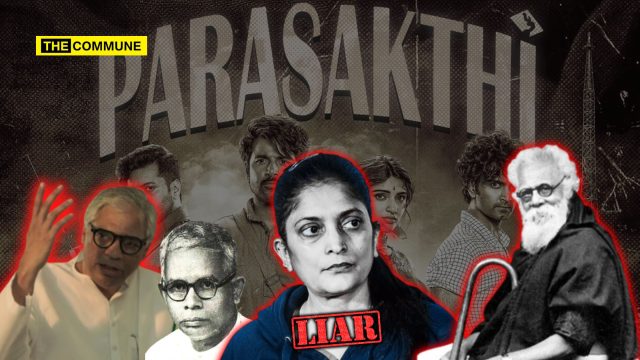
Sudha Kongara, notorious for bending and distorting historical facts in her films, has once again traded historical truth for ideological convenience, mutilating the history of the 1965 anti-Hindi imposition agitation to peddle a present-day Dravidian political narrative.
In the trailer of the her latest film ‘Parasakthi’ produced by Udhayanidhi Stalin’s son Inban Udhayanidhi, there’s a scene in which protesting students are described as “kaali payaluga” (good-for-nothing chaps). The framing strongly implies that this contemptuous description came from Bhaktavatsalam and the Congress establishment.
However, historical records tell a different story.
EVR Called The Protesting Students “Hooligans”
Archives of DK’s own mouthpiece Viduthalai from the period show that it was EV Ramasamy (hailed as ‘Periyar’ by his followers) who openly criticised the protesting students, referring to them as hooligans and questioning the political motives behind the agitation.
EVR’s mouthpiece had said:
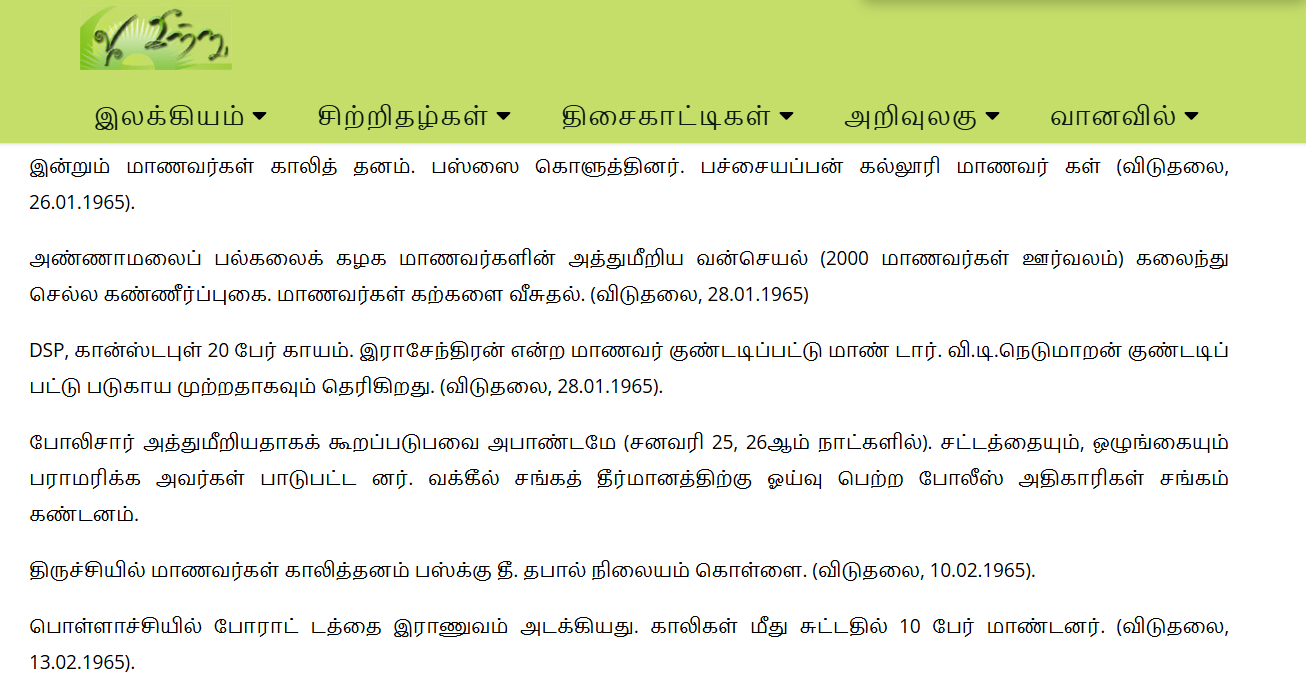
இன்றும் மாணவர்கள் காலித் தனம். பஸ்ஸை கொளுத்தினர். பச்சையப்பன் கல்லூரி மாணவர் ள் (விடுதலை, 26.01.1965).
“Today also students indulged in hooliganism. They burnt buses. Pachaiyappan College students” (Viduthalai, 26 January 1965)
திருச்சியில் மாணவர்கள் காலித்தனம் பஸ்க்கு தீ. தபால் நிலையம் கொள்ளை. (விடுதலை, 10.02.1965).
“In Trichy, students indulge in hooliganism. Bus set on fire. Post office looted.” (Viduthalai, 10 February 1965)
EVR, through his ‘Viduthalai’ newspaper, supported the brutal repression carried out by the police against the protestors.
He even went to the extent of instigating violence against the protestors saying “The hooliganism has increased. Comrades! Keep kerosene in your hands ready. Keep a matchbox. When I point, you light the fire.”
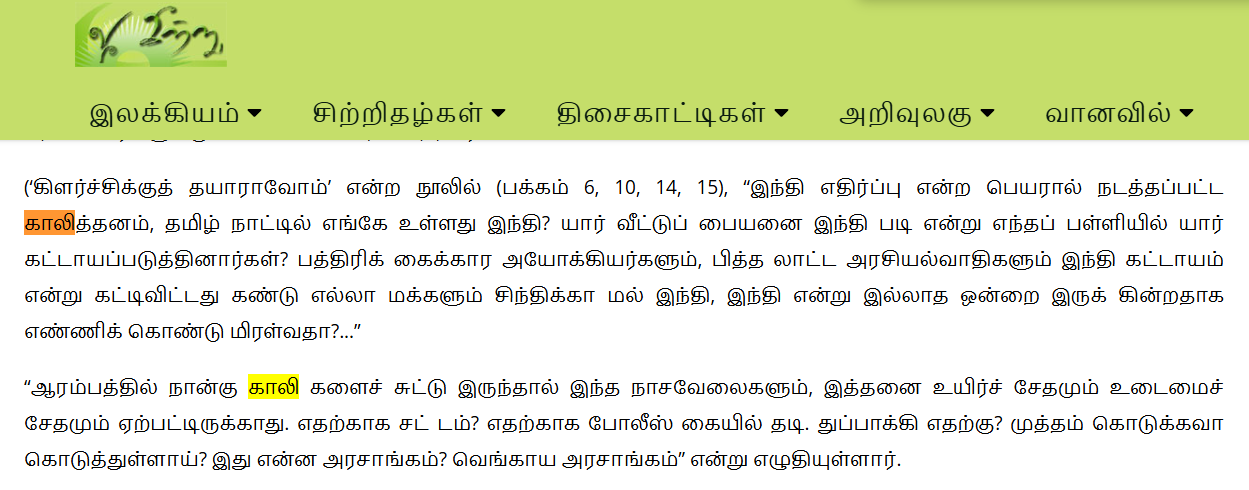
In the book “Kilarchiku Thayaaraavom! (Let’s Prepare For The Uprising)”, EVR wrote “The vandalism carried out in the name of anti-Hindi! Where is Hindi in Tamil Nadu? Which school mandated any student to study in Hindi? The newspaper scoundrels and crazy politicians who are peddling about ‘mandatory Hindi’, you people without thinking are being scared about imaginary ‘Hindi’ which doesn’t even exist!”
He further went on to say “If four hooligans had been shot in the beginning itself, all this vandalism and so much loss of life and property would not have occurred. Why is there a law? Why does police have lathis? Why do they have guns? Have they been given to kiss? What kind of a government is this!”
Bhaktavatsalam’s government, officially treated the protests as a law-and-order issue. His administration repeatedly warned against violence, threatened “stern action,” and deployed police and paramilitary forces, while blaming opposition parties like the DMK and Left groups for large-scale destruction of public property.
There are no official documents to prove that at any point Bhaktavatsalam publicly used the language attributed to him in the trailer. Transferring EVR’s words onto a Congress leader is a clear attempt to sanitise and distort EVR’s actual position.
EVR’s Position In 1965: What The Film Omits
While Parasakthi highlights Anna’s role in opposing Hindi imposition, it omits a crucial and inconvenient historical fact: EVR did not lead or support the 1965 student agitation.
By 1965, EVR’s role in anti-Hindi movements had fundamentally changed. His active, street-level leadership belonged to earlier phases: 1937–40 and 1948. During the 1965 agitation, EVR maintained a distance from the student protests, viewing them primarily as a political battle against Congress rather than a pure language struggle.
Historical research notes that EVR criticised the agitation as politically motivated and driven by DMK’s electoral interests. He accused the DMK of “sacrificing innocent students” for political gain, reiterated calls for banning both the DMK and the Swatantra Party during the agitation, believed K Kamaraj’s assurances that compulsory Hindi would not be imposed, and also expressed the view that the “language problem was almost over,” making him sceptical of the student uprising.
EVR followed developments closely through his newspaper Viduthalai and remained ideologically opposed to compulsory Hindi, but he did not stand with the students on the streets nor endorse the agitation in the manner portrayed by contemporary Dravidian retellings.
None of this nuance finds place in Sudha Kongara’s trailer.
Tamil Brahmi As “Secret Code”: A Historical Impossibility
Another scene in the trailer has drawn ridicule from scholars: a moment showing Tamil Brāhmī being used as a secret code scribbled into a Hindi document, held by a character believed to represent Bhaktavatsalam.
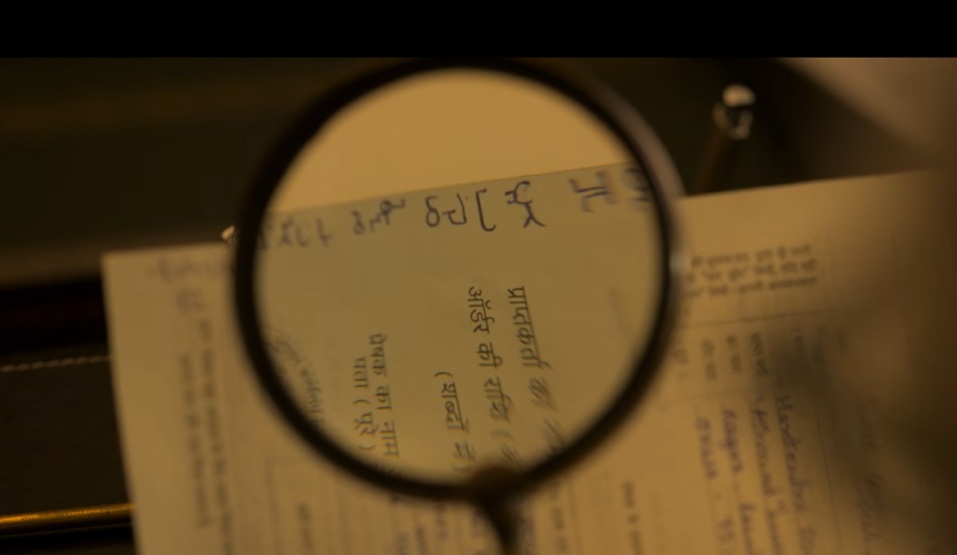
Historians have called this claim historically untenable.
Tamil Brāhmī was barely known in 1964. While KV Subramanya Iyer conducted pioneering work in the 1930s, it was not pursued systematically. Serious academic focus began only in 1961, when K A Nilakanta Sastri encouraged Iravatham Mahadevan to take up the subject.
Mahadevan published his first major findings only in 1965–66, based on the Pugalur and Mangulam inscriptions. Even then, Tamil Brāhmī did not enter wider academic or public consciousness until the 1990s, when Mahadevan resumed extensive research.
The idea that Tamil Brāhmī was being widely understood,or covertly used as a “code” within government circles in 1964, has no historical basis. This scene exemplifies propaganda-driven storytelling, where symbolism is prioritised over facts.
When propaganda takes centre stage, facts tend to go missing. Tamil Brāhmī was barely known in 1964. Although K. V. Subramanya Iyer had carried out some pioneering work in the 1930s, it was not pursued systematically thereafter. It was only in 1961 that K. A. Nilakanta Sastri… https://t.co/uADqanxGna
— 𑀓𑀺𑀭𑀼𑀱𑁆𑀡𑀷𑁆 🇮🇳 (@tskrishnan) January 5, 2026
The Kongara Pattern: Narrative Over Truth
This is not the first time Sudha Kongara has been accused of bending history to fit an ideological framework. Her approach reflects a troubling pattern where complex historical events are streamlined and often distorted to serve a present-day identity-driven narrative.
Kongara also directed the film Soorarai Potru which claimed to depict the life of Simplifly Deccan (Air Deccan) founder Captain GR Gopinath but cunningly inserted the Dravidianist ideology into the film – he was depicted as a Periyarist fighting for social justice and the villains in the film were all, no prizes for guessing, Brahmins!
Interestingly, the Hindi version of the film’s song in Soorarai Potru was released on 4 July 2024. Comparing it with the Dravidianist Tamil version featuring EVR’s picture and a black shirt-borne Suriya, the Hindi version had nothing revolutionary.
Hindi version of Soorarai Potru’s song just dropped.
Black shirt during wedding, EVR images in the background aren’t there in the Hindi version.
Maximum Puratchi is in signing the registration documents on site.Maybe there are no takers for such Vadais outside Gummidipoondi. pic.twitter.com/Ec6M4afT3j
— Tamil Labs 2.0 (@labstamil) July 4, 2024
Creative freedom does not extend to manufacturing facts. With Parasakthi, Sudha Kongara has once again blurred the line between cinema and political propaganda, leaving viewers with a carefully curated narrative rather than an honest engagement with history.
Subscribe to our channels on WhatsApp, Telegram, Instagram and YouTube to get the best stories of the day delivered to you personally.