


When the central government unveiled the National Education Policy (NEP) 2020, it promised to reimagine Indian education for the future, a bold restructuring that sought to equip young Indians with 21st century skills, global competitiveness, and multidisciplinary learning. Across the country, even states that had reservations chose to adapt and align with it.
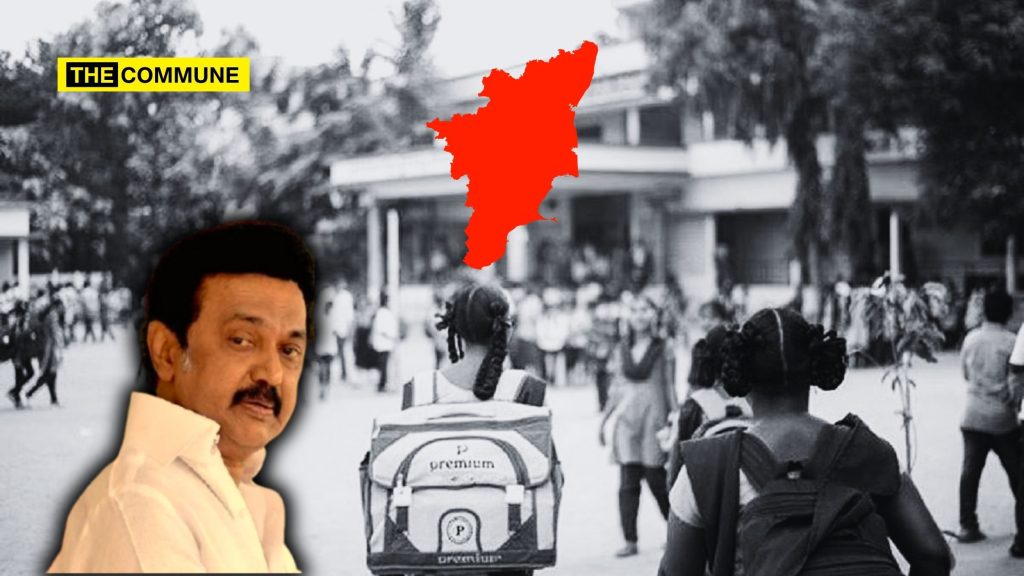
But Tamil Nadu, under the Dravida Munnetra Kazhagam (DMK), has taken a different path. With much fanfare, Chief Minister MK Stalin launched the Tamil Nadu State Education Policy 2025 (SEP) touted as a “people-centric” alternative to the NEP. In reality, it is less a roadmap for students and more a political manifesto disguised as policy.
Behind the glossy language of “equity” and “social justice,” the SEP reeks of Dravidian exceptionalism designed not to uplift students but to score political points against the Centre. Once again, DMK has shown that for them, education is not about preparing children for the world but, it is about preparing votes for elections.
Welfare Politics Over Real Learning
Tamil Nadu has a proud history of welfare in education: from Kamaraj’s midday meal scheme to later expansions under MGR and Jayalalithaa. These initiatives genuinely transformed literacy and access.
But what DMK has done with SEP is something else: populism dressed up as progress.
The policy repeatedly celebrates the Chief Minister’s Breakfast Scheme, the Pudhumai Penn stipend for girls, and Vetri Palligal “Schools of Excellence.” These are not bad in themselves, no one denies the importance of nutrition or financial support. But when an education policy reads like a party election manifesto, the problem is obvious.
Instead of hard reforms in curriculum, teacher accountability, or measurable outcomes, SEP is obsessed with announcing schemes that feed, fund, and flatter but don’t really educate.
The Language Question: Politics Above Students
Perhaps the clearest proof of DMK’s political ego is the language policy.
The NEP 2020 envisions a three-language formula, encouraging multilingualism and ensuring Indian students can compete both nationally and globally. Tamil Nadu, however, clings to its two language formula (Tamil + English), dismissing the third language as “Hindi imposition.”
Let us be honest: this isn’t about protecting Tamil. Students can learn Tamil and another Indian language and English, millions of children across India manage multilingualism effortlessly as section 4.13 of NEP 2020 clearly states that “The three-language formula will continue to be implemented while keeping in mind the Constitutional provisions, aspirations of the people, regions, and the Union, and the need to promote multilingualism as well as promote national unity. However, there will be a greater flexibility in the three-language formula, and no language will be imposed on any State. The three languages learned by children will be the choices of States, regions, and of course the students themselves, so long as at least two of the three languages are native to India. In particular, students who wish to change one or more of the three languages they are studying may do so in Grade 6 or 7, as long as they are able to demonstrate basic proficiency in three languages (including one language of India at the literature level) by the end of secondary school”. This is about DMK’s 60-year-old anti-Hindi obsession.
By refusing to give Tamil Nadu students access to a third Indian language, the DMK is deliberately limiting their mobility and opportunities in a multilingual country. A child in Bihar, Maharashtra or Karnataka will leave school with knowledge of three languages. A child in Tamil Nadu will not. This is not equity. This is deliberate handicapping of Tamil Nadu students for political mileage.
The Dangerous No-Detention Policy
Another glaring flaw is DMK’s reaffirmation of the No-Detention Policy up to Class 8. On paper, this sounds progressive “don’t fail students, give them a chance”. In practice, it has become a disaster.
Teachers across Tamil Nadu whisper the truth: students are being pushed up year after year without mastering basic literacy or numeracy. By Class 9, many cannot even read fluently or solve basic arithmetic. That is the reason why the THIRAN initiative was launched by the state government to bridge the learning gap.
The NEP is clear-eyed on this: it makes foundational literacy and numeracy by Class 3 the top national priority. Tamil Nadu’s SEP talks about literacy too, but buries it under welfare schemes and “equity audits.” The hard truth is that DMK prefers a generation of dependent, under-skilled students who will thank the party for their meals, but will never question the quality of their education.
Digital Divide and Hollow Promises
SEP brags about “21st-century skills” AI, coding, robotics. It announces platforms like TN-SPARK, Kalvi TV, and Manarkeni App. But on the ground, the reality is starkly different.
- Rural schools lack internet connectivity.
- Many classrooms still don’t have functional computers.
- Teacher training in digital pedagogy is almost non-existent.
What good is coding when half the students can’t get a stable internet connection in their village school?
This is classic DMK politics: announce a flashy scheme, hold a press conference, then quietly move on. The gap between promise and delivery is filled with propaganda.
Teachers: The Forgotten Soldiers
While the NEP envisions making teaching a respected, aspirational profession, the SEP tinkers around the edges with apps and “peer mentoring.” The real issues like irregular recruitment, lack of transparency, poor rural postings remain untouched in SEP 2025.
Why? Because teacher appointments in Tamil Nadu are deeply politicised. Union leaders aligned to ruling parties control transfers, promotions, and postings. Every teacher knows that to survive in the system, they need political backing. The SEP does nothing to dismantle this rot.
Once again, students pay the price for DMK’s unwillingness to offend its political ecosystem.
Community Engagement or Party Capture?
The SEP boasts about “community engagement” through the Namma School Namma Ooru Palli initiative through inviting alumni, CSR funds, and parents to support schools.
But let’s be blunt: in Tamil Nadu’s hyper-politicised environment, such initiatives risk becoming DMK-controlled patronage networks. Already, it has been observed that government school functions are used as stages for party propaganda, more often by the DMK regimes. “Community engagement” becomes a euphemism for party control of education spaces.
Equity Without Excellence is a Trap
Tamil Nadu loves to project itself as a pioneer of social justice in education but the “quality crisis” is undeniable.
- Secondary dropout rates remain at 7–8%.
- Learning surveys show wide gaps in mathematics and reading, especially post-COVID.
- Rural and government school students lag far behind private peers in competitive exams.
Instead of addressing these realities, DMK’s SEP hides behind the rhetoric of “equity.” But equity without excellence is not empowerment, it is charity. A well-fed, under-skilled student will not compete in IIT, IIM, or the global job market. They will simply remain dependent on state welfare and loyal to the party that provides it. Which, of course, is exactly what DMK wants.
A Political Document, Not a Policy
The biggest problem with SEP 2025 is its short-termism. It promises to revise the policy every three years, an idea that sounds dynamic but actually reveals the truth that this is not a roadmap to 2040 like the NEP. This seems to be policy written for electoral cycles.
DMK is not planning for Tamil Nadu’s next generation but, it is planning for its next election.
Students Are Pawns To Soothe DMK’s Political Ego
The DMK claims SEP 2025 is a progressive alternative to the Centre’s NEP. In reality, it is a political ego trip and a refusal to align with national reforms simply because they come from Delhi. In the process, Tamil Nadu’s students are the losers.
Instead of giving them global competitiveness, multilingual skills, and rigorous academic standards, the DMK offers free meals, stipends, and slogans. Instead of preparing them for the future, it prepares them for dependency.
It is time to call this what it is “the DMK is playing with the lives of Tamil Nadu’s children for its political ego”
The NEP may not be perfect according to the DMK, but it at least has a vision while the SEP has none. Until Tamil Nadu realises that welfare is not a substitute for excellence, its students will remain trapped in the DMK’s self serving cycle of care without competence.
And the tragedy is that the rest of India will march ahead, while Tamil Nadu’s children will be left behind because one party chose politics over progress.
Karthik HP is an entrepreneur and ABVP activist.
Subscribe to our channels on Telegram, WhatsApp, and Instagram and get the best stories of the day delivered to you personally.