


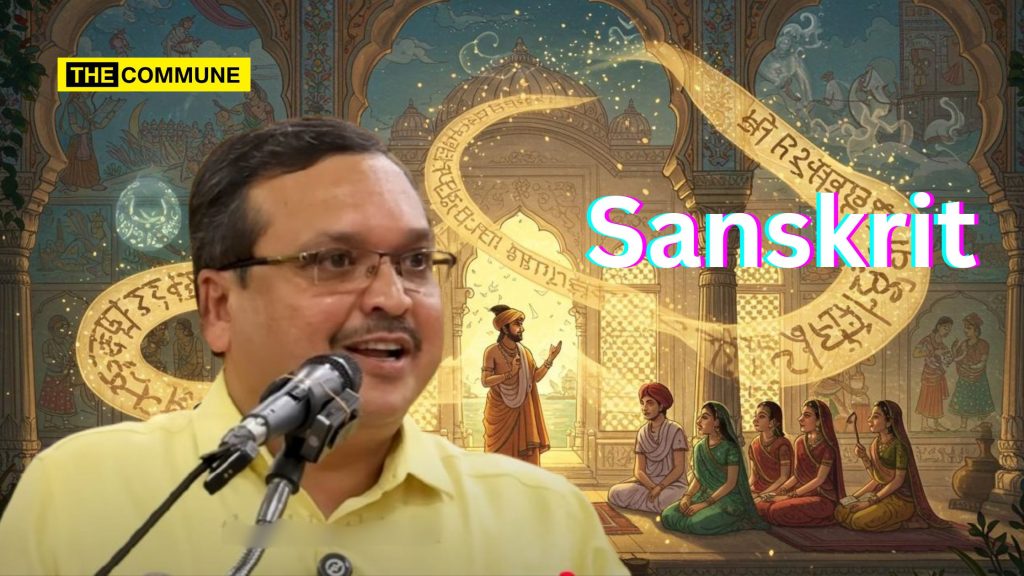
Dravidianist sympathiser and archaeologist K. Amarnath Ramakrishna appears to have taken on multiple roles linguist, historian, and cultural critic—all in the service of promoting a narrow, ideologically driven version of Indian history.
In a recent lecture titled “Excavated and Unexcavated”, delivered at the centenary symposium on the Indus Valley Civilization organized by the Tamil Nadu Progressive Writers and Artists Association, Ramakrishna made sweeping claims that not only disregard historical evidence but appear tailored to fit the Dravidianist narrative.
This is the same organization that previously hosted a conference under the deliberately provocative theme “Eradicate Sanatana Dharma,” featuring Tamil Nadu’s Deputy Chief Minister Udhayanidhi Stalin. Unsurprisingly, Ramakrishna’s remarks reflect the ideological leanings of the platform rather than objective scholarship.
Rewriting History, One Claim At A Time
During his lecture, Ramakrishna dismissed the long-established view of Kanchipuram as an ancient Sangam-era city, reducing it instead to a mere Buddhist site. In the same breath, he attempted to delegitimize Sanskrit by branding it a “manufactured” language an artificial construct that, according to him, could not possibly function as a mother tongue.
He argued that Sanskrit was derived from older languages such as Prakrit, Pali, Magadhi, and Sauraseni. He even drew bizarre analogies, claiming Sanskrit is akin to computer binary code engineered for divine communication and passed only from father to son through rituals like Upanayanam. On this basis, he declared Sanskrit fundamentally unfit to be considered a mother tongue, because, in his view, “a woman cannot speak it,” and thus it lacks the organic, feminine origins he attributes to other languages.
Speaking in the Conference Dravidianist archeologist Amarnath Ramakrishna said, “Everyone would say that Sanskrit is the primary language, but in my opinion, that’s not the case. Sanskrit is definitely a created language. Its very terminology is that, ‘refined’. When we get refined (products)? You can only refine something if there’s a raw material to begin with. You can’t refine something without a base.
This is because the languages that existed in India before Sanskrit were Prakrit. Languages like Prakrit, Sauraseni, Ardhamagadhi, and Pali. I’m a Saurashtrian who lived in Madurai, and even my own people would argue with me, saying, “Hey, you’re criticizing Sanskrit!” They’d say our own Saurashtra language came from Sanskrit, but I said you are misunderstanding. Saurashtra didn’t come from Sanskrit. Before that, a language called Sauraseni was spoken in the southwestern part of India. Languages like Sauraseni, Prakrit, Magadhi, Pali, Angika, and Maithili are ancient languages of this nation. Sanskrit was created by refining and refining these older languages.
It’s like the binary language we use for computers today. How are we using a binary language for the computer? We use language so the computer can understand. Similarly, Sanskrit is a language created for a god to understand. It’s my view that this language can never be a mother tongue. As Madhkoor Ramalingam said, Sanskrit definitely doesn’t have the qualifications to be a mother tongue. This is because a mother can’t speak it, a woman can’t speak it. All languages born in this world are born from women. Woman is the birthplace of language. When a language is born from a woman, it belongs to both genders it goes to the son and the daughter. But Sanskrit doesn’t go to the daughter; it only goes to the son. It’s passed from a father to a son.
That’s why you have the ritual of Upanyanam, also known as the sacred thread ceremony. The essence of this ritual is that a language taught in this way can never be a mother tongue. It’s a language that is taught, not a language that is inherently a mother tongue. It’s a language the father teaches his son. That’s how it has spread. It’s not a language created by a mother like other languages are. While we praise Sanskrit as an ancient language, we have forgotten the even older languages that existed before it, like Prakrit, Sauraseni, Ardhamagadhi, Pali, and Maithili. Today, I work in Delhi in North India, and my Bihari colleagues tell me they can no longer speak their own languages. There was a language called Angika. Have you heard of the kingdom of Anga, ruled by Karna? The language is Angika. Magadhi is spoken in Patna. Angika is spoken in Bhagalpur. North of the Ganges, they speak Maithili. These languages are still spoken, but they’ve lost their richness due to the dominance of another language.
Sanskrit was created from many such languages, yet we praise it as the most ancient. However, our Tamil language is even older. The birthplace of Tamil is this region and its Sangam literature. That’s why we say our people are an ancient civilization. Our people have contributed many things to this civilization. Many scripts originated from here. These scripts are the crucial parent scripts for all the other language scripts in India. We should call that script ‘Tamizhi’ instead of ‘Brahmi.’ We’ve been calling it Brahmi because that’s what princep who named it, thought was right.”
சமஸ்கிருதம் யாருக்கும் தாய்மொழி இல்லை!
உருவாக்கப்பட்ட மொழிதான் சமஸ்கிருதம்! அமர்நாத் ராமகிருஷ்ணா, தொல்லியல்துறை இயக்குநர்Full Video : https://t.co/mUiPL16q8X#Theekkathir | #sanskrit | #keezhadi | #Tamil pic.twitter.com/U07TBYCdzC
— Theekkathir (@Theekkathir) September 22, 2025
These assertions are not only speculative they are in direct contradiction to well-established linguistic scholarship, including that of Jain scholars who, despite having no allegiance to Vedic tradition, acknowledged Sanskrit’s centrality.
What Real Scholars Say
Historical grammarians many of them Jain and explicitly non-Hindu never denied Sanskrit’s primacy in the linguistic landscape of ancient India. Jain scholar Hemacandra, in his seminal work Siddha-Hema-Śabdanuśāsana, clearly defines Prakrit as derived from Sanskrit, “prakṛtiḥ saṃskṛtam, tatrabhavaṃ tata āgataṃ vā prākṛtaṃ” – “Sanskrit is the source, and Prakrit arises from it.”
Similarly, Mārkaṇḍeya in Prākṛtasarvasva says, “prakṛtiḥ saṃskṛtaṃ, tatrabhavaṃ prākṛtam ucyate” which translates to “Sanskrit is called the prakṛti, and Prākrit is said to originate from it.” Vāsudeva in his commentary Prākṛtasaṃjīvanī reiterates, “prākṛtasya tu sarvameva saṃskṛtaṃ yoniḥ” which translates to, “Sanskrit is the mother of all Prākrit,” same conclusion that Sanskrit is the linguistic root of all Prakrit forms.
Furthermore, authoritative texts like Prakrita Prakasha and Bali Vyakarana focus entirely on how Prakrit words are phonetically derived from Sanskrit roots. None of these texts posit Prakrit as an independent or more “natural” language. The very name Saṃskṛta (refined) does not imply artificiality but rather an elevated form of expression. It was also referred to historically as Chandas or Bhāṣā, indicating its foundational status in Indian linguistic tradition.
This is what happens when an archaeologist tries to play the role of a linguist without actually knowing the languages. Let us look at what authoritative scholars themselves have said about Sanskrit and Prakrit:
Hemacandra (a Jain grammarian), in his grammar of Sanskrit and… https://t.co/EiE3PMDX83
— 𑀓𑀺𑀭𑀼𑀱𑁆𑀡𑀷𑁆 🇮🇳 (@tskrishnan) September 23, 2025
Ramakrishna’s attempt to rename the Brahmi script as “Tamizhi” is another example of politically motivated revisionism. This reinterpretation isn’t based on new archaeological evidence but on a desire to detach historical scripts and languages from their established roots and rebrand them within a narrowly defined Dravidian framework.
His claim that Tamil predates Sanskrit is not new it is a common trope in Dravidianist circles but one that remains unsupported by serious linguistic or archaeological research. The elevation of Tamil as the origin of all Indian scripts and languages may appeal to regional pride, but such statements collapse under the weight of historical evidence and linguistic methodology.
The core issue here is not linguistic debate it is the politicization of history under the guise of scholarship. Ramakrishna’s commentary serves a specific ideological agenda, one that seeks to downplay or erase the contributions of Sanskrit and broader pan-Indian traditions to the subcontinent’s civilizational history.
This is what happens when an archaeologist strays into linguistic and historical commentary without adequate training, guided more by ideology than evidence. It is vital that history especially one as complex and multi-layered as India’s be studied with intellectual honesty, not molded to fit contemporary political narratives.
In serious academic discourse, facts must take precedence over ideology. And in the case of Sanskrit and Prakrit, the facts are clear even non-Vedic, non-Brahmanical scholars acknowledged Sanskrit’s foundational role. It is time modern commentators did the same.
Subscribe to our channels on Telegram, WhatsApp, and Instagram and get the best stories of the day delivered to you personally.