In a 5 December 2025 interview with Bloomberg, acclaimed author Salman Rushdie expressed being “very worried” about rising Hindu nationalism and threats to free expression in India. However, this statement stands in stark contrast to the 33 years of violent extremism he himself endured following the publication of his novel The Satanic Verses, a campaign of terror that included riots, arson, bombings, murders of translators, assassination attempts, and ultimately the 2022 stabbing that cost him his right eye.
The worldwide impact of The Satanic Verses has been devastating, approximately 57-62 deaths, three murders or targeted killings, protests in more than 20 countries, and book bans in over 15 nations.
In this report, we take a look at Salman Rushdie.
Early Life and Background
Ahmed Salman Rushdie was born on 19 June 1947, in Bombay, into a prosperous Kashmiri Muslim family in post-independence India. His father, Anis Ahmed Rushdie, was a Cambridge-educated lawyer who became a businessman after being dismissed from the Indian Civil Services for age falsification on his application. The family surname was adopted in honor of the medieval Muslim philosopher Ibn Rushd.
His mother, Negin Bhatt, worked as a teacher, and the family lived in affluent areas such as Windsor Villa in Bombay. Rushdie has ancestral roots in Delhi’s Ballimaran neighborhood through his grandfather, a textile magnate.
Rushdie attended Cathedral and John Connon School in Bombay before moving to England in 1961. He attended Rugby School and later King’s College, Cambridge, where he earned a BA in history in 1968.
The Satanic Verses Crisis: A Timeline of Violence
The 1989 Fatwa
On 14 February 1989, Iran’s Ayatollah Ruhollah Khomeini broadcast a fatwa on Tehran radio, declaring The Satanic Verses blasphemous for insulting Prophet Muhammad. Khomeini called Rushdie an “apostate” deserving death and urged Muslims worldwide to execute him and his publishers. The Iranian bounty initially stood at one million dollars, rising to 2.8 million dollars or more by the 1990s. Fifteen Iranian Khomeini followers offered an additional three million dollars.
The Satanic Verses, published in 1988, mixed London and Mecca in a magic-realist narrative that many Muslims viewed as blasphemous. India banned the book, copies were burned in the UK, riots occurred in Pakistan, and several translators were attacked or killed.
For almost 13 years, Rushdie lived in hiding under the pseudonym Joseph Anton, moving between safe houses and changing base 56 times in the first six months. His solitude was worsened by his split with his wife, American novelist Marianne Wiggins, to whom The Satanic Verses is dedicated.
Deadly Protests Around the World
Islamabad, Pakistan (12 February 1989)
More than 10,000 Jamiat Ulema-e-Islam supporters marched after Friday prayers and attacked the US Cultural Center, American Express office, and US Embassy annex in protest against the US publication of The Satanic Verses. Police opened fire when the crowd broke barricades, killing six people (some reports say five) and injuring over 100. The unrest later spread to Rawalpindi.
The Cultural Center, home to an American library and cultural programs, suffered heavy damage worth thousands of dollars as demonstrators forced their way in, vandalized the premises, and set two small fires while shouting anti-American slogans including “American dogs!” and “God is great!”
Bombay, India (24 February 1989)
Over 2,000 protesters gathered at Mastan Talao after Friday prayers to denounce Britain’s protection of Salman Rushdie following the Khomeini fatwa. Defying a ban, the crowd marched toward the British High Commission, set a bookstore near Crawford Market on fire, and clashed with police. Officers opened fire, killing 12 people (some reports say 10) and injuring more than 40, while around 500 people were arrested.
Bolton, London (2 December 1988)
Bolton witnessed one of the earliest and most dramatic public protests against The Satanic Verses. An estimated 7,000 Muslims marched from the Zakariyya Jame Masjid to the town center, where they burned copies of Rushdie’s novel in a mass demonstration.
Parliament Square, London (27 May 1989)
A massive demonstration took place in Parliament Square, where an estimated 15,000 to 20,000 protesters gathered. Demonstrators marched through central London and burned effigies of Salman Rushdie, symbolizing the peak of UK-based outrage during the Rushdie affair. Police said 84 people were arrested and six police officers were injured during the march, which erupted in a scuffle before the Parliament building.
Bombings and Attacks in the UK
London Bookstore Bombings (9 April 1989)
Two bombs exploded at the Collets and Dillons bookstores on Charing Cross Road in London, both of which were stocking The Satanic Verses. The blasts caused significant property damage, but no injuries were reported, marking one of the earliest violent attacks in the UK linked to the Rushdie controversy.
Penguin Bookshop Bombings (June 1989)
A bomb exploded outside a Penguin bookshop in York just before an army disposal unit could defuse it. Two hours earlier, a caller with an Indian accent warned ITV that four bombs had been placed in York, Peterborough, Nottingham, and Guildford, all outside Penguin outlets. Police found the remaining devices: one was defused in Guildford, one was destroyed by controlled blast in Nottingham, and one was safely removed in Peterborough.
Authorities linked the attacks to The Satanic Verses, published by Viking Penguin. A separate pipe-bomb attack on Liberty’s, London, earlier that month had also included a warning referencing the novel.
The Sivas Massacre in Turkey (2 July 1993)
In Sivas, Turkey, more than 20,000 people, stirred after Friday prayers over writer Aziz Nesin’s plan to publish The Satanic Verses in Turkish, surrounded the Madımak Hotel during an Alevi cultural festival. The mob set the building on fire, killing 37 Alevi intellectuals, poets, and musicians trapped inside. Nesin survived after being evacuated in a police armored vehicle.
Jaipur Literature Festival Cancellation (January 2012)
Salman Rushdie was scheduled to attend the January 2012 Jaipur Literature Festival, but Darul Uloom Deoband demanded that he be prevented from coming, citing anger over The Satanic Verses. Although Rushdie did not require a visa, protests mounted and police warned of possible underworld assassins targeting him. Rushdie then cancelled his visit, saying intelligence inputs indicated hired killers had been sent to attack him. The episode revived memories of the 1989 fatwa and the wave of violence that followed globally.
Targeted Killings and Attacks on Translators
Murder of Hitoshi Igarashi (11 July 1991)
At Tsukuba University, Japan, Hitoshi Igarashi, a 44-year-old assistant professor of comparative Islamic culture and the Japanese translator of The Satanic Verses, was brutally stabbed in the face, neck, and arms sometime between 10 PM on July 11 and 2 AM on July 12. A cleaning staff member discovered his body in the hallway outside his office. The case remains unsolved, and the statute of limitations expired in 2006. The killing occurred months after Ayatollah Khamenei renewed the bounty on Rushdie and those involved with the book in March 1991.
Attack on Ettore Capriolo (4 July 1991)
In Milan, Italy, Ettore Capriolo, the 61-year-old Italian translator of The Satanic Verses, was stabbed 11 times in the neck, chest, and hands inside his apartment by a bearded man posing as an Iranian postal worker who claimed he needed help translating a Muslim pamphlet. The attacker asked for Salman Rushdie’s address before assaulting him and fled the scene. Capriolo survived after hospitalization, but no arrests were ever made.
Shooting of William Nygaard (11 October 1993)
In Oslo, Norway, William Nygaard, the Aschehoug publisher of the Norwegian edition of The Satanic Verses, was shot three times in the back and thigh outside his home on Dagaliveien at around 7:30 AM while walking to his car. He was critically injured but survived after surgery at Sunnaas Hospital.
The 2022 Stabbing Attack (August 12, 2022)
Salman Rushdie was violently attacked onstage at the Chautauqua Institution in New York. A 24-year-old Lebanese-American Shia Muslim, Hadi Matar, suddenly rushed the stage and stabbed Rushdie more than 27 times, causing severe injuries including a punctured liver, the loss of sight in Rushdie’s right eye, and severed nerves in his hand.
The moderator was also injured while trying to prevent the attack. Matar carried a copy of Rushdie’s controversial novel The Satanic Verses and later admitted he was inspired by the 1989 fatwa issued by Iran’s Ayatollah Khomeini, identifying himself as a “soldier of Imam Khomeini.”
Following the attack, Rushdie underwent multiple surgeries and faced a long recovery, which he detailed in his 2024 memoir Knife.
Controversial Statements on India and Hindu Nationalism
Comments on Hindu Nationalism (5 December 2025)
In a Bloomberg interview with Mishal Husain, Rushdie expressed being “very worried” about growing Hindu nationalism and restrictions on free expression in Modi’s India. He stated: “I feel very worried about it. I have lots of friends in India. Everybody is extremely concerned with the attack on freedoms of journalists, writers, intellectuals, professors, et cetera.”
He further added: “There seems to be a desire to rewrite the history of the country; essentially to say Hindus good, Muslims bad—the thing VS Naipaul once called a ‘wounded civilisation,’ the idea that India is a Hindu civilization wounded by the arrival of Muslims.”
On India’s Democratic Decline (December 2021)
Rushdie stated that Pakistan remains unchanged in its old problems, but India has clearly declined. He noted that India’s status as a democracy has been downgraded by various international bodies, which he called tragic. He observed that India used to take enormous pride in being the world’s largest democracy, pointing out that it is much easier for rich countries to be democratic and very hard for poor countries to maintain democratic freedoms. He described it as truly tragic that Prime Minister Modi has managed to sell to many Indians the idea of Hindu majoritarian rule, which he characterized as anti-democratic.
Kashmir and Article 370 (15 August 2019)
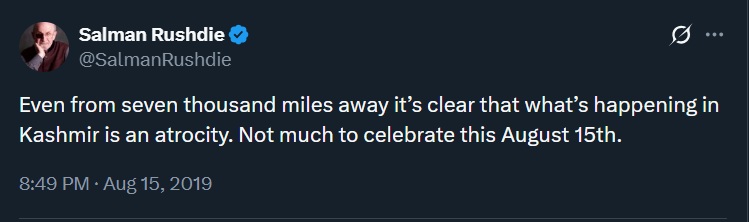
On India’s 73rd Independence Day, Rushdie tweeted: “Even from seven thousand miles away it’s clear that what’s happening in Kashmir is an atrocity. Not much to celebrate this August 15th.”
The move triggered sharp reactions: Pakistan marked the day as “Black Day,” and China pushed for UN consultations.
Award Wapasi Controversy (13 October 2015)
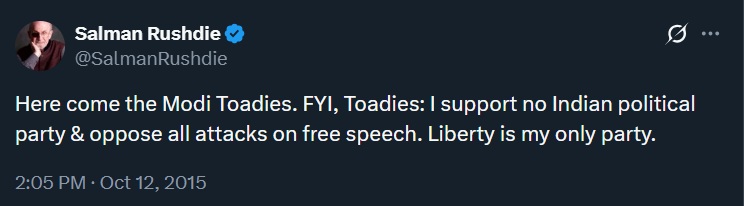
After Salman Rushdie supported writers returning their Sahitya Akademi awards over what they called rising intolerance including rationalist murders, beef-lynching incidents, and ink attacks, he was heavily trolled by political supporters online. He tweeted: “Here come the Modi Toadies. FYI, Toadies: I support no Indian political party & oppose all attacks on free speech. Liberty is my only party.”
Open Letter Against Modi’s Candidacy (April 2014)
Prominent Indian artists and academics, including Salman Rushdie and Anish Kapoor, wrote an open letter warning against Narendra Modi becoming Prime Minister. Regarding the possibility of Modi becoming India’s next PM, the letter stated: “Were he to be elected prime minister, it would bode ill for India’s future as a country that cherishes the ideals of inclusion and protection for all its peoples and communities.”
They criticized his handling of the 2002 Gujarat riots, calling it a moral failure that threatens India’s secular values. The BJP dismissed the letter as baseless, saying courts found no evidence against Modi.
BJP-RSS as “Crypto-Fascist” (February 2014)
In a discussion on Indian politics, Rushdie described the BJP-RSS-type Hindu nationalist project as “actually a crypto-fascist movement.” He criticized it for attempting to create “Nuremberg-style rallies,” likening the mass mobilizations to those used by fascist regimes. He also pointed out that this project invents a collective, quasi-church-like Hindu worship, which he argued is alien to traditional Hinduism’s diverse and decentralized nature. This view was elaborated in his later essay for PEN America’s “India at 75” project, underscoring his concern that the movement distorts Hinduism into a fascist political ideology.
Literary Works
Rushdie’s extensive body of work includes novels such as Grimus (1975), Midnight’s Children (1981), Shame (1983), The Satanic Verses (1988), Haroun and the Sea of Stories (1990), The Moor’s Last Sigh (1995), The Ground Beneath Her Feet (1999), Fury (2001), Shalimar the Clown (2005), The Enchantress of Florence (2008), Luka and the Fire of Life (2010), Two Years Eight Months and Twenty-Eight Nights (2015), The Golden House (2017), Quichotte (2019), and Victory City (2023). His nonfiction works include Joseph Anton (2012), Languages of Truth (2021), Knife (2024), and The Eleventh Hour (2025).
Subscribe to our channels on WhatsApp, Telegram, Instagram and YouTube to get the best stories of the day delivered to you personally.