


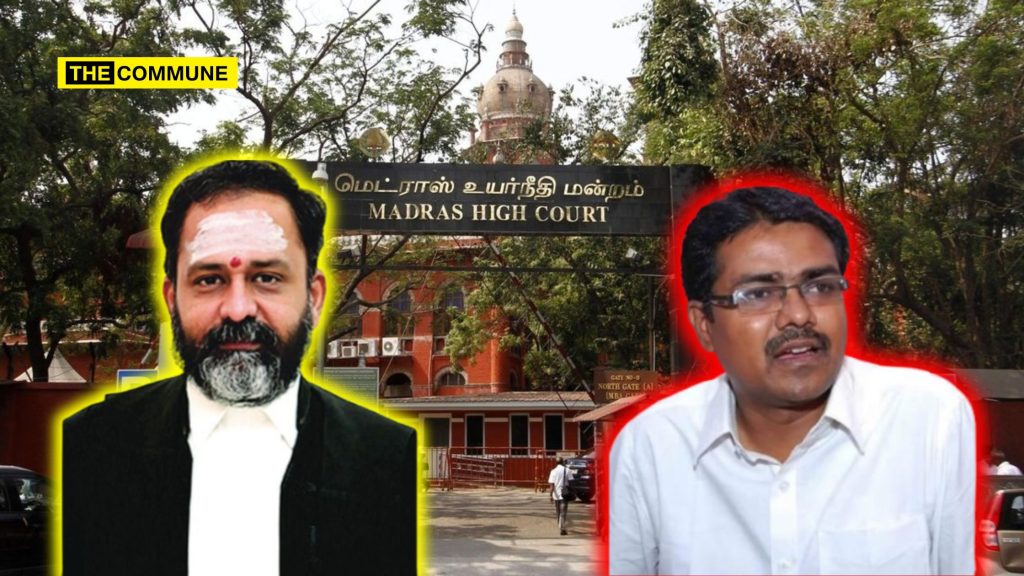
The ongoing controversy surrounding Justice G.R. Swaminathan of the Madurai Bench of the Madras High Court has exposed a disturbing pattern: politically charged attacks on the judiciary, unauthorized interventions by retired judges, and brazen interference from political actors.
What Triggered The Controversy?
The controversy began when the People’s Rights Protection Centre sent a confidential letter to the Chief Justice of India and members of the Collegium, accusing Justice G.R. Swaminathan of caste and communal bias. Advocate S. Vanchinathan was listed among the signatories. Though the letter was confidential, its contents found their way into the public domain through orchestrated leaks.
Contrary to false public narratives, Justice Swaminathan clarified in open court that no contempt proceedings had been initiated until Friday, 26 July 2025. The Court had only issued a summons to the advocate to seek clarification on whether he stood by his public statements that accused the judge of bias. The issue had nothing to do with the confidential complaint to the Chief Justice of India.
“You are a comedy piece”: Judge confronts unfounded allegations
At the hearing held before a bench comprising Justice Swaminathan and Justice K. Rajasekar, the judge confronted Advocate Vanchinathan with a video clip of his past remarks and asked him directly whether he stood by them. Vanchinathan, instead of responding to the contents of his own video, chose to remain evasive and requested that the Court pass a written order.
The judge, visibly perturbed by the lawyer’s lack of accountability, remarked, “You are a comedy piece.” He further noted, “I don’t know who called you all revolutionary. You are all comedy pieces.”
Justice Swaminathan stated firmly that while harsh criticism of judicial decisions is welcome, accusations of caste or communal bias go beyond permissible free speech. “I 100 per cent respect your right to brutally criticise my judgments. But when you are alleging caste bias, things take a different turn,” he said.
He also observed, “For four years, you have been slandering me. I have not taken any action against you. We are not fools. We are conscious of procedural rules and have only sought clarification. Judicial independence is supreme.”
Retired Judges’ Irresponsible Intervention
In an unprecedented move, eight retired judges, led by Justice K. Chandru, publicly released a letter calling the contempt proceedings “premature.” This intervention was heavily criticized by the bench, as it sought to influence ongoing judicial proceedings – an act clearly amounting to interference and scandalising of the judiciary.
Adding to the absurdity, Justice K.K. Sasidharan, whose name was included as one of the eight retired judges, issued a public statement categorically dissociating himself from the letter. He clarified unequivocally, “I was not consulted nor have I sent any such ‘written confirmation’ authorizing Mr. Justice K. Chandru to issue the said letter.” This revelation exposes the irresponsible haste and disregard for propriety by these retired judges, further eroding the credibility of their intervention.
Political Opportunism by VCK Leader
Amidst this institutional crisis, Viduthalai Chiruthaigal Katchi (VCK) leader Thol. Thirumavalavan issued a public statement demanding the intervention of the Chief Justice of the Madras High Court against Justice Swaminathan. Such political meddling represents a brazen attempt to exploit judicial proceedings for partisan ends. Thirumavalavan’s call for external intervention demonstrates blatant disregard for judicial independence, placing him squarely within the ambit of criminal contempt under Sections 2(c)(i) and 2(c)(iii) of the Contempt of Courts Act, 1971.
Precedents Demand Action Against Ex-Judges and Politicians
The judiciary has consistently held that scandalising judges or influencing judicial proceedings is intolerable. Even Justice Markandey Katju, a former Supreme Court judge, faced contempt proceedings in 2017 for publicly criticising a judicial decision. His subsequent apology underscored the gravity of such contempt.
In a landmark case, the Supreme Court convicted sitting High Court judge Justice C.S. Karnan for contempt, highlighting that no individual, regardless of their standing, is immune from judicial accountability when institutional dignity is at stake.
Furthermore, recent judgments, such as the conviction of advocate Prashant Bhushan for contempt (2020), the imprisonment and practice ban imposed on advocate Seema Sapra, and the criminal contempt proceedings against individuals who made defamatory remarks on social media against Justice Surya Kant, reinforce the judiciary’s consistent stance against reckless public attacks.
Given these robust precedents, there exists a strong case for initiating contempt proceedings against the retired judges and political figures who have openly scandalised and attempted to intimidate the judiciary.
Advocate’s History Of Misconduct
It is also worth noting that Advocate S. Vanchinathan was suspended by the Bar Council of India in 2015 for professional misconduct. This is not the first time he has been involved in controversies undermining the judiciary. His consistent pattern of conduct points to a deliberate effort to erode public confidence in the courts.
Time To Uphold Judicial Sanctity
The judiciary is under siege from retired judges who violate propriety, from politicians who exploit caste narratives, and from lawyers who abuse the shield of free speech to target individual judges. Justice Swaminathan’s unwavering stance in defending judicial independence is commendable. His clear declaration – “We will not be cowed down”, reaffirms the judiciary’s strength and resilience.
The time has come for the legal system to pull up not just errant lawyers, but also former judges and politicians who recklessly trample upon judicial dignity. If even a former apex court judge like Justice Katju could be hauled up for contempt, there is no reason why the same yardstick should not apply to the retired judges and political leaders involved in this case.
The rule of law must remain supreme, and its guardians must remain unswayed by theatrics and threats.
Shailendar Karthikeyan is the Editor of Nyayavimarsha.
Subscribe to our channels on Telegram, WhatsApp, and Instagram and get the best stories of the day delivered to you personally.