


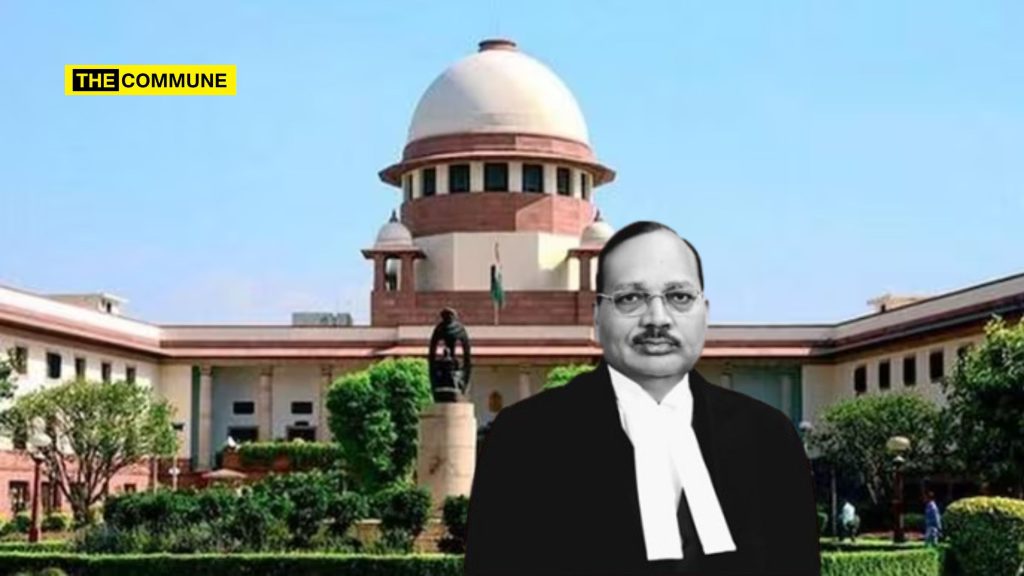
Caste-based reservation in India has come under sharp scrutiny from the Supreme Court, with Justice Surya Kant—who is set to become the next Chief Justice of India—drawing a striking analogy during a hearing on local body polls in Maharashtra.
“Reservation in the country has become like train compartments. People who have got in don’t want to let others come in,” Justice Kant observed while hearing a batch of petitions on the implementation of Other Backward Class (OBC) quotas in local elections in Maharashtra. “This is the principle of inclusivity. Governments are duty-bound to identify more classes. There are politically, economically and socially deprived people. Why should they not get the benefit? Only a few families and groups are getting the benefit,” he added.
The hearing focused on the long-pending civic elections in Maharashtra, which were last held between 2016 and 2017. The delay, spanning nearly eight years, is largely attributed to legal and procedural hurdles surrounding OBC reservations. In 2021, the Supreme Court had struck down a state government ordinance that sought to provide 27% OBC quota, ruling it unconstitutional due to non-compliance with a required three-step framework.
The court had earlier mandated that any OBC quota must meet three conditions:
- A dedicated commission must conduct a contemporary empirical inquiry into backwardness.
- The state must determine the proportion of reservation needed based on the commission’s recommendations.
- The total reservation for SCs, STs, and OBCs must not exceed 50%.
Despite the identification of OBCs during delimitation, senior advocate Indira Jaising, appearing for the petitioner, argued that Maharashtra had failed to apply the data meaningfully. She also alleged that the state government was effectively running the local bodies through handpicked officials, avoiding elections under the guise of legal hurdles.
Advocate Gopal Sankaranarayanan, representing another petitioner, emphasized the need to distinguish between politically and socially backward groups within the broader OBC category for the purpose of more equitable reservation.
Interestingly, the “train compartment” metaphor used by Justice Kant was previously employed by another senior judge, Justice BR Gavai, in a ruling on the sub-classification of Scheduled Castes (SCs) and Scheduled Tribes (STs). Justice Gavai, who will become Chief Justice later this month, stated, “I find that the attitude of the categories in the Presidential List opposing such a sub-classification is that of a person in the general compartment of the train. Firstly, the persons outside the compartment struggled to get into the general compartment. However, once they get inside it, they make every attempt possible to prevent the persons outside such a compartment from entering it.”
These observations come at a politically sensitive time, as the Union government has announced the inclusion of caste-based data in the next national Census. The move is seen as a step toward identifying underrepresented communities more effectively for affirmative action, a demand long made by several opposition parties.
The Supreme Court is expected to continue hearing the matter later on 6 May 2025.
(With inputs from NDTV)
Subscribe to our channels on Telegram, WhatsApp, and Instagram and get the best stories of the day delivered to you personally.