


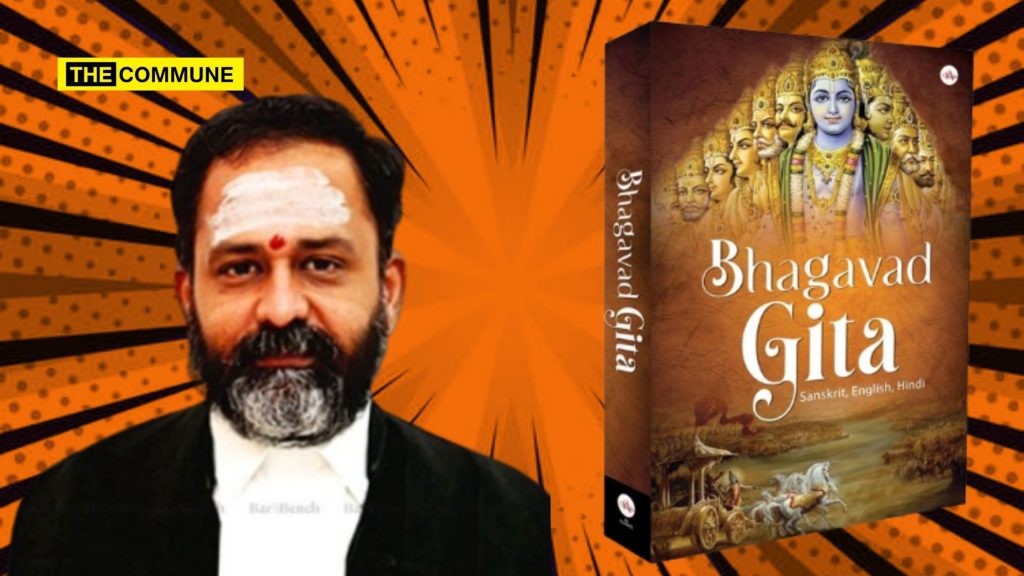
The Madras High Court has set aside an order of the Union Ministry of Home Affairs refusing registration under the Foreign Contribution (Regulation) Act, 2010 (FCRA) to a trust engaged in teaching yoga and spreading the knowledge of Vedanta, holding that the Bhagavad Gita cannot be narrowly classified as a religious book.
A Bench led by Justice GR Swaminathan ruled that the Centre’s conclusion that the petitioner (Arsha Vidya Parampara Trust) was a “religious body” merely because it propagated the Bhagavad Gita was legally unsustainable. The Court observed, “Bhagavad Gita is not a religious book. It is rather a moral science.”
During the hearing, the Court noted that the authorities had treated the petitioner’s engagement with the Bhagavad Gita as determinative of its religious character. Rejecting this approach, Justice Swaminathan referred to an earlier Allahabad High Court ruling and said the Gita could be recognised as a Rashtriya Dharma Shastra. He observed that it “speaks about internal and eternal truth” and had inspired leaders of India’s freedom struggle such as Mahatma Gandhi, Maharishi Aurobindo and Lokamanya Tilak. Citing Articles 51A(b) and 51A(f) of the Constitution, the Court held that the Bhagavad Gita “cannot therefore be confined within a given religion” and is “a part of Bharatiya civilisation.”
The case arose from a writ petition filed by a trust established in 2017 by disciples of Swami Dayananda Saraswati of Arsha Vidya Gurukalam, Coimbatore. The trust is engaged in teaching Vedanta and Sanskrit, imparting Hatha Yoga and yoga philosophy, and digitising and preserving ancient manuscripts. It had applied for FCRA registration with the Ministry of Home Affairs, but after a prolonged delay and exchange of correspondence, its application was rejected in an order passed in early 2025.
The Union Government defended the rejection on two principal grounds: that the trust had earlier received foreign contributions without prior permission and transferred funds to another organisation, and that the nature of its activities appeared religious. The Centre also argued that FCRA registration was not a matter of right and pointed to national security concerns associated with foreign funding of NGOs.
On the first ground, the Court criticised the manner in which the authorities had proceeded. It said that if the government intended to treat the alleged contravention of FCRA provisions as a ground for rejection, it ought to have clearly informed the petitioner of the consequences. Justice Swaminathan observed, “The authorities are expected to behave in a fair manner. It is an elementary principle of good governance.” Drawing an analogy with criminal law, he said that even an accused is given a Miranda warning and added that the petitioner had acted bona fide in the present case.
On the second ground, the Court held that the authority had failed to reach a definite conclusion, as required under the statute. It said describing the organisation as one that “appears to be religious” did not meet the legal standard. The Court further observed that what applied to the Bhagavad Gita would also apply to Vedanta, describing it as “pure philosophy evolved by our ancestors.”
The Bench also rejected the attempt to view yoga through a religious lens. Justice Swaminathan said, “As regards Yoga, it would be atrocious to view it through the prism of religion. It is something universal.” Referring to rulings of the Allahabad High Court and a decision of a California appellate court, the judge noted that yoga could be a secular activity focused on physical and mental well-being, and that spirituality and religion were not interchangeable terms.
Setting aside the impugned order, the High Court remitted the matter back to the Director (FCRA), Ministry of Home Affairs, directing the authority to reconsider the application by taking into account all relevant materials. The writ petition was accordingly allowed.
Source: Verdictum
Subscribe to our channels on WhatsApp, Telegram, Instagram and YouTube to get the best stories of the day delivered to you personally.