


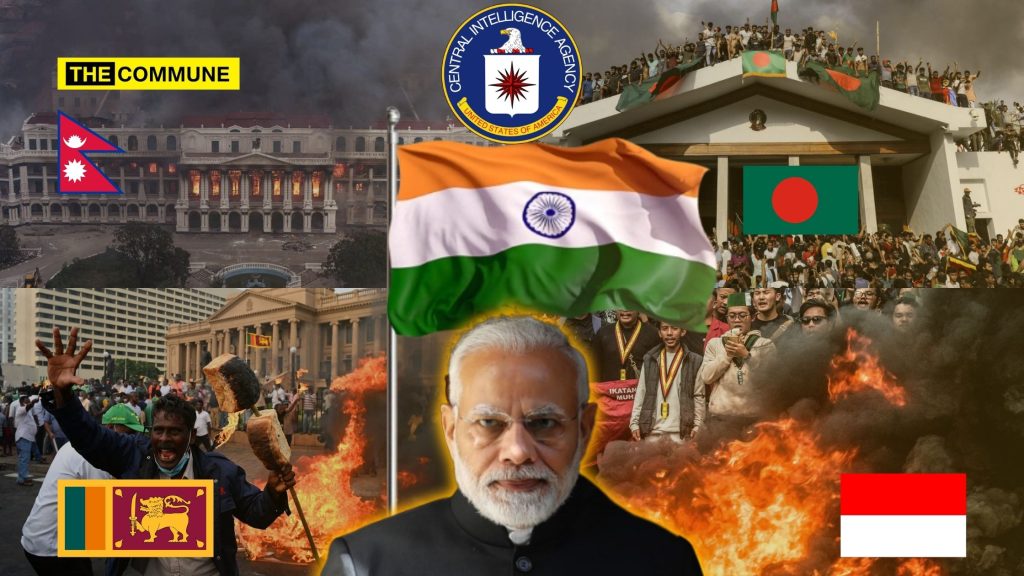
South Asia has been in near-constant churn over the last three years, with mass youth-led protests toppling governments, forcing prime ministers into exile, and reshaping fragile democracies. The latest upheaval in Nepal, where Gen-Z demonstrators this week that triggered the resignation of Prime Minister K.P. Sharma Oli is only the newest chapter in a regional trend of street power dismantling entrenched regimes.
The protests, which began over a government ban on 26 social media platforms including Facebook, Instagram, WhatsApp, and YouTube, rapidly evolved into broader demands for anti-corruption measures and political accountability.
Sri Lanka: Aragalaya And The Rajapaksas’ Fall
The cycle began in Sri Lanka in 2022, when crippling shortages and runaway inflation drove the island into the worst economic collapse in its history. The Aragalaya (struggle) movement saw hundreds of thousands descend on Colombo, eventually overrunning the presidential palace on 13 July 2022. President Gotabaya Rajapaksa fled the country, and his family dynasty, once synonymous with invincibility, faced its gravest blow.
Although Ranil Wickremesinghe was later elevated to the presidency with Rajapaksa support in parliament, the protests permanently damaged the family’s political capital. The Supreme Court later held the Rajapaksas responsible for economic mismanagement between 2019-2022, a ruling that continues to cast a shadow as Mahinda’s son Namal makes a long-shot bid for the presidency in September 2025.
Bangladesh: From Quotas To Quake In Power
If Sri Lanka exposed the risks of fiscal collapse, Bangladesh in 2024 showed how a single grievance can snowball into revolution. Student protests against the restoration of controversial job quotas exploded into a nationwide anti-government uprising. Brutal crackdowns left more than 300 dead in weeks of violence, before Prime Minister Sheikh Hasina, once celebrated as a pro-democracy icon, resigned and fled to India.
The protests began as an issue-based agitation, but quickly expanded into a mass movement against corruption, dynastic privilege, and shrinking democratic space. For a ruling party that had dominated since 2008, the uprising was a stark reminder of how quickly legitimacy can evaporate once young people decide they have no other avenue of expression.
Indonesia: Deadly Demonstrations Shake Prabowo
The unrest spread further east this year. Indonesia’s protests in August 2025 began over revelations that lawmakers were enjoying lavish housing allowances nearly 10 times Jakarta’s minimum wage. The killing of a 21-year-old motorcycle delivery driver by an armoured police vehicle became the movement’s rallying point.
At least 10 people died in five days of unrest, with protesters torching buildings and even targeting the homes of ministers. President Prabowo Subianto responded with a sweeping cabinet reshuffle, sacking Finance Minister Sri Mulyani Indrawati and four others, while revoking the controversial allowances. The crisis remains his first major stress test as he walks the line between populist optics and authoritarian reflexes.
Nepal: Gen-Z’s Revolt Topples Oli
With today’s developments, Nepal has joined the arc of crisis. Thousands of students, gig workers, and first-time protesters took to Kathmandu’s streets, defying curfews and storming Parliament.
The clashes left at least 19 dead and over 400 injured, forcing two cabinet resignations and finally Prime Minister Oli’s own exit. His office confirmed he had stepped down late Tuesday, while reports suggested he may seek to leave the country. India issued travel advisories, tightened security along the border, and urged peaceful dialogue.
The Pattern Behind The Protests
If you zoom out, a familiar script begins to emerge across South Asia:
It starts with a students’ protest — often sparked by an issue like social media bans, quotas, or economic grievances.
It escalates into violent confrontations — with police clashes, deaths, and rising anger on the streets.
Crowds storm symbols of power — from parliaments to presidential palaces, forcing rulers into hiding or exile.
A proxy leader is elevated — someone palatable to both protesters and entrenched elites, while the fallen strongman quietly exits.
This sequence has replayed in Sri Lanka, Bangladesh, Indonesia, and now Nepal, raising suspicions that these uprisings are not entirely spontaneous.
Could there be a hidden hand? Some analysts whisper about CIA-style playbooks and external actors exploiting youthful rage and hyperconnected movements to destabilize fragile democracies. Whether coincidence or coordination, the “student protest to regime change” cycle has become the region’s new political epidemic.
India In The Middle Of A Cauldron
With Myanmar under military rule, Sri Lanka just got out of a crisis and elected Anura Kumara Disanayaka as their President in 2024, Bangladesh still under the interim chief – Mohammed Yunus and in “transition”, Indonesia convulsed, and Nepal now in turmoil, India finds itself surrounded by volatility. Analysts warn of a “cauldron” in the neighbourhood, one that external powers may exploit.
It is worth recalling that India itself witnessed a massive upheaval during the 2020–21 farmers’ agitation. What began as opposition to the three farm laws soon morphed into a year-long siege at Delhi’s borders. The movement was not just domestic—international celebrities, foreign NGOs, and even Western lawmakers weighed in, amplifying the protests in ways that raised serious questions about external interests seeking to inflame the situation.
When Prime Minister Narendra Modi announced the repeal of the laws in November 2021, he remarked, “Whatever I did, I did for the farmers, and whatever I am doing, I am doing for the country.” His words were widely read as an allusion to the shadow of foreign-backed conspiracies attempting to manufacture unrest and destabilize India from within.
In hindsight, the farmers’ protest fits neatly into the same “playbook” now visible across South Asia — from Colombo to Dhaka, Jakarta to Kathmandu — where student or youth-led agitations are weaponised, escalated into violent confrontations, and then used to unseat entrenched leaders. The difference is that in India, the attempt was blunted before it could spiral into regime change.
Observers suggest that Nepal’s protests may not have been entirely organic. They hint at the involvement of “expert hands” exploiting Gen-Z’s hyperconnectivity, a pattern also observed in Bangladesh and Sri Lanka. The suspicion of foreign orchestration, particularly from Western actors, also cannot be dismissed.
Despite these cascading crises, India’s democracy has absorbed shocks that might have toppled others – even with the daily accusations from the opposition. Yet, none of these have escalated into uncontrollable mass movements.
Analysts attribute this resilience to India’s deeper institutional buffers, wider economic base, and a political culture that still channels contestation through elections also caution that adversaries are probably learning from each protest wave in the neighbourhood, and modular tactics of mobilisation could one day be tested in India.
Subscribe to our channels on Telegram, WhatsApp, and Instagram and get the best stories of the day delivered to you personally.