


There is an old story, inspired by Mahabharata, that used to be shared by family elders at home. It was about a small village, where two neighbours, say X and Y, watched the same festival procession. X, harbouring old grudges, saw only chaos and noise, muttering about the participants’ flaws. Y, open-hearted, saw joy and unity in the same scene. The procession hadn’t changed; their lenses had. X’s bitterness clouded his view, while Y’s clarity revealed beauty.
Various versions of this story, with the same theme, have been running in my head for several years. More so in the context of viewing the caste systems. There is little to no nuanced discussion around the same. Hierarchy and oppression are literally the only two words associated with the caste system.
But then, isn’t viewing the caste system solely through the lens of hierarchy and oppression risks oversimplifying its complexity and ignoring its role as a repository of cultural practices, identities, and community cohesion that have persisted for centuries?
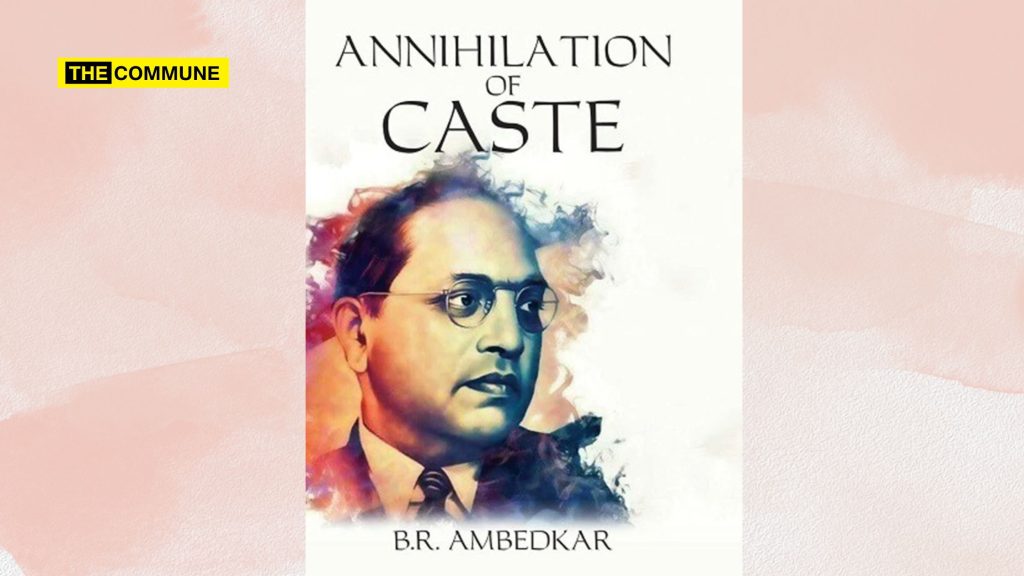
In Annihilation of Caste (1936), B.R. Ambedkar delivers a scathing critique of the caste system, arguing that it is fundamentally incompatible with social justice and equality. A key observation from the text is his assertion that caste is not merely a division of labour but a division of labourers, inherently designed to enforce hierarchy and dehumanization – “Caste is not a physical object like a wall of bricks or a line of barbed wire which prevents the Hindus from commingling… It is a notion, it is a state of mind. The destruction of caste does not therefore mean the destruction of a physical barrier, but the destruction of a mental attitude.”
His observation codifies caste as a psychological and ideological construct that perpetuates inequality by embedding notions of superiority and inferiority in society’s collective consciousness. Ambedkar argues that caste’s rigidity—especially its hereditary nature and the practice of untouchability—creates a moral and social evil that cannot be reformed but must be annihilated entirely.
Powerful, as it sounds, and as it is, it does, in my humble view, it skips nuance for the hammer, and buries all possibilities of any discussion or debate or constructive dialogue. Ambedkar’s focus on caste as a tool of oppression eminently overlooks its role as a cultural institution for several reasons –
Caste as Cultural Identity
Castes / sub-castes often embody distinct traditions, rituals, cuisines, occupations, and social networks that have shaped regional and local identities in India. For example, specific jatis are tied to unique artisanal skills (e.g., weavers, potters) or religious roles, preserving knowledge and practices across generations. These aspects foster a sense of belonging and continuity, which many communities value, even today. Many artisanal or mercantile jatis see their traditions as valuable heritage, not merely as products of hierarchy.
Ambedkar’s lens prioritizes the hierarchical and exclusionary aspects of caste, particularly its impact on Dalits, whom he represented. He views caste’s cultural practices—such as jati-specific rituals, occupations, or traditions—as inseparable from the system’s oppressive framework.
By framing caste as a “state of mind” to be eradicated, he implicitly dismisses the possibility that jati identities could be sources of cultural pride, community cohesion, or historical continuity for non-oppressive groups.
Oversimplification & Universal Condemnation
By framing caste only as a problem to be eradicated, reformers may overlook its role in cultural preservation and social organization. For instance, affirmative action in India, while addressing inequality, sometimes reinforces caste identities by institutionalizing them. A blanket rejection of caste can alienate communities who see their jati as a source of pride, not subjugation.
Ambedkar’s call for annihilation rejects any reformist approach that might preserve caste’s non-hierarchical elements. He argues that even seemingly benign cultural practices reinforce caste boundaries and perpetuate division. This totalizing critique leaves little room to consider how jati-based identities could exist without enforcing superiority or inferiority, as seen in some modern contexts where caste functions more as a cultural marker than a rigid hierarchy.
Historical Context
The caste system’s endurance reflects its adaptability, providing social structure in diverse contexts, from ancient kingdoms to colonial rule. It functioned as a decentralized system of mutual support, with jatis often acting as self-regulating communities for marriage, dispute resolution, and economic cooperation.
Writing as a Dalit leader in a deeply unequal society, Ambedkar’s condemnation stems from the lived experience of untouchability and systemic exclusion. His focus on dismantling caste entirely reflects the need to prioritize justice for the most marginalized, for whom caste offered no cultural benefits, only dehumanization. This context makes it understandable why he overlooks caste’s role as a cultural institution for communities higher up the hierarchy or those less affected by its worst excesses.
Neglect of Regional Diversity
Ambedkar’s analysis, while incisive, generalizes caste across India, underplaying regional variations where jati functions more as a cultural or professional network than a strict hierarchy. In many parts of India or among certain mercantile communities, jatis have historically fostered economic cooperation and cultural distinctiveness without always enforcing rigid oppression. His blanket condemnation doesn’t fully account for these nuances.
Balanced View
Ambedkar’s observation is powerful and morally compelling, especially for highlighting caste’s role in perpetuating inequality. However, by framing caste solely as a divisive mindset, he sidelines its function as a cultural institution that has preserved diverse traditions, social structures, and identities for centuries.
Admittedly, acknowledging caste’s cultural significance doesn’t negate its discriminatory aspects. A fair approach might involve dismantling oppressive hierarchies (e.g., untouchability, restricted mobility) while respecting the organic, community-driven aspects of jati identity that don’t harm others. This could mean focusing on equality of opportunity without erasing cultural diversity.
This nuanced approach distinguishes between caste’s oppressive mechanisms (which Ambedkar rightly targets) and its cultural expressions, allowing for reform that eliminates hierarchy while respecting non-harmful aspects of jati identity. This tension remains central to India’s ongoing grapple with caste’s legacy.
In short, reducing caste to hierarchy alone misses its multifaceted nature—both its strengths as a cultural institution and its flaws as a system of inequality. Recognizing this duality allows for a more constructive dialogue about reform that respects India’s pluralistic heritage while addressing injustice.
Taking inspiration from the Bard’s Julius Caesar, am presenting you a rephrased/improvised version to ponder over, “The fault, dear Brutus, is not in our stars, but in ourselves, that we are underlings. Our vision, often, is clouded not by the world’s deeds, but by the lens of our own prejudices.”
G Saimukundhan is a Chartered Accountant.
Subscribe to our channels on Telegram, WhatsApp, and Instagram and get the best stories of the day delivered to you personally.