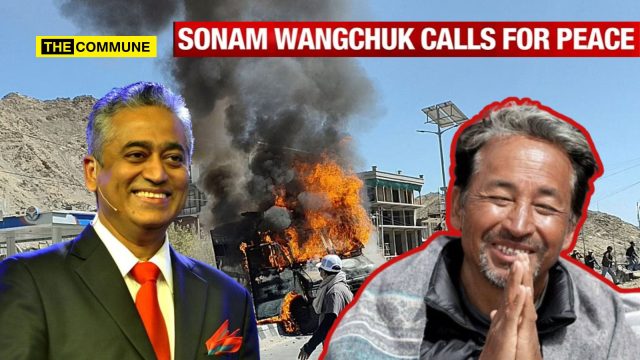
In what many are calling a glaring example of irresponsible journalism, senior journalist Rajdeep Sardesai is under heavy fire for giving a prime-time space to alleged climate activist Sonam Wangchuk, the man widely viewed as the face of the violent unrest in Leh. The interview, which aired in the aftermath of arson and violence in Ladakh’s capital, is being slammed for subtly absolving Wangchuk of responsibility while downplaying the Congress party’s alleged involvement in the protests.
The criticism stems not only from the timing of the interview coming immediately after mob-led violence and arson that left over 80 people injured, many critically, and four dead, with police vans torched and the BJP office set ablaze but also from the way Sardesai framed his questions, which many claim were carefully worded to shift blame away from certain political actors.
Sardesai opened the interview by stating, “What’s happened today is extremely tragic. The agitation that you triggered off with your fast demanding statehood for Ladakh turning violent. The BJP office being burned down. The police vans being attacked and we are told at least four of the protesters have died in the firing. How do you see the events that have happened in the last few hours? Sonam Wangchuk.”
Wangchuk, rather than directly condemning the violence, launched into a narrative that subtly pinned the blame on government inaction and delayed talks. He said, “Rajdeep, this is one of the saddest days in my life generally and particularly during this movement. For the last 5 years, we have maintained utmost peace and always peaceful approaches following Mahatma Gandhi’s path with an many times. This is the fifth time and of five weeks we marched from Leh to Delhi inflicted pain on ourselves but never on others. But today was something totally unexpected out of the blue very organic when youth came out and went on a rampage. I’m extremely saddened about it but at the same time I can understand their frustration because on one hand they have been jobless for the last five years. There have been no almost no jobs particularly at the higher levels and democracy has been curtailed their demands have been unmet. So this frustration was painting you know inside and it started actually not today. It started yesterday when out of the 15 people who are on long fast others on a short one day fast. Out of them one elderly man and an elderly lady on their 14th day of fast were in critical condition and had to be hospitalized. They were taken on stretchers and that boiled their blood. Together with the fact that the government had given a date for talks which was so far away almost unnecessarily like 16 days away from the day it was announced when people are in such critical conditions you don’t keep 16 days away the talk. So people were very upset with this and that was the immediate cause.”
This narrative, critics argue, dangerously walks the line between justification and denial, with Wangchuk essentially excusing violent actions as an emotional outburst triggered by legitimate grievances, an explanation many feel dangerously normalizes mob violence.
What has further raised eyebrows is Sardesai’s subsequent question that echoed BJP allegations but gave Congress a convenient pass, “You’re saying this is the fury and frustration of the youth. Many of them unemployed, many of them angry that demands are not being met. but we are also hearing the BJP hitting back and now claiming that the protests were organized orchestrated by the Congress. They claim there were Congress council or there was a Congress counselor who was there on the streets going and inciting the violence. Has this protest of yours been taken over by politics and political parties? Is it totally apolitical? Can you say that with confidence that there was no politics involved in the violence?”
Wangchuk responded by firmly denying any political backing and dismissed Congress involvement, claiming they lack the influence to mobilize 5,000 people. This assertion, too, has been questioned especially given the volatile political climate and visible involvement of political elements on the ground. Furthermore, Wangchuk admitted a Congress councillor had expressed “a lot of anger” the day before the violence, but downplayed his role.
He asserted, “Totally. Already you should understand that from the apex body Congress was asked to leave just to keep it apolitical, although it was all political by having all parties. Then BJP exited few years ago there was only Congress and people said it was being politicized. So recently the chairman of the Apex body asked Congress to leave. So they even left the whole forum and therefore it was apolitical and even in the movement these were like 4 (4,000) to 5,000 young people and I know Congress they’re not so competent that one leader of theirs can call 5,000 people that would be too much credit of their influence on the people. They don’t have any such influence. I know and and to correct the fact it’s Not that they were on the road going people. What what it is is that yesterday one Congress counselor did a press conference which was with lot of anger because two of these anshan (hunger strike protesters) people who went in critical conditions was from his own village. So he was expressing that anger that alone.”
In a later statement that many found even more disturbing, Wangchuk seemed to rationalize the burning of police vehicles, saying, “Now police vans being burnt often happens because the police is what stops from carnage and damage to property. So, they come in between.”
Equally troubling was his take on the BJP office being torched, which he blamed on public anger over broken promises, “As for the BJP office, I think people here have a lot of anger against the BJP because in 2020 they had in their manifesto as point number one kept that Ladak will be taken under sixth schedule. They completely took a U-turn, and the next election is supposed to be in October and they’re trying to not keep it this time also. So people have lot of frustration about that even the jobs BJP leaders had you know on on public domain said there’ll be 22,000 jobs there’ll be 6,000 jobs all kinds of promises and hardly a one or 2,000 maybe but nothing like as they promised. So there has been a pentup frustration against them and that’s the only way I can explain.”
Rather than condemning the violence in absolute terms, Wangchuk consistently framed it as an unfortunate but understandable reaction to prolonged dissatisfaction raising serious ethical concerns.
In a moment of stunning irony, Wangchuk later shifted blame to the government for letting the protests escalate ignoring the fact that he himself initiated the agitation and allowed tensions to simmer. He said, “I think it is for the government to also think that they are allowing it to happen in a sensitive border area. They had five years to listen to peaceful ways of expression. You know with the first anshan, second anshan, third anshan they could have settled some of these but they kept dillydallying and you know with wishy-washy solutions and uh people had there were many hints from youth leaders and even uh not so young leaders that uh criticized me actually very badly saying that your path of peace is no use it’s not working at least with this government and we now have to take a different path and they would accuse me for keeping to the peaceful path of anshan. So this was already building up.”
This comment, exposes Wangchuk’s role not just as a peaceful protester but as someone who either miscalculated the direction of his movement or willingly ignored its radical shift.
The interview, aired at a time when tempers are already inflamed and lives have been lost, has been roundly condemned on social media. Many users accused Sardesai of effectively sanitizing the role of both Wangchuk and the Congress party while subtly directing all blame toward the ruling BJP. In a political landscape where Gen Z-led protests like those seen in Nepal are gaining traction, this kind of media portrayal is seen as not just biased but actively harmful.
By giving airtime to incendiary figures without rigorous challenge, and by appearing to sympathize with those linked to violence, the interview is being viewed as an example of journalism that crosses the line from reportage to recklessness.
Subscribe to our channels on Telegram, WhatsApp, and Instagram and get the best stories of the day delivered to you personally.