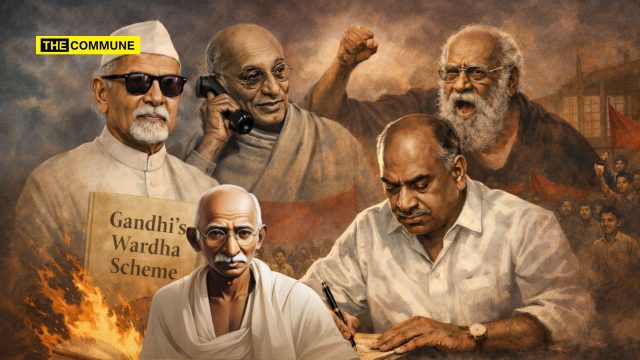
For a very long time, Dravidianists have been peddling the lie that it was their ideologue EV Ramasamy Naicker (hailed as Periyar by his followers), who forced the Congress government to do away with the alleged ‘Kula Kalvi Thittam’.
Well, they do it even to this day as seen from this X post of a Dravidianist who fashions himself as ‘Steve Jobs’ of Tamil Nadu.
#Periyar was the force behind Kamaraj signing the cancellation of Kula Kalvi Thittam. Kamaraj signs in 5 weeks after be becomes CM. 🔥 pic.twitter.com/UTiGRMOwcZ
— Suresh Sambandam (@sureshsambandam) December 24, 2025
But what is the truth?
A closer examination of historical records shows that while exaggerations and rhetorical distortions exist on all sides, the scheme itself was neither imaginary nor a mere administrative misunderstanding.
What Rajaji Actually Introduced
In 1953, C. Rajagopalachari, then Chief Minister of Madras State, introduced what was officially called the “Modified Scheme of Elementary Education.” The scheme aimed to address declining school attendance and limited infrastructure by reducing classroom instruction to roughly three hours a day and introducing a two-shift system.
Under this framework, children would spend one part of the day in school and the remaining half learning a vocational skill or a craft or help their parents in their occupations. While Rajaji defended this as practical vocational exposure, the landed-caste Dravidianists saw this as a threat to their hegemony and started peddling an anti-Brahmin propaganda about the scheme, saying that it reinforces caste-based, hereditary occupations. It was this feature that led the Dravidianists to label it Kula Kalvi Thittam.
Rajaji’s Scheme Was Based On Gandhi’s Wardha Scheme
Rajaji explicitly drew from Gandhi’s Wardha Scheme of 1937 (Nai Talim), which advocated free, compulsory education for ages 7-14 centered on productive crafts like spinning and agriculture, taught in the mother tongue to foster dignity of labor and village self-sufficiency. This aligned with Gandhi’s vision of education through manual work to combat unemployment and colonial influences, rejecting bookish learning for holistic personality development.
Zakir Husain (who later became President of India) chaired the 1937 committee that detailed Gandhi’s Wardha Scheme into the Basic National Education plan, recommending craft-based curricula, teacher training, and self-supporting schools integrated with community life. His framework provided the practical blueprint—seven years of basic education linking intellect and labor—that Rajaji adapted in 1953 by incorporating out-of-school vocational training.

Rajaji’s scheme mirrored Husain’s plan and Gandhian principles in prioritizing crafts over extended classroom time, aiming to make education financially viable and relevant to rural realities without diluting core subjects. While Husain’s version emphasized supervised school-based crafts, Rajaji extended it to home-based parental vocations, both seeking to bridge intellectual and manual labor for national regeneration. The Central Advisory Board endorsed Rajaji’s effort as an interim step toward full Basic Education.
Why The Scheme Triggered Opposition
The proposal immediately drew fierce resistance from EVR-led organisations and the emerging DMK, sections of the press, and even significant factions within the Congress party. Critics denounced the scheme as a “casteist” or “Brahminical” attempt to freeze social mobility by channeling children back into their parents’ traditional roles.
Public protests, internal party rebellion, and growing political pressure made the scheme untenable. Although the two-shift education model was briefly experimented with, the negative propaganda of EVR his organizations ensured that it could not continue.
By 1954, the controversy surrounding the education policy had become one of the central reasons forcing Rajaji to step down as Chief Minister. His resignation paved the way for K Kamaraj to assume office.
The scheme was officially withdrawn in November 1954 after just 18 months of implementation, following recommendations from the Secondary Education Commission and pressure from the central government. The Madras Legislative Assembly debated its flaws, and Rajaji resigned as Chief Minister partly due to this controversy, marking a retreat from the Gandhian craft-centric model.
What Kamaraj Did
K. Kamaraj, who succeeded Rajaji as Chief Minister in 1954, immediately abolished the scheme and reverted to the conventional single-shift system with full-day formal instruction to prioritize literacy and reduce dropouts. He launched the Mid-Day Meal Scheme in 1956 to boost enrollment, especially among poorer and rural children, alongside teacher recruitment drives that expanded school infrastructure and addressed the shortages the original scheme aimed to fix.
EVR’s DK protests amplified the anti-scheme agitation, labeling it “kula kalvi” and organizing rallies, but Congress leaders like O.P. Ramaswamy Reddiyar and Varadarajulu Naidu led legislative challenges and appeals to Nehru. Kamaraj’s decision aligned with party dynamics and his own educational priorities, not external coercion from EVR.
How Dravidianists Misrepresented Gandhi’s Scheme For Its Anti-Brahmin Narrative
The Dravidianist gang rarely targeted Gandhi directly, avoiding backlash from his nationwide reverence, and instead focused fire on Rajaji due to his Tamil Brahmin identity, accusing him of slyly reviving varnashrama through home-based parental trades after short school shifts. This narrative ignored Zakir Husain’s non-Brahmin leadership in fleshing out Gandhi’s plan and how Rajaji framed it as a pragmatic response to teacher shortages, not caste enforcement.
The Dravidianist cowards demonized Rajaji personally, without challenging the philosophy’s core proponents like Gandhi or Zakir Husain.
Subscribe to our channels on Telegram, WhatsApp, and Instagram and get the best stories of the day delivered to you personally.