


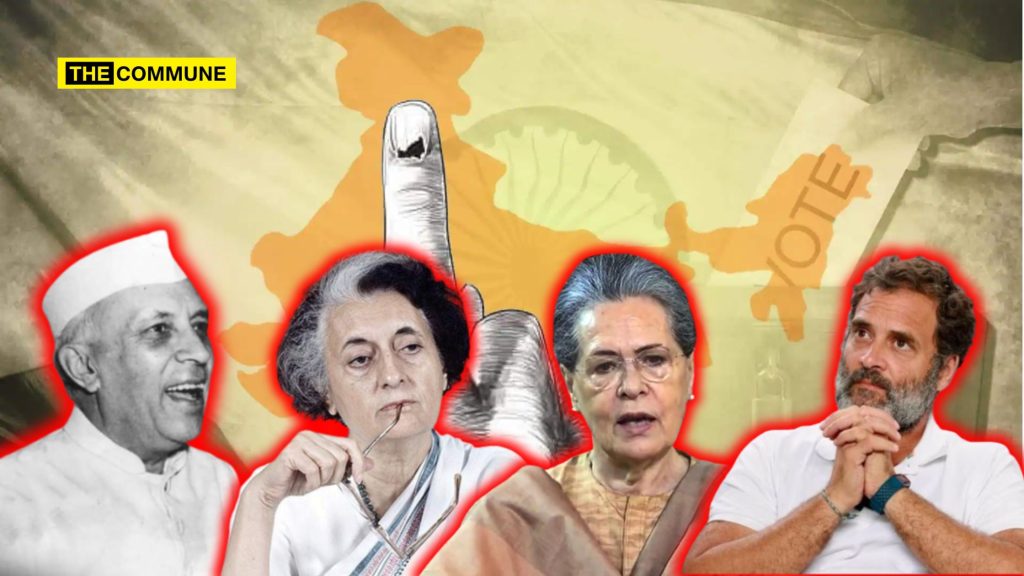
Congress scion Rahul Gandhi thought he managed to pull off a massive blow to the BJP with his so-called “atom bomb” – allegations of “vote chori”. However, a closer look at the Nehru-Gandhi family will tell you that vote chori runs deep in their veins and he is in fact trying to protect his family’s interests by deflecting the blame on to the central government, thereby confirming that Rahul Gandhi is a hypocrite.
The political history of the Gandhi–Nehru family, critics claim, is deeply intertwined with repeated acts of vote chori – electoral manipulation and subversion of democratic processes – stretching back to the pre-independence era. The following list compiles major incidents as described in historical accounts and allegations:
#1 1939 – Subhas Chandra Bose Forced Out Despite Winning Congress Presidency
In 1939, Netaji Subhas Chandra Bose contested for the Congress presidency for a second consecutive term. Mahatma Gandhi opposed his candidature, fearing Bose’s rise would diminish Jawaharlal Nehru’s stature, and fielded Pattabhi Sitaramayya against him.
Despite Gandhi’s open appeal that Sitaramayya’s defeat would be his “personal defeat,” Bose won. Following the victory, the Gandhi–Nehru faction allegedly obstructed Bose’s functioning by boycotting Working Committee meetings and creating administrative hurdles. Bose resigned, formed the Forward Bloc, and eventually left the country to lead the Indian National Army. This was labelled the first instance of ‘vote chori’ – winning a democratic mandate but being denied the ability to function.
#2 1946 – Saradar Patel Denied Premiership Despite Majority Support
In September 1946, with independence and partition imminent, provincial Congress committees were to nominate the next Congress president – who would become interim Prime Minister. All but one proposed Sardar Patel. The lone exception lacked any name and was returned with instructions to propose Nehru’s name – but the deadline had passed.
Allegedly, Gandhi intervened, persuading Patel to withdraw via a letter drafted by Acharya Kripalani. Patel signed, and Nehru assumed leadership. Critics call this the second ‘vote chori’, where Patel’s clear majority was bypassed to install Nehru.
#3 1949 – Purushottam Das Tandon Forced to Resign as Congress President
In 1949, Patel backed Purushottam Das Tandon for Congress president against Nehru’s candidate Acharya Kripalani. Tandon won. Allegedly, the Gandhi–Nehru faction repeated the Bose episode, boycotting Working Committee meetings to paralyse the party. After Patel’s death, Tandon resigned under pressure.
#4 Early 1950s – Nehru Overrides Decision to Appoint S. Nijalingappa as Congress President
During Nehru’s premiership, party consensus favoured S. Nijalingappa as the next Congress president. In the Working Committee meeting, Nehru allegedly backed a surprise proposal moved by U.N. Dhebar to appoint Indira Gandhi instead. Govind Ballabh Pant reportedly objected, but Nehru insisted, saying she was unwell and to undo that she needed to be given president post.
#5 1952 – Alleged Manipulation of Rampur Election Result
In the first general election, Maulana Abul Kalam Azad contested from Rampur against a Hindu Mahasabha candidate, who reportedly won by 20,000 votes. Jawaharlal Nehru allegedly pressured UP Chief Minister Govind Ballabh Pant to reverse the result. According to Basant Das Tandon’s own account, ballot papers were physically shifted from the opponent’s box to Azad’s, declaring him victorious. Critics cite this as proof that vote manipulation was practised at the very birth of India’s electoral democracy.
#6 Nehru–Communist Collusion Toppled Ambedkar in 1952
In the 1952 North Mumbai elections, Jawaharlal Nehru’s Congress fielded Narayan Kajrolkar against Dr. B.R. Ambedkar, while Communist leader S.A. Dange campaigned alongside Congress, branding Ambedkar a “traitor” and circulating defamatory pamphlets. Nehru personally campaigned twice in Mumbai. Allegations of large-scale malpractice arose, including 78,000 cancelled votes, which Ambedkar and socialist leader Jayaprakash Narayan questioned. Ambedkar accused Dange of conspiring with Congress to defeat him. Despite filing legal challenges, he lost again in the 1954 Bhandara by-election.
#7 1975 Verdict: Indira Gandhi’s Win Voided for Electoral Malpractice
On 12 June 1975, the Allahabad High Court annulled Prime Minister Indira Gandhi’s 1971 Rae Bareli victory for electoral malpractice. Justice Jagmohan Lal Sinha found her guilty of illegally using government machinery, officially arranged loudspeakers, stages, security, and appointing aide Yashpal Kapur before his resignation from government service. Other charges, like bribery or misuse of the Air Force, were dismissed. The court barred her from elected office for six years, sparking nationwide political upheaval. A Supreme Court partial stay let her remain PM, but the verdict triggered the Emergency, cementing this case as one of India’s most consequential election scandals.
#8 Sonia Gandhi’s Voter Registration Before Acquiring Indian Citizenship
Sonia Gandhi married Rajiv Gandhi in 1968. By 1980, her name appeared on the voters’ list, despite retaining Italian citizenship until April 1983. Under Indian law, only citizens can be voters. Her name was reportedly removed after protests, but reinstated in January 1983, still before she became a citizen. This is alleged as another violation of voter eligibility norms.
#9 Sonia Gandhi as Director of Maruti Company Before Citizenship
Before 1980, Sonia Gandhi was reportedly a director in Sanjay Gandhi’s Maruti company. Indian company law required directors to be Indian citizens, yet she allegedly held the position before acquiring citizenship in April 1983. Critics call this another instance of bypassing legal requirements.
#10 1987 J&K Elections: Rigging That Fueled Terrorism
The 1987 Jammu & Kashmir Assembly polls, contested between the Congress–National Conference alliance and the Muslim United Front (MUF), were marred by widespread rigging. In seats like Amira Kadal, where MUF’s Syed Salahuddin led by a large margin, counting was abruptly halted and results reversed. Reports detailed booth capturing, ballot boxes pre-stamped for NC, opposition agents expelled from counting centres, and arrests of MUF leaders and workers. Complaints of manipulated counts and voter suppression poured in from across the Valley. The alliance swept 66 of 76 seats, but the blatant electoral fraud deepened public resentment, fueling terrorism by 1989.
#11 1999 – Sonia Gandhi’s Claim to Form Government Without Majority
After the Vajpayee government fell by one vote, Sonia Gandhi approached President K.R. Narayanan claiming to have a majority. Critics allege she did not have the requisite numbers and attempted to form a government without actual legislative backing.
#12 2004 – Sonia Gandhi’s Attempt to Become PM Amid Citizenship Controversy
In 2004, Sonia Gandhi was invited to form the government but did not assume the prime ministership. Allegations persist from critics that questions about her citizenship and political legitimacy played a role.
#13 Rahul Gandhi’s Alleged British Citizenship Declaration
Rahul Gandhi reportedly served as a director in a UK-registered company, declaring British citizenship in official filings. Indian law automatically terminates Indian citizenship upon acquiring foreign nationality. The matter remains in court, but critics link it to the family’s alleged history of citizenship-related violations.
#14 2018 – 10,000 Fake Voter ID Cards Seized in Bengaluru
Just days before the Karnataka Assembly elections in May 2018, the Election Commission seized 9,746 voter ID cards from a Bengaluru apartment in Jalahalli, along with laptops, printers, and thousands of voter application acknowledgment slips. The flat was allegedly linked to Congress’s Rajarajeshwari Nagar candidate and sitting MLA Munirathna, who was later named as an accused in the FIR.
The BJP and JD(S) accused the Congress of attempting to subvert free and fair elections. The Congress countered by claiming the property belonged to a BJP leader. The Election Commission ordered a full probe, and the case became one of the most high-profile voter fraud controversies in recent state election history.
Pattern and Alleged Motive
Critics argue these episodes, from Bose’s ouster in 1939 to modern-day voter roll controversies, reveal a consistent pattern: undermining democratic processes to protect or expand the family’s political control. The accusations suggest that electoral rules, party norms, and even constitutional provisions were bent or bypassed when necessary to secure power and it continues even today. Just yesterday, BJP leader Anurag Thakur listed out all the fake voters, newly registered “aged” voters in various I.N.D.I. alliance members’ constituencies.
Subscribe to our channels on Telegram, WhatsApp, and Instagram and get the best stories of the day delivered to you personally.