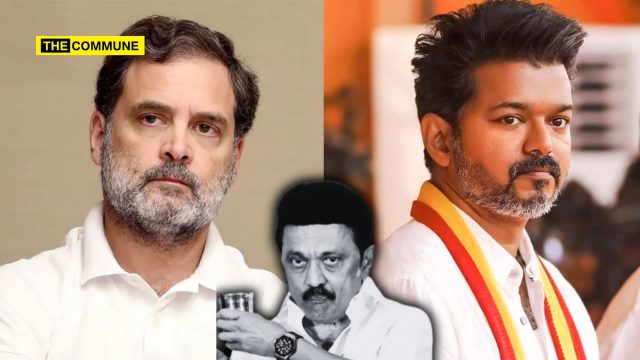
Tamil Nadu’s political landscape is entering a volatile and transformative phase as speculations mount over a potential meeting between Rahul Gandhi and Thalapathy Vijay Chandrasekhar, the actor-turned-politician leading the Tamilaga Vettri Kazhagam (TVK). The anticipated interaction comes amid visible strains between the Congress and the Dravida Munnetra Kazhagam (DMK), signaling possible recalibrations ahead of the 2026 Tamil Nadu Assembly elections.
Rahul Gandhi’s Outreach To Vijay
In late September 2025, Rahul Gandhi’s call to Vijay after the Karur stampede sparked speculation about deeper political intentions. Although Congress leaders publicly described the gesture as humanitarian, the context and timing — following Gandhi’s call to CM M.K. Stalin — raised eyebrows across political circles. Vijay, whose party is widely regarded as a growing political force, remained silent after the exchange, fueling theories of back-channel interest between TVK and Congress.
Leaders within the state Congress have voiced growing dissatisfaction with their limited influence under the DMK-led alliance, which dominates the ruling Secular Progressive Front. Some have called for more equal power-sharing, with demands reportedly extending up to 50% of assembly seats and a stake in government formation.
Given Vijay’s considerable fan base in Kerala, Congress insiders believe that bringing him on board could boost the party’s prospects of returning to power in the state.
Cracks In The DMK-Congress Alliance
Recent developments in Tamil Nadu politics have revealed growing friction between the DMK and Congress, two long-standing allies within the Secular Progressive Alliance. Several visible cracks have emerged over the past months, pointing to deeper structural tensions in their partnership ahead of the 2026 Assembly elections.
Seat-Sharing Demands And Power-Sharing Rift
One major source of strain has been the Congress’s push for a significantly larger seat share in the upcoming election. In the 2021 polls, the party contested 25 seats and won 18, but its leaders argue this underrepresents their strength. AICC in-charge Girish Chodankar announced preparations to contest in 125 constituencies, forming over 21,000 village committees to expand the Congress base. During a Tirunelveli meeting, Chodankar is reported to have floated a “fifty-fifty” power-sharing demand, calling for 117 Assembly seats and a stake in governance if the coalition wins.
Supporting voices within the party include S. Rajeshkumar, who demanded the formation of a coalition government instead of DMK’s unilateral rule, and former TNCC chief K.S. Alagiri, who echoed the call for “a rightful share in power”. These statements have been publicly leveraged by opposition leaders like Edappadi K. Palaniswami (AIADMK) to portray the alliance as fractured.
Jothimani And Karur Defection Controversy
Congress MP Jothimani openly clashed with DMK minister V. Senthil Balaji after a Congress district office-bearer in Karur defected to the DMK, calling the move “unethical” and accusing DMK leadership of political poaching. This incident followed a July 2025 dispute when Congress MLAs, including Rajeshkumar, criticized DMK MP Tiruchi Siva for remarks perceived as disrespectful toward former CM K. Kamaraj, forcing Chief Minister M.K. Stalin to personally intervene. These repeated flare-ups have heightened mistrust between grassroots cadres of both parties.
Selvaperunthagai’s Chembarambakkam Dam Row
Another flashpoint occurred in October 2025 when TNCC president K. Selvaperunthagai expressed anger over being excluded from the Chembarambakkam reservoir water release event in his constituency, Sriperumbudur. He alleged caste bias within the Water Resources Department (WRD) and accused officials of sidelining elected representatives from Congress. His televised remarks criticizing bureaucrats for lack of communication triggered official backlash; the TNSEA engineers’ association demanded a police complaint against him for “disrespectful conduct”. The controversy, though localized, highlighted growing alienation between Congress leaders and the DMK-led state administration.
Political One-Upmanship and Assertion
In recent weeks, Congress leaders have struck an increasingly assertive tone. Manickam Tagore, a senior MP, warned that only those who “give due respect to Congress” would receive Congress’s backing for chief ministership, implicitly nudging DMK toward greater accommodation. The ongoing media discourse now revolves around whether Congress intends to renegotiate terms with DMK or explore new alliances, possibly with Vijay’s Tamilaga Vettri Kazhagam (TVK), to expand its southern footprint.
In recent weeks, Congress leaders have struck an increasingly assertive tone. Manickam Tagore, a senior MP, warned that only those who “give due respect to Congress” would receive Congress’s backing for chief ministership, implicitly nudging DMK toward greater accommodation.
AIADMK chief Edappadi K. Palaniswami has seized upon these rifts, predicting that the partnership “is going to get deserted” before 2026.
Congress insiders acknowledge these tensions but insist that while their alliance with DMK remains intact, the party cannot “close channels of communication” with new political entrants like Vijay. This dual-track strategy reflects Congress’s ambition to strengthen its base independently while maintaining leverage over its senior ally.
Vijay’s Political Positioning And TVK’s Rise
Vijay’s TVK has evolved rapidly since its inception, gathering momentum with mass mobilization campaigns, a strong youth base, and populist rhetoric against both DMK and AIADMK. In September 2025, TVK officially declared Vijay as its chief ministerial candidate, signaling a clear intent to challenge DMK supremacy. Vijay has condemned both major Dravidian parties, accusing the DMK of “underground dealings” with the BJP and branding both as “ideological enemies”. His message — a fusion of anti-establishment politics and Dravidian cultural pride — resonates with younger and first-time voters disillusioned by traditional power blocs.
The Broader Political Equation
The speculation around a Rahul-Vijay meeting cannot be isolated from the larger realignments in Tamil Nadu politics. With AIADMK battling internal divisions and the BJP attempting indirect influence through regional outreach, a Congress–TVK alignment — even a limited one — could shift the axis of competition away from a pure DMK vs. rest binary. Observers note that such a move, if it materializes, would give Congress both negotiating power with DMK and a contingency link to a rising force with immense popular appeal.
Recent developments indicate that even AIADMK leaders have floated the idea of understanding with Vijay’s TVK as a “need of the hour,” further proving the magnetic pull of Vijay’s expanding political relevance.
What Lies Ahead
As Tamil Nadu approaches the 2026 elections, the state’s political ecosystem is entering a phase of flux unseen since the early Dravidian movement era. The Rahul Gandhi-Vijay engagement, even if informal, signals that national parties recognize TVK’s voter appeal and strategic potential. Whether this evolves into a tactical alliance or remains a gesture of outreach, one thing is certain — Vijay Chandrasekhar has moved from the periphery of Tamil Nadu politics to its centre stage, compelling both allies and opponents to rethink their electoral arithmetic.
Subscribe to our channels on WhatsApp, Telegram, Instagram and YouTube to get the best stories of the day delivered to you personally.