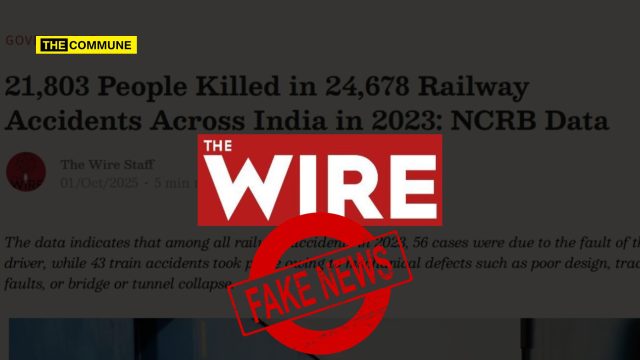
The NCRB recently released data related to railway accidents in 2023. Seeing just the numbers, leftist news portals started erupting in joy as they saw it as yet another opportunity to pull down the BJP-led central government.
A closer look at the details of the NCRB report exposes the flawed understanding and the bias of these leftists in highlighting details that are suitable for them in setting their anti-government narrative.
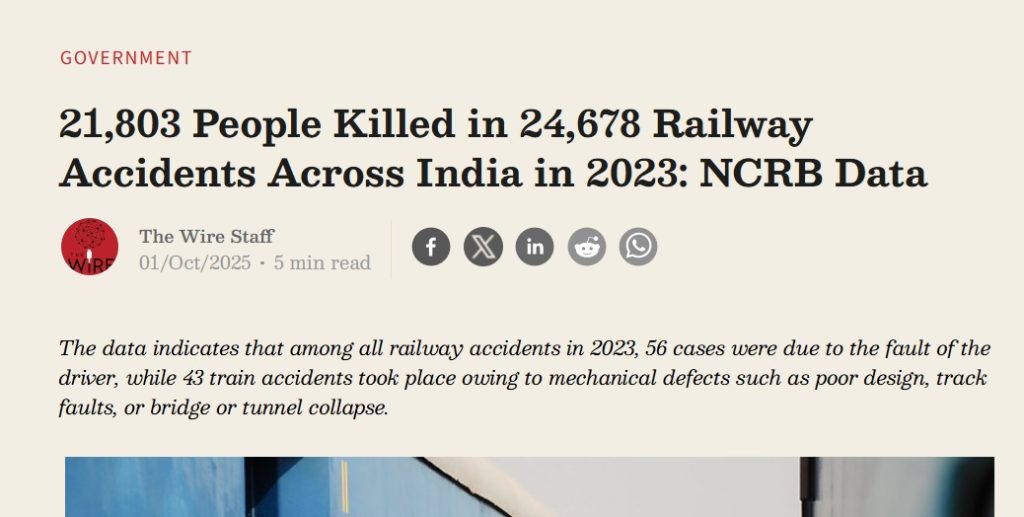
Here is what The Wire reported.
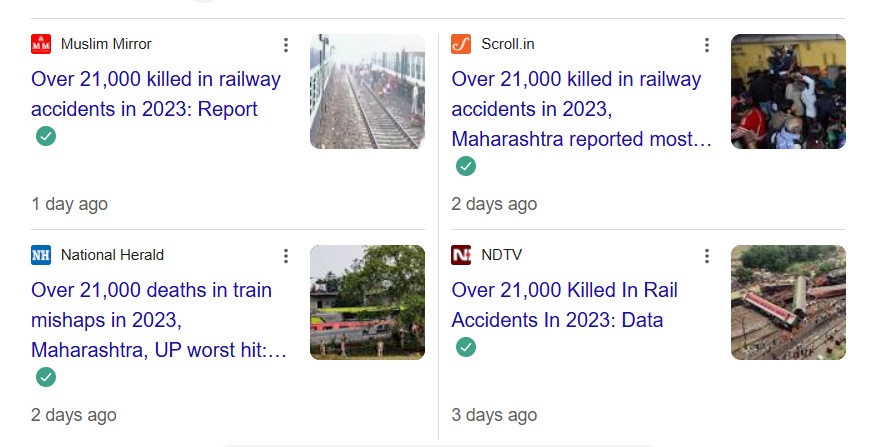
And this was what the other portals did.
Let us take a look at The Wire’s reporting to analyse the flaws.
The investigation, based on National Crime Records Bureau (NCRB) and Ministry of Railways datasets from 2004-2023, confirms the headline number but exposes its irrelevance to assessing railway operational safety, revealing instead a decade of dramatic improvement under the current administration.
The Critical Distinction: Two Classifications, One Misleading Headline
The core flaw in the reporting lies in the failure to distinguish between two entirely separate classification systems:
NCRB’s “Railway Accidents”: A broad category that includes any death reported on or near railway property. This encompasses:
- People falling from overcrowded trains.
- Trespassers being hit by trains while walking on tracks.
- Suicides on railway tracks.
- Deaths at unmanned railway crossings.
- Natural deaths occurring on railway premises.
Ministry of Railways’ “Consequential Train Accidents”: A strict metric tracking only systemic failures in train operations that cause casualties, property damage exceeding ₹2 crore, or traffic disruption exceeding 24 hours. This classification explicitly excludes trespassing, falls, and suicides.
The Real Story: 73% of “Railway Accident” Deaths Are Behavioral, Not Operational Failures
A detailed breakdown of the NCRB’s 2023 data, which reported 21,803 deaths, reveals the true nature of these incidents:
- 74.9% (18,480 cases) involved “fall from trains or collision with people on the track.”
- 72.8% (15,878 deaths) resulted specifically from falls or collisions with trains—events not classified as train operational failures.
- Only 56 cases were attributed to driver fault.
- Only 43 cases resulted from mechanical defects in rolling stock.
This data indicates that approximately 73% of the deaths attributed to “railway accidents” are behavioral incidents involving trespassing or falling from trains, not failures of the railway system’s safety.
Decade Of Dramatic Improvement In Actual Train Safety
When the correct metric, “Consequential Train Accidents” is applied, the data reveals a starkly different and positive narrative. The period from 2014-2024 shows remarkable progress compared to the previous decade (2004-2014):
60% fewer consequential train accidents, with the annual average dropping from 171 to 68.
A 73% improvement in the international safety benchmark -accidents per million train kilometers – which fell from 0.11 in 2014-15 to 0.03 in 2023-24.
For the first time in history, Indian Railways recorded zero passenger deaths from train accidents in the fiscal year 2019-20.
The Trespassing Epidemic: A Behavioral Challenge, Not An Infrastructure One
Data from the Railway Protection Force and various divisions highlights the central role of trespassing:
- In the Delhi-NCR region alone, 1,321 bodies were recovered from tracks in just 2.5 years, with over 50% due to trespassing.
- The Chennai division reports that 70-75% of daily track deaths are from trespassing and falling from trains.
- Central Railway data shows 1,210 out of 2,388 track deaths (50.6%) resulted from trespassing alone.
Studies indicate that 35% of trespassing deaths occur where foot overbridges (FOBs) are available but unused, pointing to individual choice as a primary factor.
Historical Context
An analysis of official government records, NCRB reports, and RTI data for the 2004–2014 period provides essential context for understanding India’s railway safety trajectory. During the UPA government’s tenure, consequential train accidents—those caused by operational failures resulting in casualties, property damage exceeding ₹2 crores, or significant traffic disruption—totaled 1,711, averaging 171 accidents per year. Year-wise data shows a steady decline from 234 accidents in 2004-05 to 118 in 2013-14, marking a 49% reduction over the decade.
While the total number of accidents fell, NCRB-reported railway deaths remained high, largely due to behavioral factors rather than operational failures. Available data from 2008-2014 indicates annual fatalities ranging between 24,126 and 27,765, with an average of roughly 25,960 deaths per year. Importantly, the vast majority of these deaths resulted from falls from trains, trespassing, suicides, or level crossing incidents—not systemic train errors.
Derailment statistics further underscore this distinction. Between 2007 and 2012, Indian Railways recorded 400 derailments, averaging one every five days. These incidents caused 115 deaths and 800 injuries over five years, with most derailments causing limited casualties. Major accidents in 2004-05, such as the Sadbhavana Express and Jammu Tawi-Ahmedabad collisions, led to fatalities ranging from 10 to 58, demonstrating the sporadic nature of large-scale incidents.
Safety metrics show marked improvement even during this period. Accidents per million train kilometers—a global benchmark—declined from 0.29 in 2004-05 to 0.10 in 2013-14, a 65% improvement. This trend demonstrates that Indian Railways was steadily improving operational safety, even before the substantial investments in post-2014 modernization programs.
In comparison, the period 2014-2024 saw further acceleration, with annual consequential accidents falling to 68 and total fatalities dropping to 748. While the UPA era laid the groundwork for safer operations, post-2014 investments in infrastructure, technology, and safety campaigns have delivered unprecedented reductions in operational train accidents.
Misclassification Of Suicides Inflates “Accident” Figures
Forensic studies further complicate the NCRB’s classification. A study in Secunderabad found that 56% of railway fatalities were suicides, 44% were accidents, and 0% were homicides. The NCRB’s methodology of often classifying intentional deaths as “accidents” significantly inflates the statistics used to suggest systemic failure.
Unprecedented Investment In Safety Infrastructure
The narrative of declining safety is contradicted by record levels of investment dedicated to infrastructure and prevention:
- Creation of the ₹1 lakh crore Rashtriya Rail Sanraksha Kosh dedicated solely to safety improvements.
- Annual track renewal spending surged to ₹10,201 crore (2015-23) from ₹4,702 crore (2005-14).
- Nationwide deployment of the Kavach anti-collision system on critical routes.
- Launch of “Mission Zero Death” campaigns targeting trespassing and unsafe behavior.
Leftist Narrative Debunked By Data
The reporting by The Wire and others, while numerically accurate in its raw citation of the NCRB figure, is fundamentally misleading. It conflates individual behavioral choices (trespassing, suicide) with systemic operational failures, ignores a 15.5% improvement in overall railway-related deaths since 2014, misunderstands the critical difference between NCRB’s broad classification and the railway ministry’s strict safety metrics, overlooks the 60% reduction in actual train accidents over the past decade and fails to acknowledge unprecedented safety investments and documented improvements that meet international standards.
The real challenge facing Indian Railways is not operational safety, which has seen historic improvement, but addressing complex behavioral and social issues like trespassing and suicide prevention. Conflating these distinct problems serves neither public understanding nor the goal of genuine safety enhancement.
Subscribe to our channels on Telegram, WhatsApp, and Instagram and get the best stories of the day delivered to you personally.