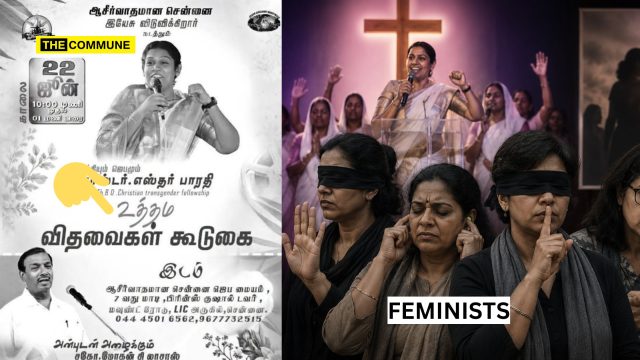
A poster advertising a Christian religious gathering for widows in Chennai has exposed yet another example of the double standards that dominate India’s secular discourse.
The event, organised under the banner of a Christian fellowship, held in Ashok Nagar, Chennai, and featured Pastor Esther Bharathi, who is identified on the poster as belonging to a ‘Christian transgender fellowship’. What is interesting is the invite is from none other than rabid Christian fundamentalist pastor, Mohan C Lazarus. The poster invites women to a special gathering and prominently refers to widows as “Utthama Vidhavaigal” or “Noble (Ideal) Widows.”
The obvious question is: what would have happened if a Hindu organisation had organised an event under a similar theme and circulated a poster glorifying widows with such terminology?
The outrage would have been immediate. Television debates would have followed. Feminist activists would have denounced the event as regressive. Social media influencers would have questioned why widows were being singled out and categorised. Editorials would have been written attacking Hindu social practices. The organisers would have been accused of perpetuating patriarchal attitudes towards women.
But because the event is being organised under a Christian banner, there is not even a whisper.
The terminology itself deserves scrutiny. Why should widows be categorised as “noble widows”? Why should a woman’s social identity be defined by her marital status? These are precisely the questions that are routinely asked when similar issues arise within Hindu society. Yet when such language appears in a Christian religious context, the outrage suddenly disappears.
This selective outrage is not an isolated phenomenon. It is part of a larger pattern in which Hindu religious and social practices are subjected to relentless scrutiny, while similar practices among minority religious groups are either ignored, excused or shielded from criticism.
The result is that secularism itself has lost credibility among large sections of the public.
Many ordinary Indians who once identified as politically moderate or secular increasingly find themselves alienated by this hypocrisy. They see one standard applied to Hindus and another applied to everyone else. They see aggressive criticism directed at Hindu customs while comparable practices in Christian or Muslim communities escape scrutiny. It is this perception of unequal treatment that has contributed significantly to the growth of Hindu uprising across the country.
The irony is that those who claim to be the guardians of secularism have done more than anyone else to damage the idea. By refusing to apply the same standards to all religious communities, they have transformed secularism from a principle of equal treatment into what can be viewed as a shield for evangelical and Islamist interests.
If genuine secularism means anything, then this poster deserves exactly the same level of criticism that would have been directed at a Hindu organisation. The question is not whether Christians have the right to organise a gathering for widows. They do. The question is whether the language and assumptions embedded in such events should be subjected to the same scrutiny that Hindu organisations routinely face.
Unfortunately, the silence is telling.
One would expect genuine secularists and feminists to be the first to challenge such messaging. Their refusal to do so only reinforces the perception that secularism in contemporary India has become less about equal standards and more about selective outrage.
The poster may advertise a gathering for “noble widows,” but the larger story is the continued unwillingness of India’s self-appointed secular establishment to apply the same standards across religious lines.
Subscribe to our channels on WhatsApp, Telegram, Instagram and YouTube to get the best stories of the day delivered to you personally.