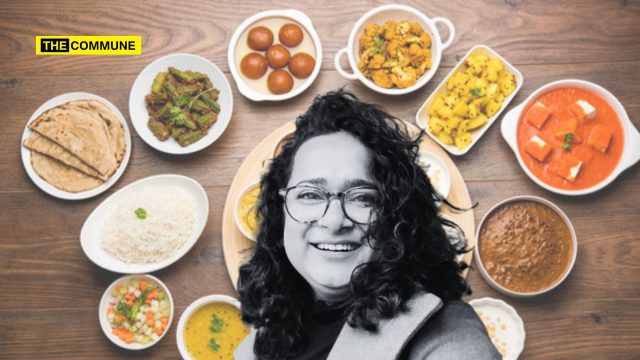
An Indian postdoctoral researcher based in Ireland has sparked sharp criticism after claiming that pure vegetarian Indian restaurants in Dublin are a “code for upper caste” – a statement that has been widely called out as a deliberate misrepresentation of why millions of Indians choose vegetarianism.
Arpita Chakraborty, a Postdoctoral Researcher at the Ireland India Institute, Dublin City University, made the remarks in what appears to be a panel discussion/podcast on the Indian diaspora.
We deleted our previous post as we identified her wrongly. She is not Dr. Shazia Shaikh but Arpita Chakraborty. She is a Postdoctoral Researcher at the Ireland India Institute at Dublin City University. She says our veg restaurants in India are ‘casteist’ because upper caste are… https://t.co/YzuiDq4Lkz pic.twitter.com/hzLpeKqssi
— Stop Hindu Hate Advocacy Network (SHHAN) (@HinduHate) March 7, 2026
Interestingly, she is a TISS alumna.
TISS alumnae Arpita Chakraborty is falsely claiming that “Pure Veg” restaurants are casteist. This leads to hate crime against Indians in Ireland. She is a postdoctoral fellow at the Ireland India Institute.@MEAIndia @HMOIndia must track her activities. https://t.co/G5kBRml3XP pic.twitter.com/mK5GqpLmUm
— Gems of Indian Academia (@GemsofAcademia) March 7, 2026
In her own words, “…the dominant idea, conception of when migrants are coming, they’re coming alone with a suitcase, like fresh off the boat or fresh off the airplane. But that hardly happens, right? People are already connecting on Facebook, on WhatsApp, they already are part of communities even before they arrive. And that community structure is replicating casteism. So, for example, in Dublin and I don’t know whether that is the same in other Irish cities, but in Dublin you will see pure veg Indian restaurants. That is a code for upper caste. And they are piggybacking on the whole vegan movement and sliding in very slyly. Pure veg restaurants in India are basically restaurants which cater to people who only eat vegetarian food – aka upper caste people. And it just irks me so much that it’s going on, and that we do not recognise it in the dominant popular narrative of…”
There are so many Indians coming to Ireland that the Indian caste system is starting to appear pic.twitter.com/9Ms4WNMUyL
— Irishman (@IrishmanIRL) March 5, 2026
What She Conveniently Left Out
In her rush to find casteism in a restaurant menu, Chakraborty omits the single most important fact: millions of Indians are vegetarian because of a deeply held moral, spiritual, and religious conviction against killing and eating animals. This principle has existed for thousands of years, long predating any Western conversation about veganism.
Hindus, Jains, many Brahmin communities, and countless non-Brahmin Hindu families across Tamil Nadu, Gujarat, Rajasthan, and Maharashtra are vegetarian not because they want to exclude Dalits but because they do not want to participate in the killing of animals. This is ahimsa. This is a centuries-old civilisational value. To reduce it to a caste conspiracy is not scholarship. It is slander.
Furthermore, and this is the fact that completely dismantles her argument, Muslims eat at pure veg restaurants in India all the time. Anyone who has spent time in Indian cities knows this. A pure veg restaurant simply means no meat is cooked on the premises which makes it attractive to anyone who wants to be certain their food has no meat contamination, including many Muslims, Jains, and health-conscious individuals of every background. If “pure veg = upper caste,” what exactly is a Muslim doing eating there? Is he engaging in casteism too?
The “Piggybacking on Veganism” Accusation
Chakraborty goes further, accusing pure veg Indian restaurants of “piggybacking on the whole vegan movement and sliding in very slyly.” This is a remarkable charge. Indian vegetarianism predates the Western vegan movement by approximately 3,000 years. The idea that Indians in Dublin opening vegetarian restaurants are somehow opportunistically exploiting a Western trend, rather than simply continuing a millennia-old food tradition, reveals more about Chakraborty’s ideological framework than about the restaurants she is describing.
No one accuses Chinese restaurants of “sliding in slyly” by serving dishes that happen to align with Western health trends. But an Indian vegetarian restaurant? That, apparently, is a caste conspiracy.
How Is a Veg Restaurant “Encroaching” on Anyone?
There is a question that Chakraborty’s entire argument cannot answer: How exactly does a pure veg Indian restaurant in Dublin harm anyone? It is not stopping non-vegetarian restaurants from opening. It is not refusing to serve customers of any caste or background – it is simply not serving meat. Any customer who walks in gets the same menu. The only people “excluded” are those who specifically want to eat meat and they have the entire rest of Dublin’s restaurant scene available to them.
The idea that Indians choosing to eat food cooked without meat, in a country where they are a tiny minority, constitutes an act of caste oppression is so detached from reality that it would be funny, if it were not being presented as serious academic research at a European university.
The “Brown Sepoy” Problem
What Chakraborty is doing has a name. She is doing her role as the perfect brown sepoy, the Indian intellectual who gains Western academic credentials and approval by relentlessly pathologising Indian culture, Hindu traditions, and Indian social structures for a white audience that has no means or motivation to verify the claims being made.
The formula is simple: take something ordinary about Indian culture: a vegetarian restaurant, a festival, a temple practice, apply the words “caste,” “oppression,” or “exclusion,” present it to a Western panel, watch the approval roll in. The white academics nod. The grant applications get funded. The conference invitations arrive. And back home, ordinary Indians who have never eaten meat in their lives, Jain businessmen who will not harm an insect are told by a Dublin researcher that their food choices are a form of bigotry.
This is not scholarship. This is performance, performed for an audience that does not know India, by someone who has decided that her career is better served by confirming Western prejudices about India than by representing her own people honestly.
The Real Question
What drives an Indian researcher in Ireland to look at a vegetarian restaurant; an establishment that harms no one, excludes no one, and simply chooses not to cook meat, and see in it a symbol of oppression? What kind of ideological conditioning produces that reflex?
The answer is the same academic ecosystem that has spent decades teaching a generation of Indian researchers to view their own civilisation through a lens of shame, to find oppression in every tradition, and to present the most uncharitable possible interpretation of Indian culture to Western audiences hungry for confirmation that India is uniquely, irredeemably bigoted.
Arpita Chakraborty did not discover casteism in a Dublin restaurant menu. She imported a predetermined conclusion and found, as these researchers always do, exactly what she was looking for.
Subscribe to our channels on Telegram, WhatsApp, and Instagram and get the best stories of the day delivered to you personally.