


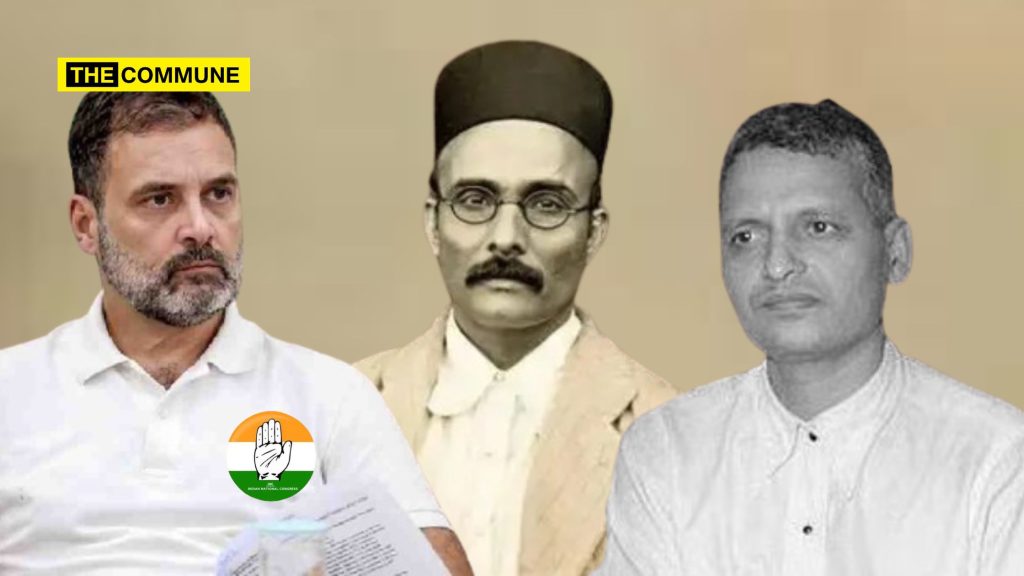
A special court in Pune has dismissed an application filed by Congress scion Rahul Gandhi that sought to present a familial connection between Vinayak Damodar Savarkar and Nathuram Godse. The court ruled that such a relationship was irrelevant in determining the defamation case filed against Gandhi for remarks he made in London about Savarkar.
Gandhi had filed the application through his lawyer Milind Pawar, attempting to introduce the maternal lineage of the complainant, Satyaki Savarkar. The claim was that Satyaki had purposefully excluded information about his mother’s side to obscure an alleged link between the Savarkar and Godse families. According to Gandhi, Satyaki is the son of Ashok Savarkar (brother of Vinayak Savarkar) and Himani, who Gandhi alleges is the daughter of Gopal Godse, the brother of Nathuram Godse.
Gandhi’s petition stated that the complainant “deliberately and cleverly avoided disclosing his maternal lineage” to hide a possible blood connection between the two prominent historical figures. He contended that this omission was crucial, as it could establish a direct familial tie and impact the complainant’s credibility.
However, Judge Amol Shinde ruled against this argument. In his detailed order dated 28 May 2025, the court clarified that the case solely pertained to the alleged defamatory remarks made by Rahul Gandhi during his speech in London about Savarkar. The judge noted that Satyaki, being the grandson of one of Vinayak Savarkar’s brothers, meets the legal requirement under Section 199(1) of the CrPC as an “aggrieved person” who can initiate a defamation suit.
Judge Shinde firmly stated that the maternal background of Satyaki was irrelevant to the central issue of the case. “This matter has nothing to do with Himani Ashok Savarkar’s family tree. There is no substance in the application, and no need for further investigation,” the court ruled, calling the plea meritless.
The court also highlighted that the complainant carries the burden of proof. If he fails to establish defamation, Gandhi will be acquitted accordingly.
In his plea, Gandhi also delved into several historical aspects. He claimed that Savarkar was not only ideologically aligned with Godse but had once been a co-accused in the Mahatma Gandhi assassination trial. Although Savarkar was acquitted due to lack of evidence, Gandhi argued that his ideological sympathies with Godse were evident.
According to Gandhi, both Savarkar and Godse were strong proponents of a Hindu Rashtra (Hindu nation) and believed that Muslims and Christians were misfits in Indian society. The petition alleged that they shared common views and even collaborated in conspiring to assassinate Mahatma Gandhi, whom they viewed as overly accommodating to Muslims during the Partition.
The application further cited historical research and writings, claiming that Savarkar had articulated the two-nation theory even before Muhammad Ali Jinnah. Gandhi argued that Savarkar, in speeches from 1937 and writings from 1943, laid out a vision of Hindus and Muslims as two separate nations, contributing ideologically to the eventual division of India.
Gandhi’s team also highlighted excerpts from Savarkar’s post-prison writings, which, according to them, advocated anti-Muslim sentiments. The petition alleged that Savarkar promoted reducing the number of Muslims in government, military, and munitions industries, and treated them as potential traitors.
Citing his 1963 book Six Glorious Epochs of Indian History, Gandhi alleged that Savarkar viewed Muslims and Christians as existential threats to Hinduism. The petition included a disturbing claim that Savarkar condoned rape as a political weapon, suggesting Muslim women should be captured and converted as trophies for Maratha warriors, just as Tipu Sultan had allegedly distributed Hindu women.
Gandhi’s legal team asserted that these historical details were necessary to refute the claim that his comments defamed Savarkar. They argued that Gandhi had merely quoted from Savarkar’s own published works.
The defamation case itself arises from a speech Gandhi delivered in London, where he allegedly stated that Savarkar had written in his book about how he and his friends “enjoyed” physically assaulting a Muslim boy. Satyaki Savarkar, identifying himself as a direct descendant, filed a complaint in Pune, claiming that the remarks were defamatory.
Now that the court has rejected Gandhi’s attempt to bring up the maternal side of the complainant’s family, the trial will focus exclusively on the main legal question: whether or not Rahul Gandhi’s speech in London amounts to criminal defamation of Vinayak Damodar Savarkar.
(With Inputs From Organiser)
Subscribe to our channels on Telegram, WhatsApp, and Instagram and get the best stories of the day delivered to you personally.