


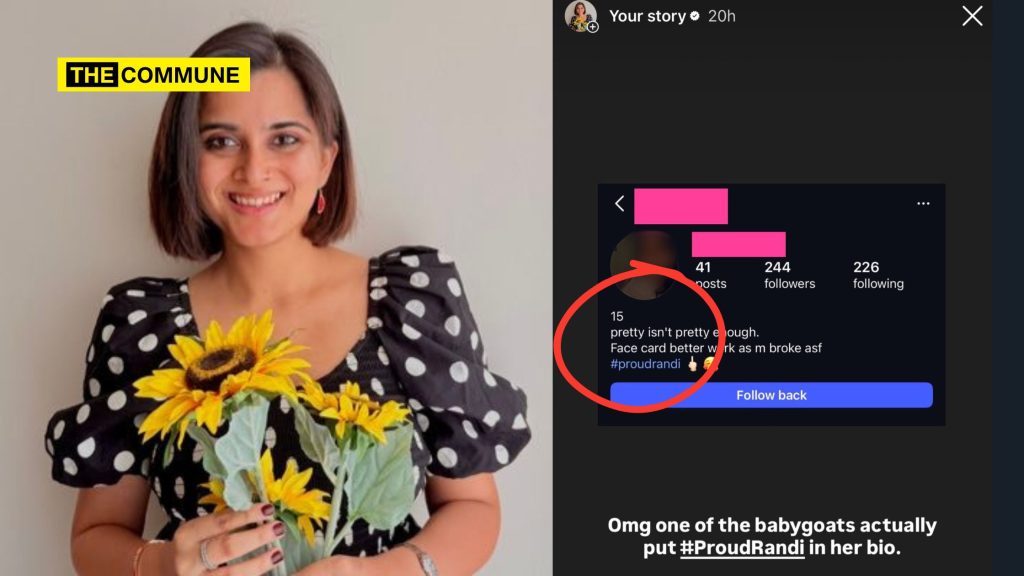
An Instagram handle that goes by “awkwardgoat” run by alleged counselling psychologist Divija Bhasin, has triggered widespread outrage after posting a series of Instagram reels attempting to “reclaim” the Hindi slur “r*ndi”, a term historically used to degrade and dehumanise women.
In the now-viral video, Bhasin sarcastically says she doesn’t “look r*ndi enough,” before changing into a black dress and explaining that the word is routinely used to shame women for anything — from wearing jeans to talking to boys. She concludes by declaring, “I am a proud r*ndi… If I’m not seen as a r*ndi, it means I’m being controlled — and that is worse.”
Minors Using the Slur After Her Reel
The controversy deepened after screenshots surfaced of teenage girls, some as young as 15, adding “#ProudR*ndi” to their Instagram bios and captions following Bhasin’s video.
Instead of condemning this alarming trend, Bhasin doubled down, writing on X, “If you are shocked to see a 15-year-old girl write #ProudR*ndi in her bio because of my video, but never spoke when girls were called r*ndi by their parents — your problem isn’t the word. It’s that I’m making it hurtless.”
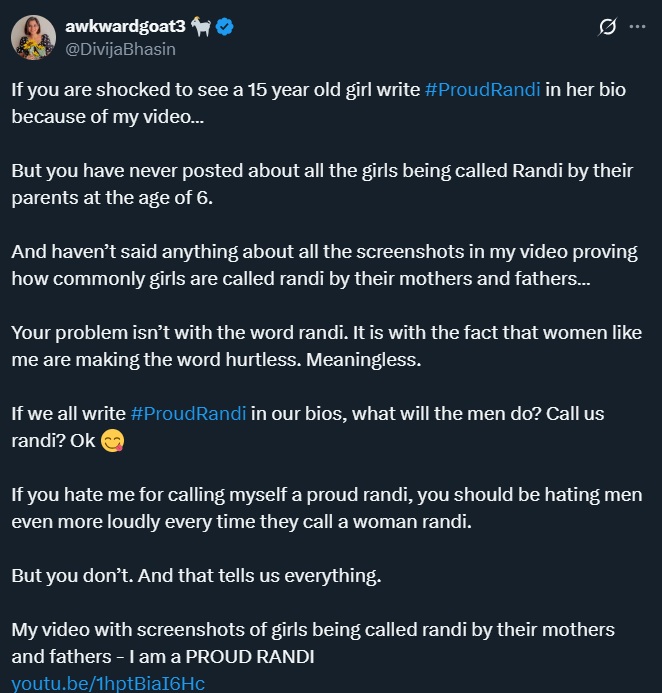

And she shared screenshots of her DMs where she did not mask the names/photos of the minors.
Critics have slammed this reasoning as irresponsible and dangerous, arguing that normalising the word erases its history of violence and misogyny, especially when impressionable minors are involved.
Legal Complaint Filed, POCSO FIR Likely
An advocate practicing at the Bombay High Court has publicly confirmed filing a formal complaint seeking registration of an FIR against Bhasin under relevant sections of the Protection of Children from Sexual Offences (POCSO) Act and the Information Technology Act.
I’m an Advocate at Bombay High Court,
I’ve submitted a formal complaint for FIR against @DivijaBhasin in the morning.
Have a meeting scheduled for tomorrow with MH Police,
I request everyone to get FIR Registered in multiple states to that bail will be impossible for her. https://t.co/nx1F80mkYr
— Hindutva Naari (@HindutvaNaari) November 10, 2025
This comes at a particularly sensitive time, just as the Supreme Court is scheduled to hear Indira Jaising’s case on November 12 regarding the lowering of the age of consent, raising further alarm about how young girls perceive sexual identity and boundaries.
A few others too came forward to file cases against Bhasin.
You won’t be spared BABYGIRL,
I will make sure to get you Booked under POCSO.
I’ve been called by local police to submit the written statement also to proceed with the FIR on day after tomorrow.
If you’re taking POCSO lightly read about Asaram.
You’re the same category as… https://t.co/9dRgRl5mtn
— Anubhav Gupta (@anubhavgupta_ji) November 10, 2025
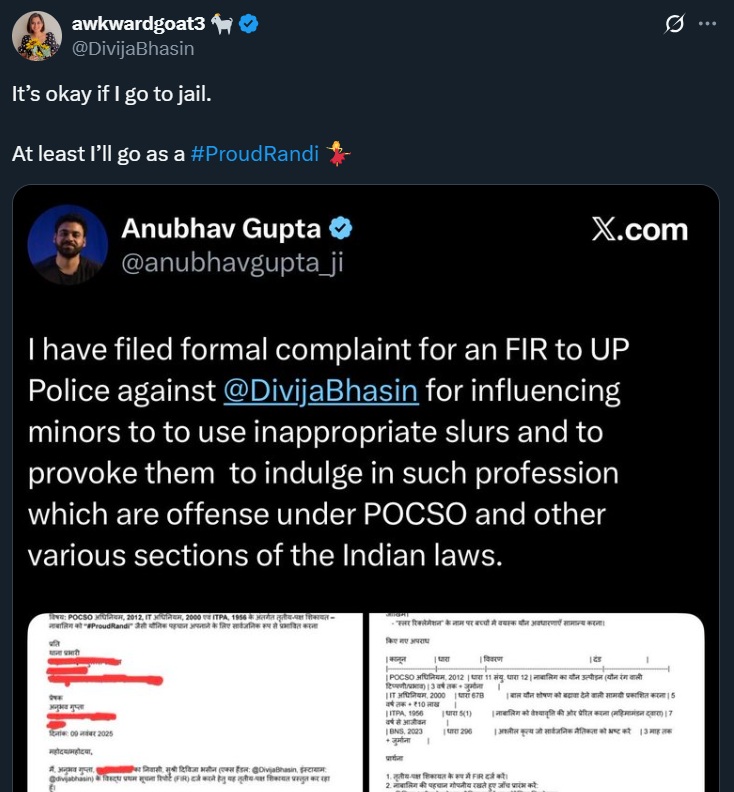
I have filed formal complaint for an FIR to UP Police against @DivijaBhasin for influencing minors to to use inappropriate slurs and to provoke them to indulge in such profession which are offense under POCSO and other various sections of the Indian laws. https://t.co/D1OvUnMFy5 pic.twitter.com/IAO3PCtZPu
— Anubhav Gupta (@anubhavgupta_ji) November 9, 2025
However, Bhasin kept up her act.

Why ‘Reclaiming’ a Sexual Slur Is Stupid & Deeply Harmful
Language has power and words like “r*ndi” are not mere insults; they are tools of humiliation rooted in centuries of casteist, patriarchal, and sexual oppression. The term has been used to label, silence, and degrade women, especially sex workers, by equating their worth solely with sexual availability.
To “reclaim” such a slur, critics argue, is to erase its violent legacy and the suffering of women forced into prostitution. Unlike words that originated within marginalised communities and were reclaimed by them, “r*ndi” is not Bhasin’s word to reclaim; it is one historically used against women, not by them.
“Reclaiming” the slur is ethically indefensible because it refers specifically to sex workers, many of whom were victims of coercion, trafficking, and caste violence. What is the point of reclaiming a slur that has been historically used to degrade women?
Impact on Young Girls
Perhaps the most disturbing outcome of Bhasin’s video is its impact on adolescent girls, who look up to social media figures for validation and guidance. Encouraging minors to “own” a sexual slur and to associate it with empowerment risks conditioning them to trivialise sexual exploitation and verbal abuse.
By glorifying a term that reduces women to sexual objects, Bhasin’s content blurs the line between empowerment and degradation. It sends a dangerous message that self-worth can be found in embracing the same language used by abusers.
Bhasin seems to either have no idea about the slur or has left her brain in the toilet because she seems to not know that there is no pride in being called a prostitute. Devaluation of oneself isn’t freedom, it’s emotional purgatory.
Why Legal Action Is Necessary
Experts argue that Bhasin’s influence over minors and her public defence of this rhetoric fall squarely under Section 11 of the POCSO Act, which criminalises sexualised communication and inducement toward minors. By creating content that sexualises minors’ self-expression, she may have violated not only POCSO but also sections of the Information Technology (Intermediary Guidelines) Rules, which prohibit sexualised material involving minors.
Feminist scholars and legal professionals have warned that failing to act now risks setting a precedent where influencers can eroticise, distort, or trivialise sexual abuse and prostitution under the guise of “reclamation.”
Under the guise of a “psychologist”, half-baked and half-naked so-called “influencers” are peddling lies, filling brains of young naive children with nonsense and creating a traumatised generation. It is unfortunate that only such low value content grabs eyeballs these days.
While Bhasin claims to be stripping the slur of its “power,” her critics say she has instead stripped it of its context – turning a word born from oppression into a social media slogan.
At a time when the nation is engaged in a sensitive debate about protecting young girls from sexual exploitation and grooming, Bhasin’s campaign is catastrophically tone-deaf. It actively encourages minor girls to self-identify with a term rooted in sexual commodification, undermining the very legal protections the POCSO Act and age-of-consent laws are designed to uphold.
Subscribe to our channels on WhatsApp, Telegram, Instagram and YouTube to get the best stories of the day delivered to you personally.