


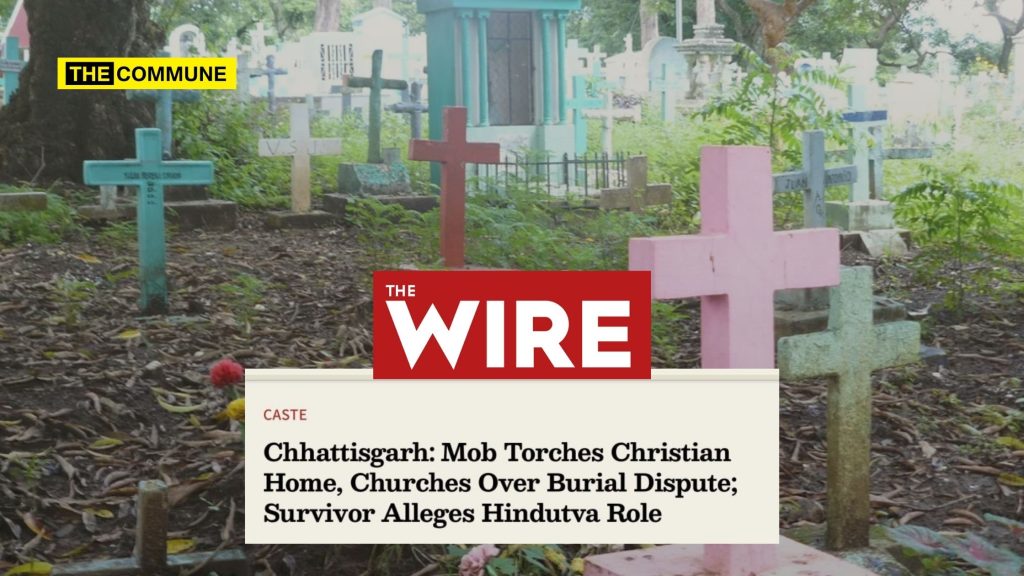
A ‘report’ published by leftist rag The Wire on 20 December 2025, on violence following a burial dispute in Chhattisgarh’s Kanker district has drawn criticism for what detractors describe as selective framing and omission of key facts that materially alter the context of the incident.
The Wire’s article headlined “Chhattisgarh: Mob Torches Christian Home, Churches Over Burial Dispute; Survivor Alleges Hindutva Role,” foregrounded allegations by a Christian family that “Hindutva groups” were responsible for the violence, repeatedly using language that portrayed the incident as a targeted attack on Christians driven by ideological hostility.
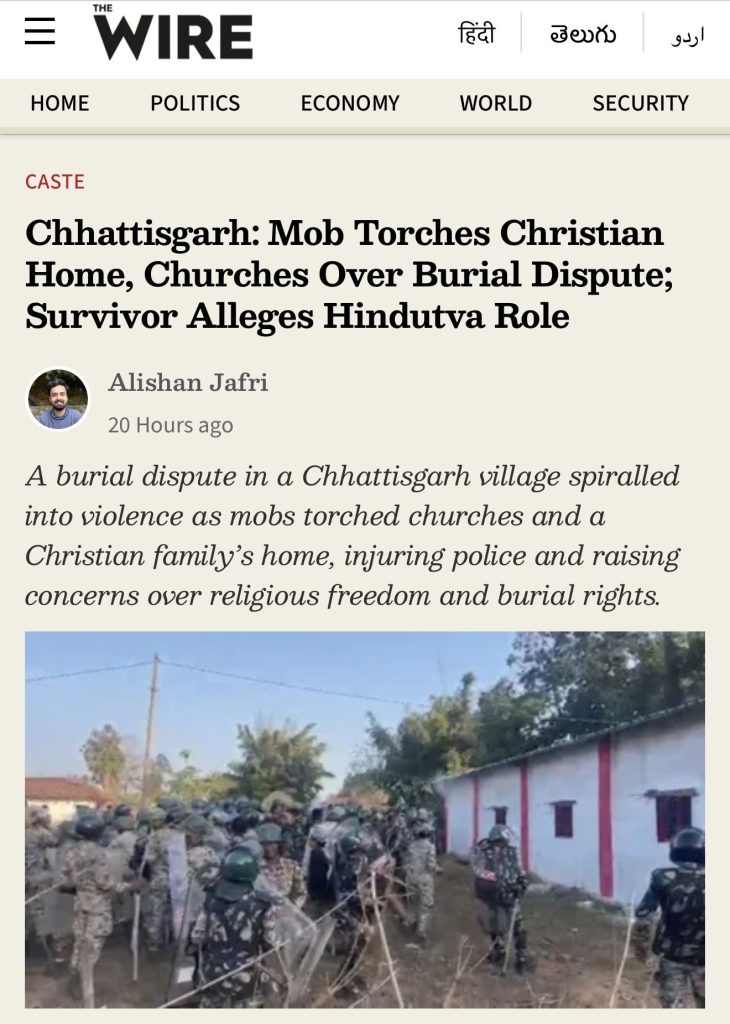

The article relied heavily on survivor testimony and activist statements, while attributing the escalation primarily to the involvement of organisations such as the RSS and Bajrang Dal.
However, contemporaneous reporting by The Hindu presented a more layered account, situating the violence within a complex local dispute involving burial practices, tribal customs, conversion-related tensions, and intra-village rivalries. According to The Hindu, the deceased father of village sarpanch Rajman Salam had not converted to Christianity, and the burial was conducted according to Christian rites on village land despite objections rooted in long-standing tribal customs. The paper also reported that villagers formally complained to the administration, leading to a legally sanctioned exhumation order by an Executive Magistrate.
Crucially, The Hindu’s report noted that the situation involved clashes between villagers themselves, stone-pelting, injuries to police personnel, and property damage during efforts to maintain order, facts that complicate a simplistic framing of the violence as a one-sided, ideologically driven attack. Senior police officials cited by The Hindu stated that the exhumation was ordered under legal provisions following villagers’ complaints and that the administration had attempted mediation before violence broke out.
By centring the narrative almost entirely on “Hindutva violence” and downplaying the role of tribal customs, administrative orders, and local disputes, including allegations that political rivalry played a role, The Wire reduced a multifaceted law-and-order situation into a binary communal storyline. The leftist rag which positions itself as an advocate for ‘human rights’, leave alone tribal rights, did not sufficiently reflect tribal perspectives that opposed the burial on customary grounds, thereby marginalising those voices in favour of a predetermined ideological frame.
The article’s reliance on allegations without equivalent scrutiny of countervailing accounts, particularly when official police statements acknowledged injuries to more than 20 personnel and described the events as “clashes among villagers.” Such omissions mislead readers by presenting allegation as established fact.
The divergence between the two reports has fuelled a broader debate on editorial responsibility and narrative balance, especially in conflict reporting involving religion, tribal customs, and local governance. Serious incidents of violence warrant comprehensive coverage that reflects all material facts and perspectives, rather than selective emphasis that aligns with a particular political or ideological outlook.
Subscribe to our channels on WhatsApp, Telegram, Instagram and YouTube to get the best stories of the day delivered to you personally.