Political theorist Pratap Bhanu Mehta has triggered fresh debate over his long-standing role in India’s intellectual ecosystem.
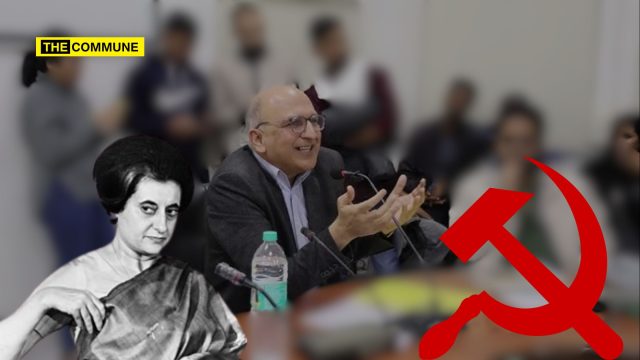
The short clip, taken during his interaction with students at JNU after a lecture on “Reflections on Global Political Thought”, shows Mehta acknowledging a controversial episode from the Emergency period.
In the video, Mehta is seen saying or rather admitting, “When I talk about history, the pact made during Emergency by CPI and Indira Gandhi with regard to Indian history department, history textbooks, it was a disaster for academic life in India. The left was also quite happy with it, quite complicit with it.”
Hear it from Pratap Bhanu Mehta himself:
Indira Gandhi & Communists made a pact to influence Indian history textbooks and history writing
But if anyone else says this, they become “Whatsapp University” pic.twitter.com/x4P5lNQ3JU
— Abhishek (@AbhishBanerj) December 4, 2025
While Rahul Gandhi complains about ‘RSS capturing institutions’, Pratap Banu Mehta reveals how Congress and Communists captured India’s academic space for indoctrination.
Who Is Pratap Bhanu Mehta?
Mehta, a former Vice-Chancellor of Ashoka University and ex-president of the Centre for Policy Research (CPR), is a part of the global networks linked to billionaire philanthropist George Soros. CPR has partnered with Namati Inc., an organisation that receives funding from the Open Society Foundations (OSF); Soros sits on Namati’s advisory council. Mehta himself is listed on Namati’s Board of Directors.
It is a known fact that Soros-funded NGOs have cultivated a class of intellectuals consistently opposed to the Modi government, naming figures such as Harsh Mander, Indira Jaising, Amartya Sen, and Mehta among them.
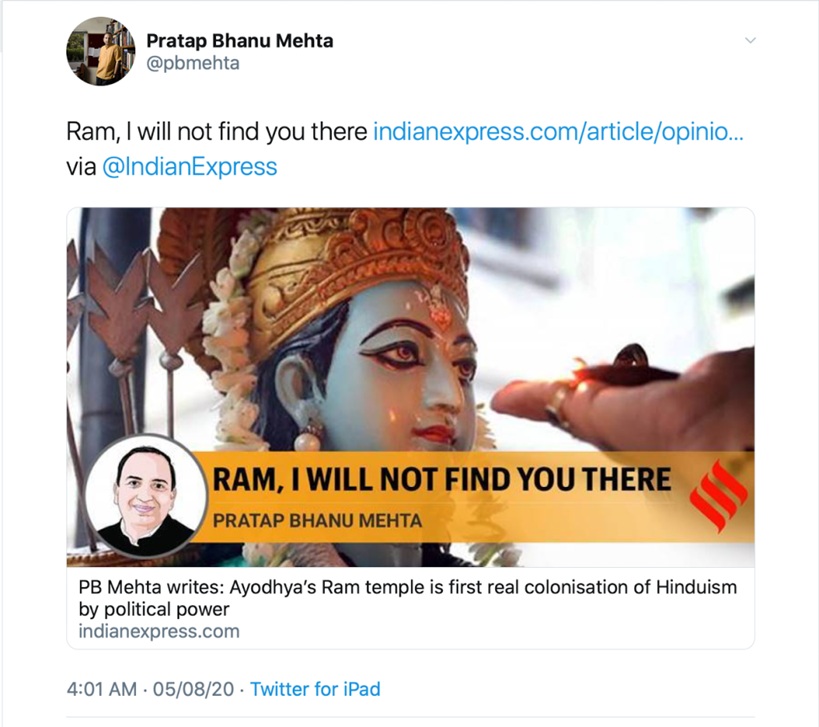
Mehta has repeatedly drawn backlash for his columns, including his reaction to the Ram Temple inauguration, in which he wrote that Ayodhya’s Ram Mandir was the “first colonisation of Hinduism by political power.”
His commentary on the hijab dispute also stirred debate. In his Indian Express column, Mehta argued the controversy should be viewed as a test of constitutional values, liberty, dignity, and non-discrimination. According to him, “the hijab does not interfere with education, holding a job, voting, participating in public life, or achieving anything in life,” and excluding students or teachers on that basis represented “a moral and constitutional failure.”
He further wrote that the moment reflected “an attempt to visibly erase Muslims from India’s public culture” and that portraying the hijab as a challenge to equality was misguided. Mehta framed the issue as one of state overreach and societal intolerance, warning that current actions “normalise hostility towards minorities” and weaken democratic principles.
Mehta’s disclosure has given the shot in the arm for the long-alleged ideological capture of Indian academic institutions, a charge often levelled by critics who say that key universities, research bodies and textbook committees were steered for decades by tightly knit ideological circles. The comment has reopened scrutiny of how historical narratives were shaped, appointments influenced, and academic ecosystems consolidated during and after the Emergency, issues that have typically been dismissed or downplayed in mainstream discourse.
Subscribe to our channels on WhatsApp, Telegram, Instagram and YouTube to get the best stories of the day delivered to you personally.