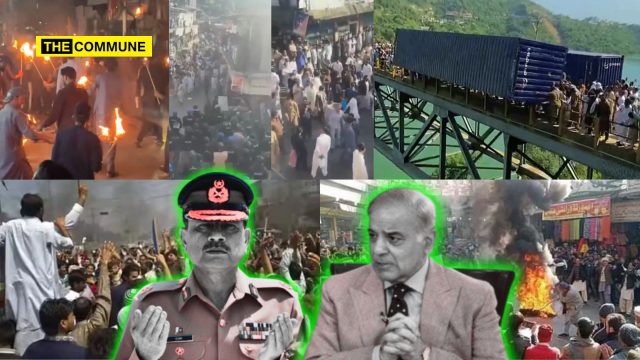
Unprecedented protests have erupted across Pakistan-Occupied Kashmir (PoK) or rather “illegally occupied Kashmir since late September 2025, shaking Islamabad’s control over the region and exposing decades of political repression, economic exploitation, and human rights violations.
What began as a “shutter-down” and “wheel-jam” strike organised by traders and civil society groups rapidly escalated into a mass uprising. Violent clashes between protesters and Pakistani security forces have left at least 12 civilians dead, several police personnel injured, and hundreds wounded, according to reports from local sources. Entire towns have been paralysed by continuous strikes, blockades, and curfews.
The containers that had been placed by Pakistani authorities to block the demonstrators’ advance, were toppled from a bridge into the river below.
🚨 Dramatic visual from Dadyal, PoJK
This is not a foreign scene. Pakistan blocked peaceful protesters with three heavy containers on Palak Bridge, Dadyal. Locals lifted and threw them off the bridge with bare hands. Sources say the protest is intensifying across PoJK. pic.twitter.com/6pwoaI0feP
— OsintTV 📺 (@OsintTV) October 1, 2025
The Historic Uprising Blacked Out By The West
Organised by a coalition of traders, civil society groups, and local activists, the protests brought major towns to a standstill, marking one of the largest uprisings in PoK in over forty years. Streets that were once bustling with daily activity were now dominated by chants of resistance and mourning. At least a dozen civilians lost their lives, several police personnel were injured, and hundreds more were hurt as clashes turned the region into a hotspot of unrest
Information Blackout And Media Censorship
Despite the scale of the unrest, the events in PoK have been almost completely blacked out in Pakistani mainstream media. Internet services have been shut down in multiple districts, cutting off communications and preventing citizens from sharing footage of the crackdown. Independent journalists have reported being threatened or detained by local authorities.
Activists have described the situation as “genocidal,” alleging that Pakistani forces have used live ammunition against unarmed protesters and targeted residential areas under the guise of “restoring order.” Several eyewitness videos that surfaced briefly before the internet shutdown showed armoured vehicles firing directly into crowds, and locals bleeding on the streets. Many of these clips were quickly removed from social media platforms inside Pakistan.
A Revolt Unlike Any In Decades
Observers have called the uprising the largest in nearly four decades. Demonstrators in Muzaffarabad, Rawalakot, Kotli, Dadyal, and Neelum Valley raised slogans such as “Kashmir is ours, we will decide its fate” and “rulers, beware, we are your doom,” directly challenging Pakistan’s military and administrative control.
The protests saw unprecedented participation by women and youth, with coordination across towns through social media before digital communications were cut off. More than 100 security vehicles were torched, and in several instances, locals briefly held Pakistani soldiers captive.
Economic Exploitation And Broken Promises
Residents accused Pakistan of systematically looting PoK’s resources while denying basic services. Although the region produces significant hydropower through projects such as the Mangla Dam and Neelum-Jhelum, residents face crippling electricity bills and frequent outages.
The
The shortage of subsidised wheat flour and surging food prices amid Pakistan’s wider economic collapse have worsened living conditions. Protesters demanded free or heavily subsidised electricity and flour, as well as tax parity on property transfers—pointing out that PoK’s rates are higher than those in Punjab or Khyber Pakhtunkhwa.
Development remains stagnant despite repeated promises. Protesters cited the absence of an international airport in Mirpur as a prime example of Islamabad’s neglect. “PoK generates the power that lights up Punjab, but our homes remain in darkness,” one activist reportedly said before communication lines were cut.
Political Marginalisation And Military Control
Protesters also demanded the abolition of 12 reserved seats in the PoK Legislative Assembly for “Kashmiri refugees” living in Pakistan, alleging that Islamabad uses these seats to manipulate local governments.
The Legislative Assembly itself holds limited authority, with most executive powers controlled by an administrative council chaired by Pakistan’s Prime Minister. Locals have described this arrangement as “colonial,” arguing that PoK functions under Pakistan’s thumb without real autonomy.
Calls for representation in Pakistan’s National Assembly and Senate have grown louder, alongside demands for constitutional reforms, fair elections, and an end to military interference. Videos circulating before the blackout showed angry residents stripping captured soldiers of their uniforms and auctioning them for as little as PKR 10—a striking symbol of public fury and humiliation.
Pattern Of Crackdowns And Unfulfilled Deals
The 2025 uprising follows earlier protests in 2023 and 2024 over similar demands for subsidies and local rights. While those demonstrations led to 3–5 deaths, the current unrest has already claimed at least a dozen lives, marking a sharp escalation.
Pakistan’s initial response involved large-scale deployment of troops from Punjab, extensive use of tear gas and live ammunition, and mass arrests. Prime Minister Shehbaz Sharif authorised a crackdown while calling the protesters “miscreants” attempting to destabilise the state.
By October 3, Islamabad sent a high-level delegation to negotiate with protest leaders. The October 4 agreement promised subsidised wheat, reduced electricity tariffs, property tax parity, and PKR 10 billion for infrastructure development. It also included plans for a Mirpur airport feasibility study and review of the disputed assembly seats.
However, local activists have dismissed the pact as another deception. Civil society leader Shaukat Nawaz Mir described the government as a “dayan (witch) administration” and vowed to monitor implementation closely.
Humanitarian Crisis Underway
Reports from ground sources indicate a worsening humanitarian situation. Security forces have imposed indefinite curfews in several districts, while food and medical supplies are reportedly running low. Dozens of missing persons cases have been filed by families alleging arbitrary detentions and abductions by paramilitary units.
Activists have compared the situation to “a silent genocide,” saying that entire towns are being starved and terrorised into submission.
India’s Response And International Silence
India’s Ministry of External Affairs reiterated that Pakistan-Occupied Kashmir remains an integral part of India under illegal occupation. MEA spokesperson Randhir Jaiswal condemned what he termed Pakistan’s “oppressive approach” and “horrific human rights violations,” urging international attention to the crisis.
Despite growing evidence of mass repression, international media coverage has been minimal, with Pakistan reportedly restricting access to foreign correspondents.
A Challenge To Pakistan’s Narrative
Analysts said the unrest has destroyed Pakistan’s decades-old narrative that PoK is a “model of freedom” compared to Jammu and Kashmir. Instead, the protests have revealed a population disillusioned with Islamabad’s governance and increasingly willing to confront the military establishment.
Pakistan’s mounting debt—estimated at nearly 80 percent of GDP—and dependence on IMF bailouts limit its ability to meet PoK’s economic demands. Experts warn that unless Islamabad addresses core grievances, PoK could become a flashpoint for wider instability within Pakistan.
For the first time in recent memory, the people of Pakistan-Occupied Kashmir are not just protesting for subsidies or development—they are openly questioning the legitimacy of Pakistan’s rule itself. And as the blackout continues, their cries for justice are being silenced under the shadow of state power.
(With inputs from India Today)
Subscribe to our channels on Telegram, WhatsApp, and Instagram and get the best stories of the day delivered to you personally.