
The recent Supreme Court order on stray dogs in Delhi-NCR region set off a wave of reactions from the so-called animal lovers. Not to feel left out, so-called “animal rights” organisation PETA India also gave their two pennies.
Speaking to reporters, PETA India Advocacy Associate Shaurya Agrawal said the Delhi government had been given 24 years to implement sterilisation programmes under the Animal Birth Control (ABC) Rules but had failed to do so effectively. “Delhi has 10 lakh dogs and only half of them are sterilised. Housing them in shelters is impractical. It is very difficult. This is going to create chaos and problems,” Agrawal said.
Agrawal argued that the removal of dogs from the streets was “inhumane” and amounted to cruelty, adding that shelter conditions could be “very bad” for the animals. “Removal of dogs is inhumane, is cruelty in itself, and the conditions within the shelters are going to be very bad,” he said.
#WATCH | Delhi: On SC order to send all stray dogs in Delhi-NCR to shelters within 8 weeks, PETA India Advocacy Associate, Shaurya Agrawal says, “This particular order is impractical, illogical and according to the animal birth control rules, also illegal. The Delhi government… pic.twitter.com/T5BLFWy8kQ
— ANI (@ANI) August 12, 2025
He added that PETA India is “exploring all our legal avenues” to challenge the order and reiterated the organisation’s longstanding demand for the government to focus on sterilisation and vaccination drives instead of mass removal. “In the past, we have met the Delhi government and have urged them to implement the ABC rules properly and the sterilisation programs in the city,” he said.
Are They Really An Animal Rights Organization?
The People for the Ethical Treatment of Animals (PETA) is a household name synonymous with animal rights advocacy, championing issues ranging from anti-fur campaigns to opposition to animal testing and hunting. Despite its vocal advocacy against animal cruelty, PETA euthanizes the vast majority of dogs and cats that enter its facility, often within hours of arrival, raising serious ethical questions about its true mission.
Shocking Euthanasia Rates: A Shelter Or A Slaughterhouse?
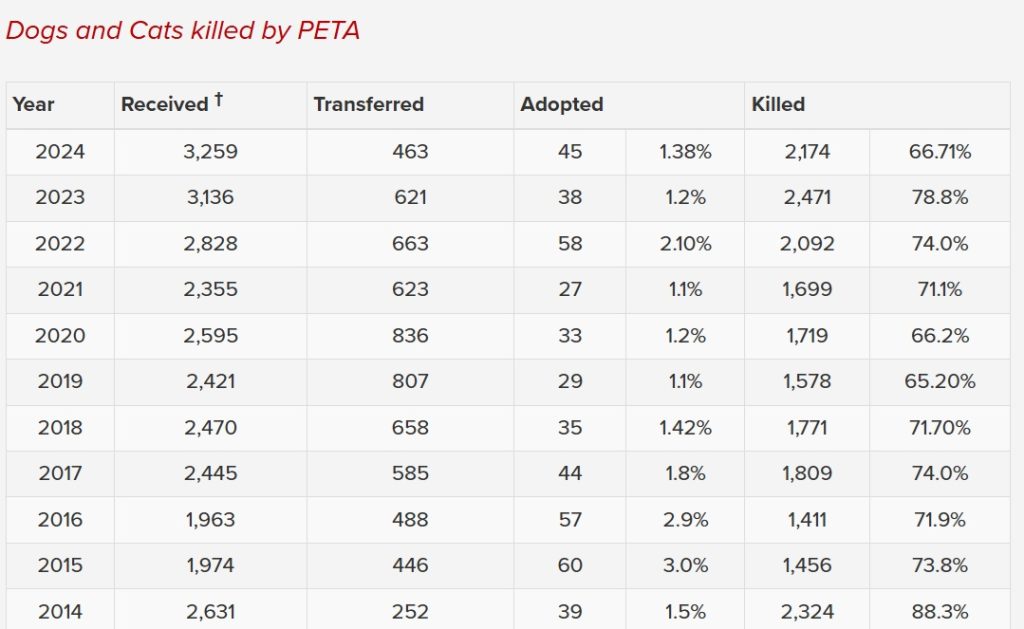
According to records from the Virginia Department of Agriculture and Consumer Services (VDACS), PETA’s shelter took in 3,117 animals in 2023 and euthanized 2,471 of them: a kill rate of nearly 80%. This trend is not new. Over the past two decades, PETA has euthanized more than 51,000 animals, with some years seeing kill rates as high as 97%.
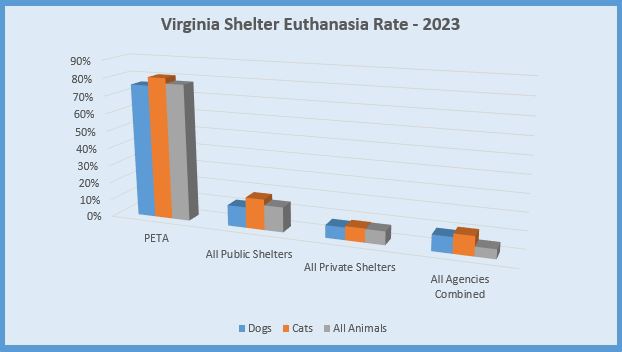
By comparison, most private shelters in Virginia maintain euthanasia rates below 10%, striving for “no-kill” status (90%+ adoption rates). Even Norfolk’s public animal shelter, which operates under similar constraints, euthanized just 14% of dogs in 2023, far lower than PETA’s 76%.
For more information, read how PETA kills animals here.
How And Why PETA Justifies Euthanasia
PETA positions its shelter as a “shelter of last resort,” claiming to accept animals other facilities reject: the old, the sick, the aggressive, or otherwise unadoptable. They publicly assert that euthanasia is an act of mercy, to spare suffering animals from pain, neglect, or life-threatening conditions.
However, extensive reporting, as well as state inspections, contest this narrative:
- Quick Turnaround: In a 2010 state investigation, it was found that 84% of animals taken into PETA’s shelter were killed within 24 hours of arrival.
- Shelter or Clinic?: The inspector concluded that PETA’s facility did not operate as a true shelter seeking adoptive homes but resembled a “euthanasia clinic,” with very limited housing and virtually no animals available for the public to adopt.
- Low Adoption Efforts: The adoption/transfer rate has at times fallen to as little as 0.7%.
The Case Of “Maya” The Chihuahua
One of the most damning incidents occurred in 2014, when PETA employees stole a family’s healthy Chihuahua, Maya, from their porch and euthanized her the same day, violating Virginia’s mandatory 5-day holding period for strays.
Surveillance footage showed PETA workers luring the dog into their van. When confronted, PETA initially denied involvement, then later returned with a fruit basket and an apology, but no dog. The family sued for $9.7 million; PETA settled for $50,000 and was fined by the state. This case exposed PETA’s ruthless efficiency in killing animals, even those with loving homes.
Why Does PETA Kill So Many Animals?
Critics argue PETA’s anti-pet ownership ideology drives its euthanasia policies. Ingrid Newkirk, PETA’s president, has stated: “In the end, I think it would be lovely if we stopped this whole notion of pets altogether.” PETA believes no animal should live under human care, even if well-treated. In court, it has argued that elephants in zoos would be “better off dead” than in captivity.
The group has even advocated for killing feral cats rather than allowing TNR (Trap-Neuter-Release) programs, claiming death is “kinder” than potential future suffering.
- Hypocrisy in Action: PETA’s Radical Agenda vs. Its Actions
While PETA condemns hunting, medical testing, and even pet ownership, its own shelter operates like an assembly line of death. - Adoption rates are abysmal: only 1.38% of animals were adopted in 2024.
- Transfers to other shelters are rare (just 463 out of 3,259 animals in 2024).
- No public access: PETA’s “shelter” is hidden inside its office building, with no walk-in adoption services.
Criticisms from Media and Fellow Advocates
Multiple animal welfare groups, shelter directors, and veterinarians have condemned PETA’s approach:
- Adoptable Animals: Evidence from trials (including a notable North Carolina animal cruelty case) showed PETA euthanized pets described by witnesses as “adorable” and “perfect,” not exclusively terminal or dangerous animals.
- Failure to Rehome: Other organizations have testified that they believed PETA would facilitate adoptions, only to learn the animals were killed almost immediately upon transfer.
PETA spends millions on shock campaigns (like comparing livestock to Holocaust victims) while killing tens of thousands of pets yearly. Its extreme stance, that death is preferable to domestication, makes it one of America’s most prolific animal killers, despite its sanctimonious rhetoric.
Subscribe to our channels on Telegram, WhatsApp, and Instagram and get the best stories of the day delivered to you personally.