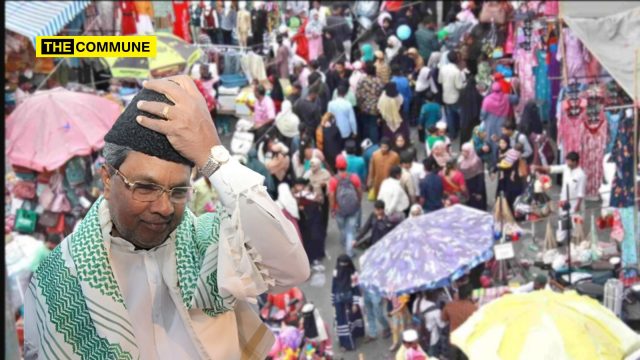
The Congress-led government in Karnataka, under Chief Minister Siddaramaiah, has approved a substantial grant of ₹398 crore for the development of Muslim-dominated areas across the state. The decision was finalized during a cabinet meeting held at the Vidhana Soudha, and has since sparked a political debate.
According to sources, the government aims to upgrade socio-economically backward neighbourhoods in 22 urban Assembly constituencies, transforming them into what it calls “model colonies.” Critics, however, allege that the move is a strategic attempt to secure minority votes ahead of upcoming elections.
This is not the first time the Siddaramaiah administration has been accused of appeasement. Earlier this year, the state government withdrew legal cases against individuals linked to the 2019 Chittapur stone-pelting incident, which targeted Hindu activists. The individuals reportedly had connections to extremist outfits.
Additionally, Chief Minister Siddaramaiah has defended the government’s decision to allocate 4% reservation for Muslims in public contracts under the Other Backward Classes (OBC) category, stating that supporting underrepresented groups is a constitutional responsibility inspired by Dr. B.R. Ambedkar’s vision.
2025 Budget Raises Eyebrows Over Targeted Benefits
The 2025 Karnataka State Budget, as analysed by political observers, appears to include several policies directly benefiting the Muslim community. These include:
- ₹500 crore allocated for launching 250 “Maulana Azad Model English Medium Schools”, modeled on Karnataka’s public school system.
- ₹400 crore set aside for upgrading 100 Urdu medium schools across the state.
- ₹150 crore earmarked for the restoration and renovation of Waqf properties.
- An additional ₹1,000 crore dedicated to the Chief Minister’s Minority Colony Development Programme, a broader plan focusing primarily on Muslim-populated areas.
- Budget provisions for building a new Hajj Bhavan and establishing a Karnataka State Open University (KSOU) campus to cater to educational needs of “deprived” Muslim students.
Further, the state has introduced social welfare schemes specific to the Muslim community:
- ₹50,000 wedding assistance for economically weaker Muslim couples.
- Monthly honorariums raised to ₹5,000 for muezzins and ₹6,000 for pesh imams.
- Funding for the construction of women’s colleges on Waqf-owned land.
- Infrastructure support for cultural and social initiatives within the Muslim community.
- 50% tuition reimbursement for Muslim students, along with an increase in the foreign education scholarship from ₹20 lakh to ₹30 lakh.
Opposition parties and critics have slammed the Congress government for what they see as blatant religious favoritism. They argue that such targeted allocations risk deepening communal divides and reflect a vote-centric approach to governance rather than an inclusive development strategy.
They further claim that while the state government promotes Urdu schools and Muslim-centric programs, it continues to foster divisions on linguistic and cultural lines such as the recent Hindi vs. Kannada debates creating inconsistencies in policy direction. The Siddaramaiah government’s recent budget and policy decisions have reignited the debate over minority appeasement in Indian politics. While the administration maintains that these efforts are aimed at uplifting marginalized communities, critics view them as a calculated electoral move designed to consolidate a specific vote bank.
(With Inputs From OpIndia)
Subscribe to our channels on Telegram, WhatsApp, and Instagram and get the best stories of the day delivered to you personally.