


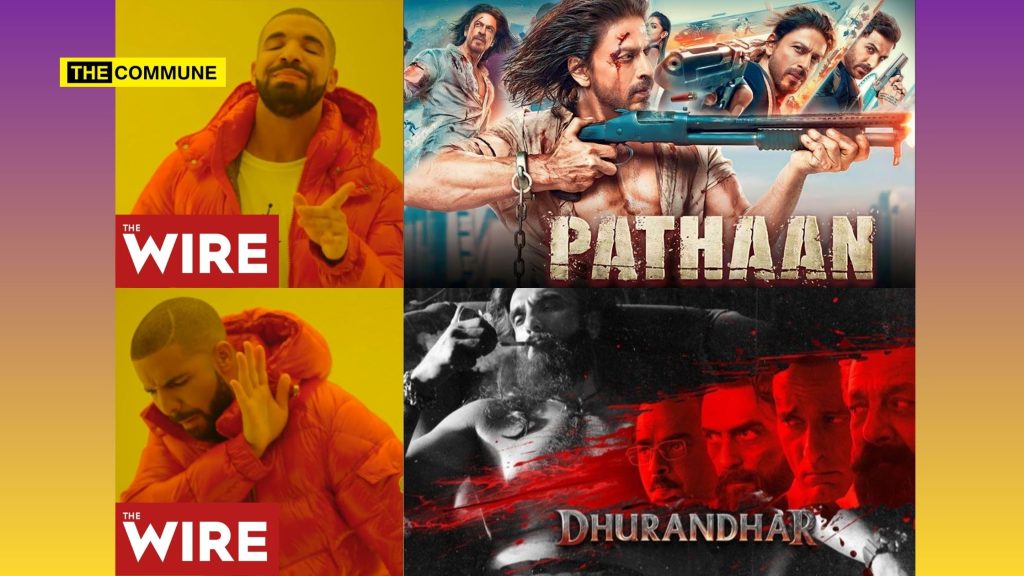
Leftist rag The Wire has crossed all levels of hypocrisy with its latest article – a review of Aditya Dhar’s Dhurandhar, that seems to have left the leftists/Congress supporters sleepless.
The entire leftist ecosystem is breaking bangles over the success and the truthful nature of Dhurandhar. The Wire, especially, has gone overboard. Let us take a look at its review of the latest release and Shah Rukh Khan starrer Pathaan, allegedly a spy-thriller.
Pathaan: When Fiction is Framed as Progressive Politics
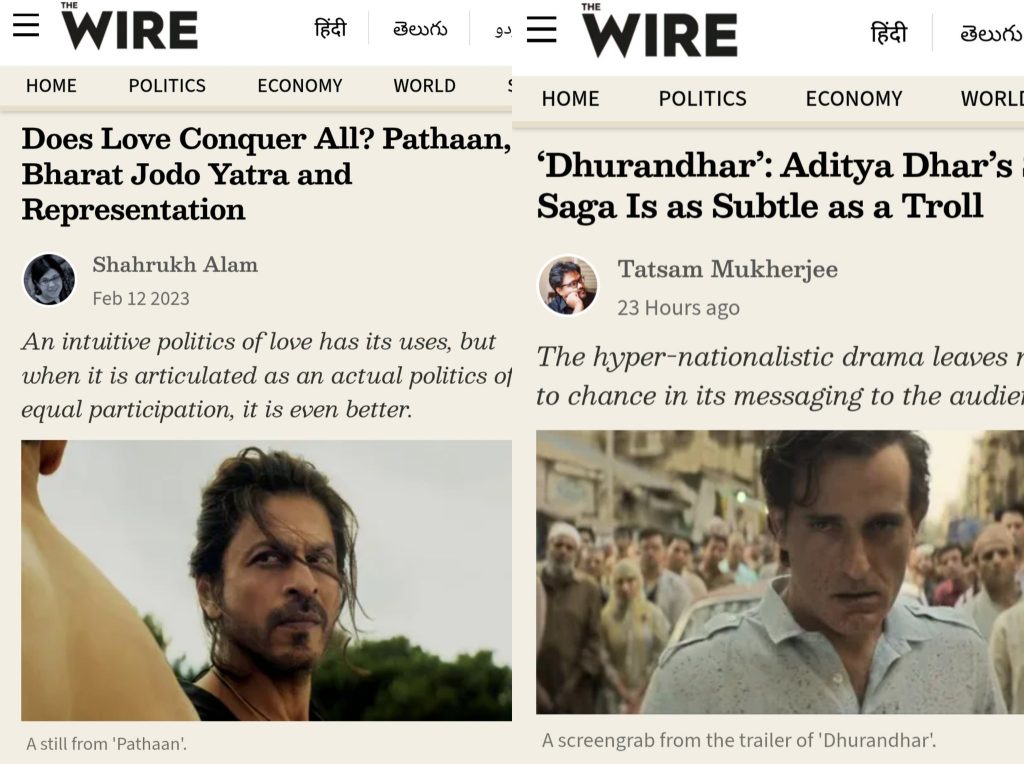
On 12 February 2023, The Wire published an article by Shahrukh Alam titled “Does Love Conquer All? Pathaan, Bharat Jodo Yatra and Representation.”
The review framed Pathaan, in which Shah Rukh Khan’s character is pointedly described as “born without a religion”, as a work of “affective politics” that promotes “love” and inclusive nationalism. Writer Shahrukh Alam connected the film’s messaging to Rahul Gandhi’s Bharat Jodo Yatra, arguing that both operate in “the realm of the affective” and quietly project “solidarity.” Critically, the review sidestepped the film’s highly fictionalized, even naïve, portrayal of cross-border espionage, instead celebrating its “clever subversion” and calling it a “plea to all good people to not withdraw from civil spaces.”
Dhurandhar: When Fact is Framed as Propaganda
Contrast this with The Wire’s treatment of the recently announced film Dhurandhar, directed by Aditya Dhar (Uri: The Surgical Strike). In a review published just soon after the film was released, author Tatsam Mukherjee dismisses the project with the headline: “‘Dhurandhar’: Aditya Dhar’s Saga Is as Subtle as a Troll.” The review accuses the film of “rage-bait,” “venom,” and “strategically spilled… selective truths.” The author takes particular issue with the film’s use of actual 26/11 attack transcripts, where terrorists and their handlers discuss killing kaafirs, calling the inclusion “insidiously crafty” and meant to “incite anger.” The review further criticizes the film for showing “Pakistani characters mock their Indian counterparts” and for depicting a “butcher aesthetic” in Karachi. While Pathaan’s romanticized ISI agent was seen as a bridge for love, Dhurandhar’s incorporation of real terrorist evidence is framed as “hyper-nationalistic” and “propaganda.”
The core difference that appears to trigger The Wire’s shift in tone is the source material. Critics ask: Why is a film that uses fictionalized romance to bridge the India-Pakistan divide praised for its “politics of love,” while a film that uses actual evidence of Pakistani state-sponsored terrorism against Indian civilians is immediately labeled a “troll” and “hyper-nationalistic”?

A Clear Editorial Double Standard
This is not merely a difference in cinematic taste. It is a revealing case of ideological gatekeeping. The Wire’s criticism pivots not on filmmaking craft but on political alignment:
When a film erases history and sells fantasy (Pathaan), it is “clever,” “subversive,” and part of a “politics of love.”
When a film engages with documented history and national trauma (Dhurandhar), it is a “troll,” “cynical,” and “mean-spirited.”
The outlet praised Pathaan for avoiding “overt progressive politics” while simultaneously expecting “good politics” from it – a contradiction in terms. Yet, Dhurandhar is condemned precisely for having a clear political perspective, one that dares to foreground Pakistani state sponsorship of terrorism rather than gloss over it with romance.
The Underlying Bias: Which Narratives Are Legitimate?
The Wire’s reviews make its editorial priorities clear: narratives that downplay Pakistani terrorism and emphasize abstract “love” are worthy of intellectualization and linkage to opposition political campaigns. Narratives that foreground the violent reality of cross-border jihad, using actual evidence, are delegitimized as jingoistic, “right-wing propaganda,” and unworthy of serious engagement beyond contempt.
For The Wire, the only “correct” representation of India-Pakistan relations is one where India’s pain is downplayed, its enemies are romanticized, and its legitimate security concerns are dismissed as bigotry. Any departure from this script is met not with critique, but with contempt. This is a betrayal of journalistic integrity in service of a political project. Any assertive, evidence-based recounting of threats to national security is dismissed not on factual grounds, but as “trolling.” For countless Indians who lived through the 26/11 attacks, the “chilling words” in Dhurandhar are not creative embellishment, they are historical fact.
Subscribe to our channels on WhatsApp, Telegram, Instagram and YouTube to get the best stories of the day delivered to you personally.