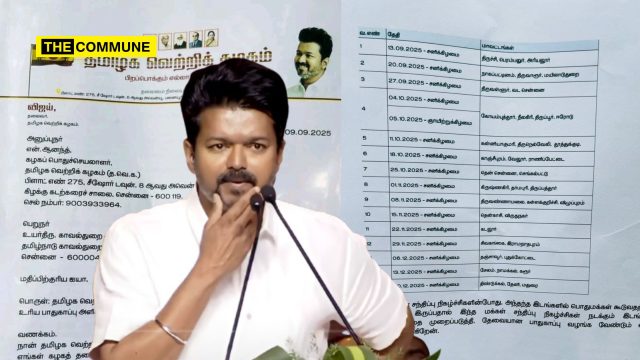
Following the conclusion of his second state-level conference, Tamilaga Vettri Kazhagam (TVK) chief and part-time politican Vijay has announced his first state-wide political tour, set to begin on 13 September 2025, in the central Tamil Nadu districts of Trichy, Perambalur, and Ariyalur. However, what has drawn widespread attention and ridicule is the nature of his schedule. Vijay’s tour is limited strictly to Saturdays, a decision that has sparked significant criticism across media and political circles.
Many question how such large districts could be meaningfully covered in a single day, and the consensus is growing that Vijay appears to be engaging in politics only as a weekend hobby. This has led to the label of “weekend politician” being attached to him, suggesting a lack of seriousness and full-time commitment to public life.
TVK’s general secretary, N. Anand, has formally written to the Director-General of Police, requesting security for the tour, which is expected to conclude on 20 December. The announcement comes just a week after TVK’s second major state conference in Madurai on 21 August, which attracted a sizable crowd.
At the event, Vijay sought to position TVK as a credible alternative to the ruling DMK. However, the conference itself, which ran from 3:30 p.m. to 7:30 p.m., raised eyebrows for its brevity. Vijay’s own speech lasted a mere 35 minutes and notably avoided addressing pressing state issues such as law and order, governance failures, or current political developments.
The tour itinerary, once made public, quickly went viral on social media not for its ambition, but for its glaring limitations. Vijay plans to visit different regions exclusively on Saturdays, often targeting multiple districts on the same day. These visits are expected to involve brief public interactions, some reportedly lasting only 15 minutes and scheduled after sunset. This minimalist approach has been widely mocked online, with critics describing it as an insultingly shallow effort from someone who aspires to lead the state. Many have gone so far as to liken his weekly public appearances to religious darshans, accusing Vijay of assuming a god-like stature where the mere act of showing up is seen as doing the people a favor.
The tour itinerary, now viral online, outlines visits to several districts exclusively on Saturdays:
- Sep 13: Trichy, Perambalur, Ariyalur
- Sep 20: Nagapattinam, Tiruvarur, Mayiladuthurai
- Sep 27: Tiruvallur, North Chennai
- Oct 4–5: Coimbatore, Nilgiris, Tiruppur, Erode
- Oct 11: Kanniyakumari, Tirunelveli, Thoothukudi
- Oct 18: Kancheepuram, Vellore, Ranipet
- Oct 25: South Chennai, Chengalpattu
- Nov 1: Krishnagiri, Dharmapuri, Tirupattur
- Nov 8: Tiruvannamalai, Kallakurichi, Villupuram
- Nov 15: Tenkasi, Virudhunagar
- Nov 22: Cuddalore
- Nov 29: Sivaganga, Ramanathapuram
- Dec 6: Thanjavur, Pudukottai
- Dec 13: Salem, Namakkal, Karur
- Dec 20: Likely to conclude in Dindigul, Theni, Madurai
விஜய்யின் சுற்றுப்பயண விவரம் வெளியீடு! செப்.13ம் தேதி திருச்சியில் தொடரும் சுற்றுப்பயணம் டிச.20 வரை நடைபெறும்! #TVKVijay #TNPolitics #TVK #PoliticsToday #Oneindia #OneindiaTamil pic.twitter.com/qXIro3xlZr
— Oneindia Tamil (@thatsTamil) September 9, 2025
Political commentators have drawn sharp contrasts between Vijay’s campaign strategy and the rigorous, hands-on styles of veteran politicians. Former Chief Minister Edappadi K. Palaniswami, for instance, managed to campaign across 74 constituencies in just 30 days, despite being in his seventies. Prime Minister Narendra Modi is also frequently cited, having spoken at over 226 public rallies in a single election cycle, along with more than 100 padayatras. Historical leaders like NTR, MGR, Annadurai, and Kamarajar are remembered for their relentless dedication to grassroots campaigning and their deep connections with the people. By comparison, Vijay’s efforts are seen as superficial and celebrity-driven, lacking the authenticity and hard work expected from someone entering public service.
The underlying criticism is not merely about the number of meetings or their duration but about what this approach reveals about Vijay’s mindset. Critics argue that he is trying to translate his film stardom into political capital without undergoing the rigors of political life. They claim he is relying on visibility and fan loyalty rather than addressing real issues, building trust, or presenting policies. His refusal to campaign on Sundays or engage for more than a few minutes a week is viewed as a sign of elitism, arrogance, and complete disconnect from democratic values. Some even suggest that this signals a belief that the Tamil electorate is naive enough to vote simply because of his celebrity presence an attitude considered both disrespectful and dangerously out of touch.
Adding to these concerns is the lack of substance in his public speeches. Observers point out that Vijay has so far failed to address any local or regional issues in his appearances. Unlike seasoned politicians who immerse themselves in the unique challenges of each constituency, he appears to be on a promotional tour, reminiscent of his movie marketing campaigns. This has led to the accusation that he is treating politics as an extension of his film career rather than a platform for public service. His schedule, spanning four months but featuring only 14 public meetings and no concrete engagement with the grassroots, reinforces the view that he is ill-prepared for the responsibilities of political leadership.
The comparison with historical political figures further underscores the point. Leaders like Annadurai and Kamarajar built their reputations through sheer hard work, traversing towns and villages, organizing public meetings, and speaking directly to people’s concerns. Even film-based leaders like MGR and NTR transitioned into politics only after committing themselves fully to campaigning, often attending multiple events a day and engaging extensively with the public. Vijay’s limited and passive approach, by contrast, seems to lack any of the urgency or vision associated with such predecessors.
In conclusion, critics argue that Vijay is not a genuine political leader, but a celebrity attempting to mimic political involvement without understanding its responsibilities. His brief weekly appearances, minimalist tour schedule, and failure to address real issues suggest a disinterest in governance and public engagement. For many, Vijay’s political entry appears more like a vanity project than a serious movement, and his reliance on stardom rather than substance is viewed as both disrespectful to the people and harmful to democratic values. As one observer aptly put it, Vijay is not leading a political revolution he is simply stepping onto another stage, expecting applause.
Subscribe to our channels on Telegram, WhatsApp, and Instagram and get the best stories of the day delivered to you personally.