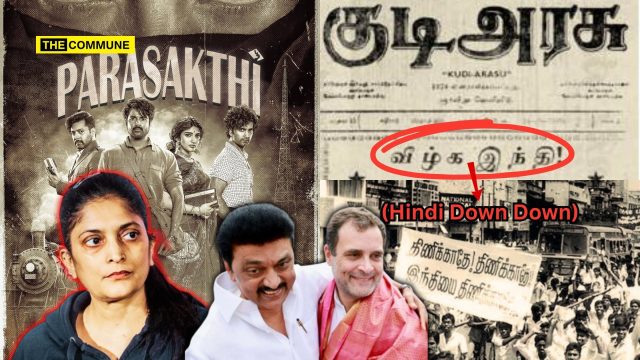
The release of the trailer of Parasakthi, directed by Sudha Kongara and headlined by Sivakarthikeyan, has ignited fresh political debate well ahead of the 2026 Tamil Nadu Assembly elections. Set against the backdrop of the 1965 anti-Hindi agitations, the film appears to directly foreground the history of Hindi imposition under Congress rule – a subject that has long been selectively framed in Tamil Nadu’s political discourse.
The film, slated for a Pongal 2026 release, is produced by Inban Udhayanidhi, the grandson of MK Stalin, and is being promoted through DMK-aligned channels, including Red Giant Movies.
Trailer Signals Direct Confrontation With Congress-Era Language Policy
The trailer opens with Sivakarthikeyan’s character mocking linguistic hypocrisy — joking that when Tamils go to Delhi, they are expected to speak Hindi, but when Hindi speakers come to Madras, they do not extend the same courtesy to Tamil. The narrative escalates with the passage of a law declaring Hindi as the principal language of the Union, triggering protests, street violence, and ideological conflict.
Set firmly in the 1960s, the film unmistakably points to the historical reality that the push to impose Hindi as a unifying national language originated under Congress leadership, not the BJP – a fact often blurred or omitted in contemporary Dravidian political messaging.
The Origins Of Hindi Imposition
Historical records show that Mahatma Gandhi himself initiated organised Hindi propagation in the South by founding the Dakshina Bharat Hindi Prachar Sabha in Madras in 1918, serving as its founding president. Gandhi personally promoted Hindi in the Madras Presidency, sending his son Devdas as the first pracharak, conducting early classes at Gokhale Hall in George Town, and making repeated visits to push Hindi as part of Congress’s national integration project.
This ideological push was later institutionalised by Jawaharlal Nehru and constitutionally embedded in Article 343(1) of the Indian Constitution in 1949, which envisaged Hindi becoming the sole official language of the Union after a 15-year transition period ending in 1965. As that deadline approached, the Congress government under Lal Bahadur Shastri prepared to operationalise Hindi as the primary Union language, triggering unprecedented unrest in Madras State.
1965 Agitations Forced Congress Retreat
While the Bengali Language Movement of 1952 and the eventual 1971 Bangladesh Liberation War served as international warnings against enforced language policy, contemporary accounts of 1965 make it clear that it was the scale and intensity of the anti-Hindi agitations in Tamil Nadu marked by statewide shutdowns, riots, arson, and suicides that forced New Delhi to retreat.
Prime Minister Shastri was compelled to publicly assure the continued use of English alongside Hindi, effectively abandoning Congress’s long-standing plan for linguistic centralisation. Notably, these protests were directed against Congress rule at the Centre, at a time when the BJP did not exist in its present form.
An Inconvenient History For The DMK–Congress
Against this backdrop, Parasakthi raises an uncomfortable political question. While the film’s historical setting and trailer appear to critique Congress-era Hindi imposition, it is being aggressively promoted by DMK-aligned entities at a time when the DMK and Congress are electoral allies.
With Rahul Gandhi positioned as a central figure in opposition politics, the optics of a DMK-backed film revisiting the role of Indira Gandhi-era Congress policies in provoking Tamil Nadu’s greatest linguistic uprising are hard to ignore.
Cinema, Politics, And The 2026 Assembly Elections
The central question now is whether Parasakthi will faithfully present the historical record, placing responsibility for Hindi imposition squarely on Congress, or whether the narrative will be repackaged to align with contemporary political messaging that shifts blame onto the BJP.
As Tamil Nadu heads towards the 2026 elections, the trailer alone has already reopened debates long buried under alliance politics: who imposed Hindi, who resisted it, and how history has been selectively retold.
Whether Parasakthi unsettles the DMK–Congress alliance by confronting inconvenient truths, or ultimately reinforces a curated narrative, will only be known when the film releases.
Subscribe to our channels on WhatsApp, Telegram, Instagram and YouTube to get the best stories of the day delivered to you personally.