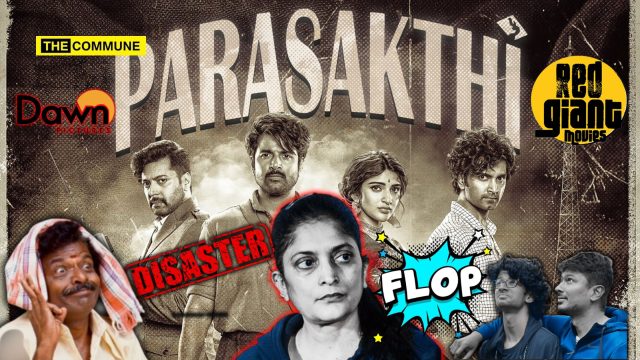
Dravidianist filmmaker Sudha Kongara’s bloated, agenda-soaked period drama promptly crashes like a big piece of donkey’s dump—splattering everywhere with the stench of failure that no one can ignore.
Let’s be honest—Parasakthi was never meant to be a film. It was engineered propaganda, assembled with all the subtlety of a party pamphlet.
From day one, the film was engineered as naked pro-DMK propaganda: timed for Pongal 2026 (conveniently ahead of assembly polls), produced by Dawn Pictures (tied to DMK ecosystem) and distributed by Red Giant Movies which is run by DMK scion Udhayanidhi Stalin’s son Inban Udhayanidhi.
And the subject? A carefully curated, sanctified retelling of the 1965 anti-Hindi agitations, scrubbed clean of complexity and rewritten as pure Dravidianist propaganda film which ends up showing Congress in bad light instead of BJP.
Though the film is based on “real-life events”, the fictional part is as cliche and boring it can get.
Sivakarthikeyan plays Chezhiyan “Che” (a blatant, heavy-handed homage to Che Guevara, because why not slap revolutionary iconography on a Tamil protagonist for extra virtue points?). He starts as an ordinary, peaceful guy (railway loco pilot or similar, minding his own business, even learning Hindi).
His younger brother Chinnadurai (Atharvaa, homage to Annadurai – because nothing says “subtle” like naming characters after political legends) is the fiery rebel diving headfirst into protests and social causes. Sivakarthikeyan initially dislikes the activism, wants no part of it. Enter the ruthless antagonist Thirunaadan (Ravi Mohan), a Delhi-sent intelligence officer/police brute who unleashes hell, leading to the brother’s tragic death in the agitation.
Cue the predictable transformation: the reluctant brother avenges the loss, stands up for the cause, becomes the hero of the movement, and delivers the triumphant message. It’s the classic reluctant-hero arc: peaceful man → family tragedy → righteous awakening → revenge/protest climax. We’ve seen this template in a dozen films – brother dies fighting injustice, sibling takes up the mantle, fights the system. Add the period setting, anti-imposition theme, forced romance (with Sreeleela as the token love interest/newsreader), and endless monologues, and you’ve got a paint-by-numbers propaganda piece masquerading as historical drama. No fresh twists, no depth – just recycled clichés dressed in 1960s costumes.
The love track is forced and cringy, zero chemistry, dragging like a bad college romance in a protest film. Period visuals look okay initially, but then it’s just repetitive slow scenes, lecture-heavy dialogues, and no grip.
Post-interval, the film is on a complete freefall. The plot stretches like stale chewing gum, and every supposed “emotional beat” is telegraphed from miles away. Atharvaa’s death? So predictable even a child could call it ten minutes earlier. The protest sequences are hollow – just loud speeches, raised fists, and thunderous background score trying desperately to manufacture emotion where none exists.
The only saving grace for the film is the acting of Sivakarthikeyan and Ravi Mohan.
If you are an agmark Oopi craving to simp for anti-Hindi rhetoric, save your money and listen to old Karunanidhi speeches on YouTube. At least that won’t cost you a ticket.
Sudha Kongara uses the same playbook as her earlier works: twist facts for ideological convenience, preach endlessly, and hope the message overrides the mess.
The film whitewashes the role of EV Ramasamy Naicker (hailed as ‘Periyar’ by his followers) who opposed the 1965 anti-Hindi agitations and insulted the protesting students as “hooligans”. Congress figures are converted into cartoon villains, while DMK icons are framed as flawless saviors.
This is Sudha Kongara’s trademark fraud. She has done it before. In Soorarai Pottru, she airbrushed Captain Gopinath’s Brahmin roots and magically reinvented him as a EVR-admiring crusader, who fights a north-Indian airline owner and the government system controlled by the powers at be in Delhi. Her separatist streak is visible in Parasakthi too, as Sudha Kongara plays to the DMK’s gallery of projecting ‘Tamil Nadu Vs Delhi’ politics.
This isn’t cinema—it’s regurgitated Dravidianist vomit prioritizing politics over originality or entertainment.
Theatres are already reporting empty screens, dull shows, and dead silence where applause was expected. Social media is flooded with viewers trashing the film, mocking its boredom, and openly abusing it – and frankly, it has earned every bit of that backlash.
While Telugu and Kannada industries are producing films like Kantara, Pushpa, and RRR—stories that travel globally on the strength of content – Dravidianwood remains stuck in in a cesspool crying Hindi imposition, oppression, suppression, depression.
Avoid this unoriginal flop. Sudha Kongara’s career low—lazy, clichéd, agenda-driver, cynical, preachy, boring mess.
The film’s hook line is “Thee Paravattum”.
But it is only Dravidianist stench that is spreading through this “P** padon”.
Vallavaraayan is a political writer.
Subscribe to our channels on Telegram, WhatsApp, and Instagram and get the best stories of the day delivered to you personally.