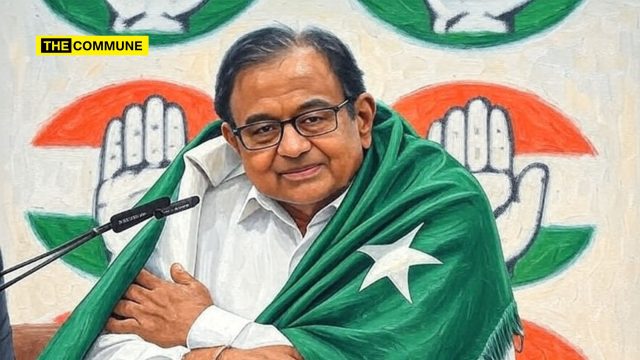
In a nation that has endured countless terror attacks originating from across the border, more so during the Congress regime, statements that undercut the country’s counterterror operations embolden the country’s adversaries. One such voice that repeatedly raises concerns is that of former Union Home Minister and senior Congress leader P Chidambaram. His recent comments giving clean chit to Pakistan for the Pahalgam massacre seem make one wonder if he is merely being contrarian, or if there is a dangerous pattern in his rhetoric.
Pahalgam Attack and Operation Mahadev: What Union HM Amit Shah Revealed
On 29 July 2025, Union Home Minister Amit Shah made a striking statement in Parliament detailing the events behind Operation Mahadev, launched in response to the Pahalgam terror attack of April 22, which saw the brutal killing of 26 Hindu pilgrims.
Shah revealed that the operation to neutralize the perpetrators began in May 2025, long before any public announcement. Three terrorists were eliminated after being tracked via electronic and human intelligence, including satellite phone signals. Forensic analysis confirmed that weapons used in the attack were recovered from the neutralized terrorists, including an M9 rifle, a carbine, and an AK-47. Voter ID cards issued in Pakistan were recovered from the slain terrorists, establishing their Pakistani identity beyond doubt. The Union Home Minister emphasized that no escape route to Pakistan or Nepal was left open for the attackers. Over 105 people were interrogated for 3000 hours, and electronic surveillance confirmed their movement and location.
This data-backed statement laid to rest any ambiguity regarding the Pakistani origin of the attackers. It is noteworthy that India tracked down and eliminated the mastermind and the perpetrators of the terror attack within just 97 days! Remember it took the US, 18 months to track down the mastermind behind the 9/11 attack and about a decade to eliminate Osama bin Laden.
Chidambaram’s Contrarian Comments: “Could Be Homegrown”
Yet, in an interview to The Quint, a portal known for its left-liberal leanings, Chidambaram questioned the government and NIA, asking, “Have they identified the terrorists or where they came from? For all we know, they could be homegrown terrorists. Why do you assume they came from Pakistan? There is no evidence of that.”
He did not even take into consideration the statement of the The Resistance Front (TRF), a proxy of Pakistan-based Lashkar-e-Taiba, which claimed responsibility for the Pahalgam massacre. Indian intelligence had already traced weapons and satellite communication to Pakistan-based handlers.
Chidambaram’s Pattern Of Excusing Pakistan, Undermining India
This isn’t the first time Chidambaram has sided with narratives that downplay or outright dismiss Pakistan’s role in terrorism.
26/11 Mumbai Attacks and the “Saffron Terror” Narrative
While the nation mourned the 2008 Mumbai attacks, orchestrated by Pakistani terrorists, Chidambaram, then Home Minister, coined the term “saffron terror”, warning of “Hindu terrorism.” This false equivalence not only diverted focus from jihadi terror but also laid the groundwork for the targeting of Indian Army officer Lt. Col. Purohit, who was later cleared of terrorism charges in the Malegaon blast case.
De La Rue Scam: Currency Contract to Pakistan-Linked Firm
As Finance Minister, Chidambaram awarded a currency printing contract to De La Rue, a British company that was also printing currency for Pakistan. Intelligence reports later confirmed that Pakistan’s ISI used De La Rue’s paper to flood India with counterfeit notes, fuelling terror financing. Shockingly, after being blacklisted under Pranab Mukherjee, De La Rue was reinstated in 2012 under Chidambaram’s watch.
Statements Favoring Pakistan Engagement
Despite Pakistan’s support for cross-border terror, Chidambaram has persistently argued for continued dialogue with Pakistan:
In December 2016, during a public discussion, Chidambaram insisted that India should not walk away from diplomacy even in the face of provocations. “You have to continue to engage with Pakistan,” he said, adding that eventually, India must find a way to coexist peacefully. His remarks were perceived by many as dangerously naïve and misaligned with ground realities, particularly in light of Pakistan’s repeated ceasefire violations and terror infiltration.
In February 2017, Chidambaram asserted that India must continuously engage with Pakistan, stating, “We are neighbours… we will be neighbours for hundreds of years.” He cautioned against flip-flop foreign policy and argued that dialogue was the only sustainable solution. This statement came at a time of heightened tensions effectively downplaying Pakistan’s continued support for terrorism.
In April 2019, while speaking at an Observer Research Foundation (ORF) symposium, Chidambaram stated that India must “change its behaviour toward Pakistan” in order to bring about a change in Islamabad’s conduct. He emphasized that “war is not an option” and advocated for a more harmonious relationship.
Even as recently as May 2025, during a controversy over an India-Pakistan ceasefire agreement, Chidambaram questioned whether India’s decision was influenced by external pressure, particularly from the United States. He asked whether India’s foreign policy was being dictated from Washington, a remark that was seen as undermining India’s strategic autonomy and feeding into the narrative promoted by Pakistan and its allies.
These views are dangerously naive at best or strategically aligned with Pakistan’s narrative at worst.
Supporting Insurgency in Manipur
Chidambaram’s recent tweet during the Manipur crisis called for removing the elected CM, blaming CM Biren Singh for the crisis instead of condemning Kuki militants., and proposed autonomy for ethnic groups, even hinting at a breakup of the state. He brought Myanmar-based insurgent Thanglianpau Guite into Manipur under the Suspension of Operations (SoO) pact.
His post where he talks about “Meitei, Kuki-Zo, and Naga can live together only with regional autonomy” echoes separatist demands.
Looking back, it was P Chidambaram who brought in a Myanmar national like Thanglianpau Guite into Manipur, India, and made him an important part of the SoO agreement.
In one of his tweets, he suggested that a solution lies in breaking up a state like Manipur, a state with a… pic.twitter.com/iiJpcs6DbF
— N. Biren Singh (@NBirenSingh) July 29, 2025
The question that arises from this long pattern of suspicious decisions, soft stances on Pakistan, and consistent undercutting of Indian intelligence agencies is whether Chidambaram merely a misguided contrarian, or has he functioned in a manner that objectively aligns with ISI’s goals of destabilizing India? Given his age and experience, he surely is not misguided but seems to be the latter.
While opposition is essential in a democracy, opposition to truth, security, and national integrity is not. Chidambaram’s long trail of decisions, statements, and policy choices demands scrutiny not just in the media but in Parliament and the judiciary. India’s enemies are not just across the border; they often find enablers within the system.
Subscribe to our channels on Telegram, WhatsApp, and Instagram and get the best stories of the day delivered to you personally.