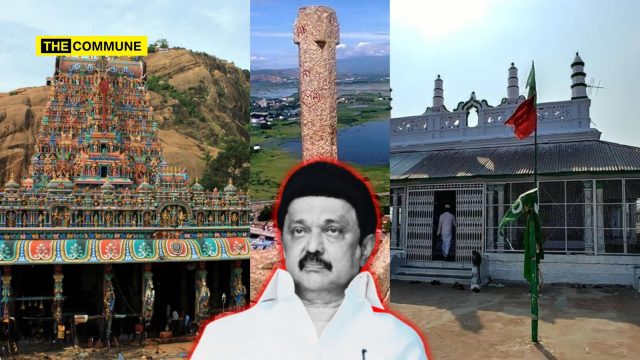
Opposing the appeals filed by the DMK-led Tamil Nadu government, Madurai district authorities and the Dargah management against a single judge’s order directing the lighting of a lamp at the stone pillar (Deepathoon) on the Thirupparankundram hills, devotees urged the Madras High Court on Wednesday (17 December 2025) not to relegate them back to the authorities, contending that the authorities had shown “undisguised scorn and contempt” towards their faith.
The devotees submitted that the State was attempting to placate one set of rights instead of acting in a secular and neutral manner. They argued that if the matter were relegated to the authorities, their religious rights would not be safe in the hands of officials.
A Division Bench comprising Justice G Jayachandran and Justice KK Ramakrishnan was hearing a batch of appeals, including those filed by the Dargah management, challenging the single judge’s order directing temple authorities to light the lamp at the stone pillar. For context, the single judge had held that the Deepathoon was not located on land belonging to the Muslim community and that lighting the lamp would not infringe upon their rights.
The State authorities, including the Hindu Religious and Charitable Endowments (HR&CE) Department, had also filed an appeal challenging the single judge’s order passed on December 4 in a contempt plea, by which the judge had quashed a prohibitory order issued under Section 144 of the Criminal Procedure Code. Another set of appeals was filed challenging the single judge’s December 9 order in the contempt proceedings directing the appearance of the Chief Secretary, the Additional Director General of Police, the Deputy Commissioner of Police, and impleading the Union Home Secretary.
“State Needs To Be Secular And Protect My Rights”
During the hearing, Senior Advocate S Sriram, appearing for respondent Paramasivam, submitted that the appellants’ contention that there was never a practice of lighting the lamp anywhere other than the Uchi Pillaiyar temple was aimed at “placating one set of rights and in pursuance of a clear policy of subjugation of another”.
“State keeps surrendering, reiterating to maintain status quo. Protect yourself. Live for another day. Don’t assert your right. This is the stand of the State who is the guardian, who needs to be secular and fiercely neutral to protect my rights under Article 25,” he said.
The court orally observed that the writ petitioners had not availed of alternative remedies before approaching the court and were now alleging that the State had a closed mind, adding that the State was open to providing an alternate remedy.
Responding to this, Sriram said that the temple’s Executive Officer and the Temple Board, which had chosen to be spectators earlier, were now asking the devotees to come back to them. “It’s like I’ve been wounded by same person and remedy can also be given by same person,” he added.
“Department Speaking In Multiple Voices”
Sriram submitted that the counsel appearing for the temple and the authorities had taken shifting stands. He said they initially argued that there was no evidence to show the structure was a Deepathoon, then described it as a granite pillar, later as an ASI structure, thereafter as a Jain structure, and finally, the Waqf Board claimed it belonged to them.
He argued that these inconsistent positions lacked bona fides and were aimed at creating a right where none existed.
“This is not a case of State resisting plea of respondents. It’s the State in solidarity with the contesting respondents and the department speaking in multiple voices creating a claim. Don’t send me to the (HR&CE) Commissioner who has undisguised scorn and contempt towards my faith. I don’t think my rights are safe at the hands of the authorities,” he said.
Right To Worship Also Falls Under Article 19
Sriram further argued that the right to worship should not be confined only to Article 25 but was also an aspect of the right to expression under Article 19. Referring to Justice J Chelameswar’s opinion in the 2017 KS Puttaswamy judgment, he said the plea of public order raised by the district administration was neither raised nor substantiated before the single judge.
“Plea of public order is not a bogey or an alibi or a gate-pass to avoid scrutiny,” he said, adding that the test laid down in Shreya Singhal required the State to meet a higher threshold.
He submitted that the State could not equate itself with a citizen and that merely invoking public order without detailed pleadings could not defeat an inalienable fundamental right.
“Lighting Lamp Is An Essential Practice”
Sriram asserted that lighting the lamp was an “essential practice of Hindu religion” and criticised the State for simultaneously arguing that the right did not fall under Article 25 while also claiming it threatened public order.
At this stage, the court orally remarked, “How are they interfering by saying don’t light lamp? Argument of public order is also exaggerated. But your argument also…”
Sriram responded that in writ proceedings, when both parties were aware of the substance of the dispute, deficiencies in pleadings could not be used as an excuse. He said his client had clearly sought permission to light the lamp at the pillar atop the hill, which he described as an ideal location based on earlier judgments.
“State’s Mind Is Closed And Tilted”
Sriram said there was no point in directing the devotees back to the authorities. “The mind of authorities is so closed and tilted to the other side, towards subjugation of this right and enforcement of a non-existent right in behalf of contesting party that I find it unviable to go to that closed mind,” he said.
He differentiated between the objectives of Moksha Deepam and Karthigai Deepam, stating that the latter was about enjoyment of a religious right and divine grace.
He further submitted that the single judge had not created a new practice but had merely enforced liberties recognised in earlier judgments, including a 1920 decree. Referring to attempts to light the lamp in 1862 and 1912, he said limiting custom to a 100-year window reflected a “closed mind”.
He described the single judge’s order as a “textbook case of exercise of powers of judicial review”.
Allegations Of Changing Religious Character
Sriram accused the State of attempting to complicate the issue and then offering mediation. He referred to Wakf Board arguments about apprehensions of encroachment and alleged attempts to change the religious nature of the hill, contrary to the Places of Worship Act.
He cited Section 3D of the Waqf (Amendment) Act, 2025, and provisions of the Ancient Monuments and Archaeological Sites and Remains Rules, 1959, arguing that Wakf could not be a party if the area was a protected monument.
On mediation, Sriram said: “Them wounding and then asking us to come back and discuss is toxic mental cruelty. It’s a strategy.”
Lighting Deepam Will Foster Peace
Senior Advocate Valliappan, appearing for another devotee Rama Ravikumar, submitted that lighting the Karthigai Deepam was an essential religious practice. He said it served multiple purposes, including visibility for the entire village and historical necessity before electricity.
“A mountain can have multiple peaks… For some reasons, the temple lost its highest peak. Therefore, next lower peak is selected,” he said.
Valliappan argued that no material had been produced to show the structure was not a Deepathoon and that lighting the lamp would foster peace. “Just one day you permit 10 persons to go & light… It will foster peace. Won’t harm anyone,” he said.
He added that the Dargah could not claim exclusive rights over the hilltop when it was using temple-owned steps.
Maintainability And Mediation
On maintainability, Valliappan cited Supreme Court rulings that availability of alternative remedies did not bar High Court jurisdiction. On mediation, he said it should not be at the mercy of any party.
The court observed inconsistencies in the arguments regarding individual versus public relief. Advocate General PS Raman remarked that it appeared the prayer was for the “entire world,” a view the court said it also shared.
The Bench declined to enter Wakf Board mediation issues at this stage, noting objections to the Board’s locus.
The matter has been listed for Thursday, 18 December 2025, when the Advocate General is expected to make rejoinder submissions.
Source: LiveLaw
Subscribe to our channels on WhatsApp, Telegram, Instagram and YouTube to get the best stories of the day delivered to you personally.