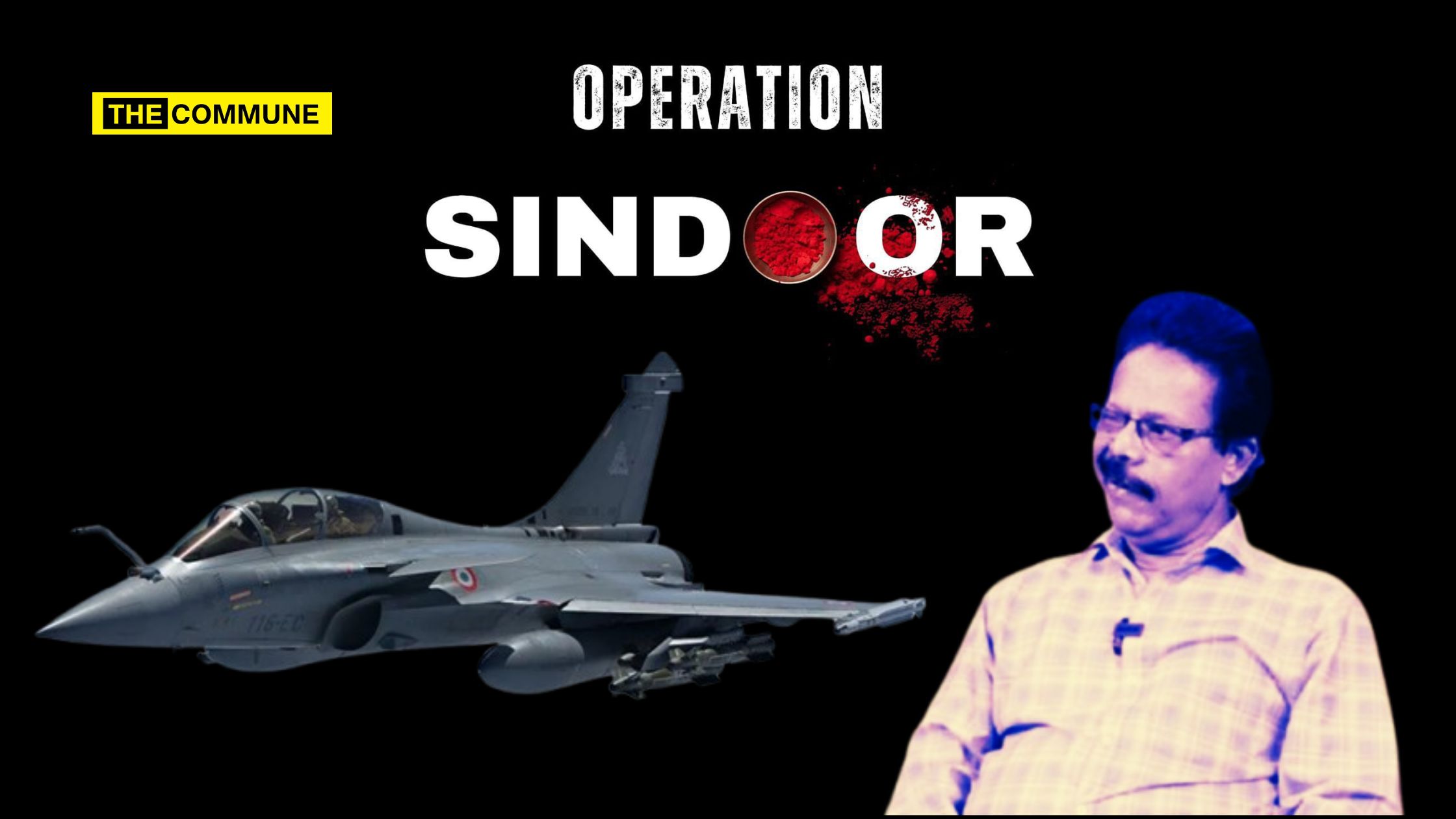
In an irresponsible and factually baseless post, DMK-supporting “journalist” Damodharan Prakash who is associated with ‘Nakkheeran’, took to his social media handle to declare Operation Sindoor, a “failure”—a claim that not only contradicts official reports and strategic assessments but dangerously echoes Pakistani disinformation narratives.
He wrote, “Will someone declare to the enemy that they are coming to fight and then go to war? When Indian aircraft went to Pakistan, Pakistani aircraft were ready in the sky to counter it. Indian Army Chief Anil Chauhan says that India lost its fighter jets because Pakistan shot them down. Three of the French Rafale aircraft, which were bought for Rs 2800 crores, were shot down by Pakistan’s C10 aircraft bought from China, saying that no one can win the war. Five of India’s strongest aircraft, a MiG and a Russian Sukhoi, were destroyed. Their total value is Rs 15,000 crores. After that counterattack, Indian aircraft were afraid to fly. There is no information about the pilots of those aircraft. The victory of a war is the victory in the air war. India has never lost to Pakistan in the air war. Operation Sindoor is a huge failure! India has lost Rs 15,000 crores in an hour to kill 100 terrorists! Disgraceful”
யாராவது எதிரி நாட்டுக்கு நான் சண்டைக்கு வருகிறேன் என அறிவித்துவிட்டு போருக்கு செல்வார்களா? இந்திய விமானங்கள் பாகிஸ்தான் சென்ற போது அதை எதிர்க்க பாக் விமானங்கள் வானில் தயாராக இருந்தன.பாகிஸ் தான் சுட்டதில் இந்தியா ஜெட்போர் விமானங்களை இழந்த்து என்கிறார் இந்திய இராணுவ தலைவர் அனில்… pic.twitter.com/kJ9k4SsLIF
— Damodharan Prakash (@sathrak1967) June 2, 2025
His claim echoing Pakistan about the three Rafale jets were “shot down, along with two other Indian Air Force aircrafts”, and that there was no information on the pilots.
This statement is not just misleading—it’s an outright fabrication. There is no evidence, from either Indian or neutral international sources, of such losses. In fact, what Operation Sindoor has clearly demonstrated is India’s overwhelming tactical superiority and operational precision.
What CDS Said?
Speaking to various news agencies at the Shangri La Dialogue in Singapore, Chief of Defence Staff, Anil Chauhan said, “There were losses but the numbers and that’s not important. What was important is why did these losses occur and what did we do after that. So, we rectified tactics and then went back on 7th, 8th, and 10th and in large numbers to hit air bases deep inside Pakistan. We penetrated all their air defences with impunity, carried out precision strikes. They rectified their tactics and flew in again and flew all types of aircraft with all type of ordinances on 10th. Now that satellite imageries for all the strikes are available not only through Indian media but from global sources and you would have seen that most of the strikes were delivered with pinpoint accuracy some even to a metre.”
What Military Briefing Told Us?
In May 2024, in a special briefing on Operation Sindoor, Air Marshal AK Bharti confirmed that the Indian Air Force (IAF) successfully downed Pakistani jets and drones while preventing enemy aircraft from entering Indian airspace. “Their planes were prevented from entering our border. We have downed a few planes. There are losses on their side that we have inflicted,” he stated.
The Air Marshal emphasized that the IAF achieved its mission to eliminate terrorist camps: “Have we achieved our objectives of decimating the terrorist camps? And the answer is a thumping Yes, and the results are for the whole world to see.”
“All our pilots are safe and back home,” he affirmed, adding, “We are in a combat scenario, and losses are part of combat. However, we have achieved all our objectives.”
Strikes targeted Pakistani military bases in Chaklala, Rafiq, Rahim Yar Khan, Sargodha, Bhulari, and Jacobabad, signaling India’s military reach. Bharti said, “It was only a measured response to instill good wisdom to our adversary… avoiding civilians and collateral damage.”
Pakistan had launched Operation Bunyanun Marsoos, deploying 300–400 drones to target 36 Indian sites, including religious and military locations.
Let’s Set The Record Straight: India Had The Upper Hand
Atleast 2 weeks following the deadly Pahalgam terror attack, India launched Operation Sindoor. India’s pre-emptive strike on terrorist launchpads across the Line of Control was swift, effective, and completely caught the enemy off guard, despite claims otherwise.
In retaliation to Pakistan’s aerial incursions using kamikaze drones, India’s indigenous air defence systems—most notably the Akash and other DRDO-developed platforms—successfully intercepted and neutralized every incoming threat, ensuring that not a single drone or missile breached Indian airspace.
Pakistan relied heavily on Chinese-supplied HQ-9 air defence systems, often likened to Russia’s S-300. Confidence in this system proved misplaced when Indian Rudram missiles, specially designed to destroy enemy radar, effectively blinded the HQ-9. Additionally, Pakistan deployed LY-90 short-range air defence systems, which proved ineffective in actual combat. In terms of aerial assets, China’s Wing Loong drones (possibly CH-9 variants), which were said to be on par with American Predator drones, failed to penetrate beyond 10 km into Indian airspace. Turkey’s much-touted TB2 Bayraktar drones fared no better; one was shot down and reportedly landed in pieces on a clothesline in Rajasthan. Pakistan also used old F-6 fighter aircraft, stationed at the Quetta airbase to avoid India’s S-400 range, but these too were destroyed while still on the ground.
India’s Response
India’s military response was multi-pronged and technologically advanced. The initial wave saw atleast 85 aircrafts, including Rafales and Sukhois, take to the skies in a coordinated strike. Precision-guided munitions were used to eliminate terrorist strongholds, most notably at Markaz Subhanallah, where over 100 terrorists were killed along with Masood Azhar’s family members. Satellite imagery confirmed the precision of the strikes. Key Pakistani military bases like Chaklala, Rafiq, Rahim Yar Khan, Sargodha, Bholari, and Jacobabad were also struck.
While India’s S-400 missile system (described as “Sudarshana Chakra”) was reserved for higher-priority threats, it was used on the final day to intercept aircrafts with its radar capable of detecting even fifth-generation jets up to 400 km away. Indigenous defence systems played a pivotal role. The Akash Air Defence System, entirely made in India, emerged as the “Hero of Operation Sindoor,” successfully intercepting aerial threats up to 30 km away with near-perfect accuracy.
Another standout was the upgraded L70 gun, a legacy Swedish artillery piece modernized with Indian innovations. These included DownBlink Imaging for day/night tracking and servo systems from Coimbatore. This retrofitted system achieved 100% success in downing both Chinese and Turkish drones, including the TB2 Bayraktar and Wing Loong. Its cost-effectiveness—at under ₹2,000 per round—was remarkable. Other effective systems included the Barak 8 missile system, co-developed with Israel, and the Prithvi Air Defence System, both made in India. The Rudram missile, specifically designed to neutralize radar systems, played a crucial role in blinding Pakistan’s HQ-9 system.
India also deployed the Akash Teer system, a dream project of Dr. APJ Abdul Kalam, integrating command and control of various air defence assets remotely. For long-range precision, BrahMos missiles—flying at speeds of Mach 2.8–3.3—were used to “lightly touch” two sensitive locations in Pakistan, including one just 12 km from their Army Headquarters in Rawalpindi, sending a powerful deterrent message.
The success of Operation Sindoor is attributed to several key factors. India’s deep and precise strikes targeted the core of Pakistan’s terrorist infrastructure, including the Jaish-e-Mohammed complex in Bahawalpur, killing top operatives. The breadth of India’s strikes—from north to south Pakistan—showcased unmatched reach and coordination. Striking near Pakistan’s Kirana Hills nuclear site was an audacious move, while BrahMos near Rawalpindi HQ demonstrated India’s deterrent capacity.
Technological superiority—especially the stellar performance of Made-in-India systems—was a defining edge. The sequence of attacks (at 1:30 AM, 4:30 AM, 7:30 AM, and 12:30 PM on May 9–10) reflected India’s calibrated escalation strategy, forcing Pakistan to request a ceasefire. National unity across political and institutional lines also amplified India’s resolve, making Operation Sindoor not just a military victory, but a demonstration of strategic, technological, and patriotic synergy.
Damodar Prakash – A Pakistani Stooge?
It is deeply alarming that while India’s armed forces work to neutralize threats and defend the homeland, some in the media ecosystem aligned with the ruling DMK choose to parrot enemy narratives. Damodar Prakash’s post reads less like journalism and more like a copy-paste job of ISPR talking points.
This is not just poor journalism—it is an insult to the bravery of the Indian Air Force. These are men and women who put their lives on the line to defend this country while some comfortably peddle misinformation from their desks.
Maybe Damodar must try and listen to what retired army personnel such as Major Madhan Kumar share via his YouTube channel in his own Tamil language and he will probably be able to do a better job at his profession for once.
Operation Sindoor Is Not A Failure—It Is A Message To The World Announcing India’s Arrival
The operation sent an unambiguous signal to Pakistan and its terror proxies: India will strike preemptively and decisively when the safety of its citizens is threatened. It also served to test and prove India’s indigenous defense capabilities, which passed with flying colors, unlike the much-hyped imported Chinese and Turkish systems used by Pakistan.
Even senior defence analysts, both domestic and international, have lauded the operation as a technological and strategic success, highlighting the seamless coordination between intelligence agencies, air defense networks, and the IAF strike squadrons.
Subscribe to our channels on Telegram, WhatsApp, and Instagram and get the best stories of the day delivered to you personally.