


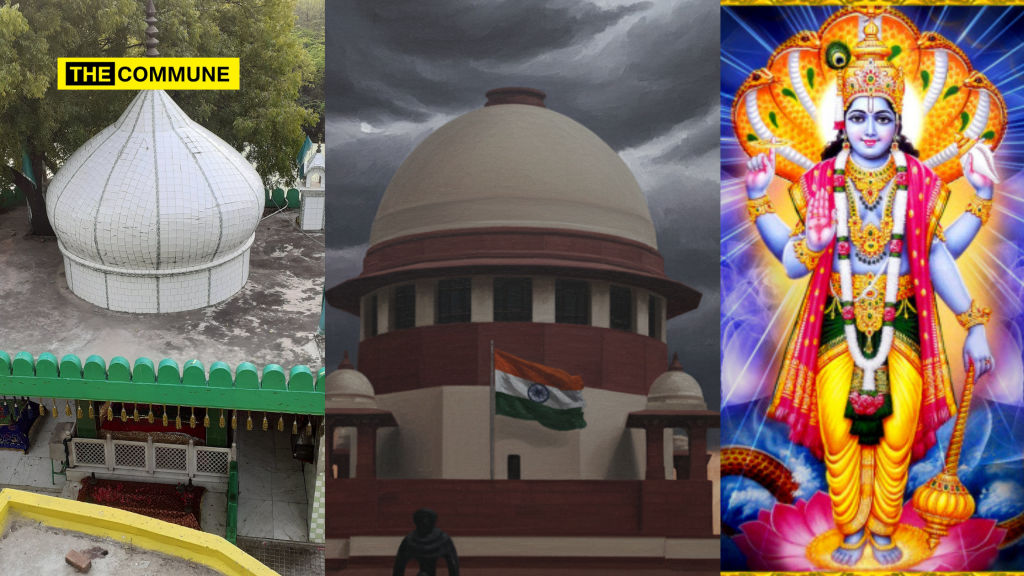
The Supreme Court of India is under scrutiny for what is seen as an inconsistent approach to heritage protection based on religion, following CJI Gavai’s insensitive remarks in a recent petition seeking restoration of a beheaded Vishnu idol at the Khajuraho temple complex. The court reportedly told the petitioner that, as Khajuraho is an archaeological site, he would require permission from the Archaeological Survey of India (ASI) to restore the idol; a remark critics say appeared dismissive and insensitive.
However, the same court recently directed the ASI to take active supervision of Muslim religious sites in Delhi, including the 13th-century Ashiq Allah Dargah and the Chillagah of Baba Farid inside Mehrauli Archaeological Park.
In August 2025, a bench of Justice B.V. Nagarathna and Justice R. Mahadevan ordered the ASI to repair and renovate these centuries-old monuments, despite them not being listed as “protected” under the Ancient Monuments and Archaeological Sites and Remains Act, 1958 (AMASR Act).
The intervention came after petitioners, led by Zameer Ahmed Jumlana, raised concerns about potential demolition by the Delhi Development Authority (DDA), which had earlier destroyed a 600-year-old mosque, Masjid Akhonji, and associated structures in January 2024. The Supreme Court noted that these monuments were historically significant and within ASI’s purview, directing: “That monument has to be preserved… ASI should take under its consideration the supervision of monuments in question, the matter of repair and renovation.”
Critics point out the contrast with the court’s treatment of Hindu heritage. In the case of the Khajuraho Vishnu idol, the petitioner seeking restoration was effectively told to approach the deity, rather than being granted direct relief through the ASI. Legal observers argue that this sets a troubling precedent in which protection and restoration efforts appear influenced by the religion associated with the monument.
Similar examples of active judicial intervention in heritage preservation include:
Allahabad High Court (Dec 2024): The court granted interim protection to the 17th-century Hammam of Ali Vardi Khan in Agra and directed the ASI and state authorities to prevent damage from illegal encroachments, based on a PIL filed by Chandrapal Singh Rana. The ASI had confirmed the structure dated back to 1620 AD.
Allahabad High Court (Feb-Mar 2025): The Shahi Jama Masjid in Sambhal received court-sanctioned cleaning and maintenance supervision by the ASI after the management committee sought routine whitewashing and repairs for Ramzan.
Supreme Court (2023-2025): The Supreme Court criticized the Goa Bench of Bombay High Court for quashing ASI’s order to demolish a residential house in Old Goa’s UNESCO heritage zone. The ASI had ordered the demolition under Section 19(2) of the Ancient Monuments Act, citing illegal construction near Viceroy’s Arch and Church of St. Cajetan. The High Court claimed ASI violated natural justice by not hearing the owners. The Supreme Court observed that the High Court acted prematurely and should have remitted the matter back to ASI for reconsideration with proper hearings, rather than outright canceling the demolition order.
High courts across India have repeatedly intervened to preserve heritage sites of all religions. The Madras, Bombay, Allahabad, Patna, and Calcutta High Courts have issued orders directing ASI supervision, police protection, and preventive measures against unauthorized construction or demolition in both Hindu and Muslim monuments.
Critics argue, however, that the Supreme Court’s contrasting tone, mocking a Hindu petitioner while actively directing ASI oversight for Muslim sites, raises concerns of inconsistency in heritage jurisprudence.
Subscribe to our channels on Telegram, WhatsApp, and Instagram and get the best stories of the day delivered to you personally.