


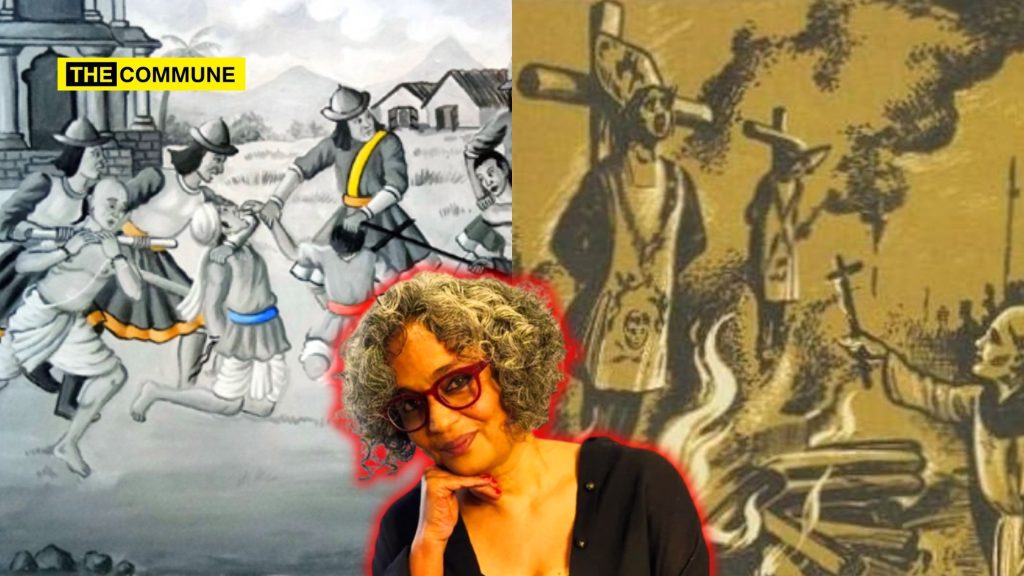
An undated video featuring left-wing extremist writer Arundhati Roy is being widely shared on social media platforms, in which she describes the Indian state as “a colonial state” that has waged military wars against its own people in regions like Kashmir, northeastern states, Punjab, Telangana, and Goa.
Roy argues that the Indian government, backed by an “upper caste Hindu state,” deployed armed forces in these areas, contrasting India’s approach unfavorably with Pakistan’s treatment of its citizens.
One particularly contentious claim in the video is about the 1961 liberation of Goa. Roy suggests that it was not freedom from colonial rule but a form of aggression by an “upper caste Hindu state” against the Christian population.
In the video, she said, “The Indian state, from the moment it became a sovereign nation, from the moment it shook off the shackles of colonialism, it became a colonial state. And it has waged war since 1947 in Kashmir, Manipur, Nagaland, Mizoram, Telangana, Punjab, Kashmir, Goa, Hyderabad. If you look at it, it’s like a state that has been perpetually at war and a military war and deploying the army against its own people. The state of Pakistan has not deployed its army against its own people in the way the democratic Indian state has. And if you look at who are these people that the Indian state chose to fight, in all the northeastern states, they were tribal people. In Kashmir, it was the Muslims. In Telangana, it was the tribal people. In Hyderabad, it was the Muslims. In Goa, it’s the Christians. In Punjab, it’s the Sikhs. So, you see this sort of upper caste Hindu state perpetually at war.”
When irresistible weed meets immovable hallucination.
According to Arundhati Roy, the 1961 liberation of Goa by India was in reality an Upper-caste Hindu State waging a war against Christians. pic.twitter.com/YXLqaxgskD
— Anand Ranganathan (@ARanganathan72) September 15, 2025
Truth About 1961 Goan Liberation
As regards the 1961 military operation, India’s annexation of Goa ended over 450 years of Portuguese colonial rule. This brief campaign, known as Operation Vijay, lasted just over 36 hours with minimal casualties on both sides.
The Indian government, led by then-Prime Minister Jawaharlal Nehru, had first sought diplomatic and peaceful solutions but was forced to take military action after decades of failed negotiations and Portuguese refusal to relinquish control. The action was widely seen in India as the liberation of Goa from colonizers, not an act of religious oppression against Christians.
The Reality Roy Omits: The Goan Inquisition
The Goan Inquisition (1560–1812), a dark 250-year chapter in history, was indeed a brutal institution run by Portuguese colonialist authorities. Eyewitness accounts, such as those by Gabriel Dellon, a 17th-century French detainee in Goa, detail harrowing events including executions for “heresy,” forced conversions, and grave desecrations.
The Inquisition targeted Hindus, Jews, and even Christians accused of “Judaizing” or practicing their former faith in secret. The punishments were grotesque. Dellon writes of a dead Christian man, tried posthumously for heresy, whose remains were exhumed and burned. The living faced public executions at the stake. Those who consented to a last-minute conversion were granted the ‘mercy’ of being strangled before their bodies were burned; all others were burned alive. Their portraits were later displayed in churches as a warning.
The Inquisition sought to erase indigenous religious practices and enforce Christian orthodoxy but also retained Portuguese-era social hierarchies such as the caste system among converts.
This was the oppressive colonial reality, one where people were persecuted for their faith and burned without trial, that the Indian state ended in 1961. To frame this liberation as an act of Hindu aggression is not just inaccurate; it is a perverse insult to the memory of its victims.
Despite this traumatic past, the Christian community in Goa today receives no hate because Hindus are a micro minority in the state, reducing in number as the days go by.
Exposing Roy’s Frame
Roy’s portrayal distorts the historical realities in several ways. She equated India’s democratic state actions with colonial oppression ignores the context of India’s unity and sovereignty after independence. The Indian military action in Goa was against a foreign colonial power, not an indigenous religious group.
Roy’s commentary is not an isolated lapse but part of a persistent pattern. For her, oppression is not a historical fact to be accurately recorded but a narrative to be weaponized selectively. She vocally condemns the Indian state while whitewashing the crimes of actual colonial and fanatical regimes that inflicted generations of suffering upon millions.
Her rhetoric thrives on sowing division and painting the entire India, a complex, pluralistic democracy, with the reductive brush of majoritarian hate.
The Christian community of Goa remains an integral part of India’s diverse social fabric. The Goan Inquisition was Hindu persecution by the Western Christian powers; the liberation was not an Indian state action against Christians; it was for freedom. The caste-based critique of the Indian state conflates colonial legacies and post-independence developments simplistically.
Experts and scholars emphasize that while India has had internal conflicts and human rights challenges, the history of Goa’s liberation was a decolonizing event benefiting all Goans regardless of faith, not an upper-caste Hindu war on Christians.
An eyewitness account of the Goan Inquisition comes from one Gabriel Dellon of France who spent two years in a Goan prison in the late 17th century.
He writes of a dead man—a Christian man—who was on trial for “Judaizing.” Reverting to Judaism was as heretical as being a Hindu.… pic.twitter.com/f7tECAN5Sb
— Amit Schandillia (@Schandillia) September 16, 2025
Subscribe to our channels on Telegram, WhatsApp, and Instagram and get the best stories of the day delivered to you personally.