


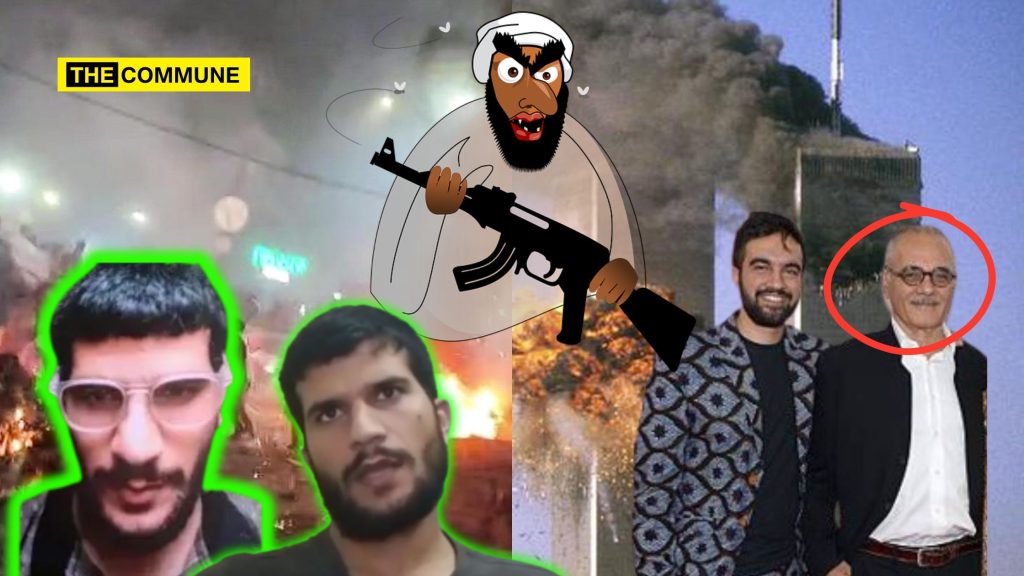
News channels and social media platforms were abuzz with a chilling video of the Delhi blast suicide bomber Umar Mohammad where he called suicide bombing as “martyrdom”.
A week after the November 10 car blast near Delhi’s Red Fort killed 13 people, an undated self-recorded video of the suspected bomber, Dr. Umar Mohammad alias Umar-un-Nabi, surfaced, offering investigators the first direct insight into his radicalisation.
In the video, Umar is heard discussing what he calls “martyrdom operations”, a term often used by terror groups to describe suicide attacks. Speaking in English with a noticeable accent, Umar says: “One of the very misunderstood concepts is the concept of what has been labelled as suicide bombing. It is a martyrdom operation… known in Islam. Now, there are multiple contradictions; there are multiple arguments that have been brought against it”. He further claims that a “martyrdom” operation is one in which a person assumes he will die at a particular time and place, and adds, “Don’t fear death.”
Clear undated video – Cold blooded message of terrorist Umar (before the Delhi blast) trying level best to justify Su!cide Bombing or Islamic J!had!
And some librandus & political parties were questioning his intent & playing religion! pic.twitter.com/HxRleiR5hG
— Megh Updates 🚨™ (@MeghUpdates) November 18, 2025
But just rewind to a few days ago when the internet was discussing something similar.
This “rationale” was what was echoed in the writings of Mahmood Mamdani, a professor at Columbia University. These surfaced in the run-up to the NYC Mayoral polls where Mahmood Mamdani’s son Zohran Mamdani was elected.
In his 2004 book, Good Muslim, Bad Muslim: America, the Cold War, and the Roots of Terror, Mamdani argued for a similar reframing of suicide bombers in the post-9/11 world.
The excerpts, from his book Good Muslim, Bad Muslim: America, the Cold War, and the Roots of Terror, read, “Suicide bombing needs to be understood as a feature of modern political violence rather than stigmatized as a mark of barbarism. We need to recognize the suicide bomber, first and foremost, as a category of soldier.”
Zohran Mamdani’s dad Mahmood wrote this 3 years after 9/11 pic.twitter.com/OAvVEqj6NJ
— End Wokeness (@EndWokeness) October 27, 2025

Mamdani wrote this book just three years after the attacks that killed nearly 3,000 Americans.
In interviews following the book’s release, Mamdani further argued that suicide bombers emerge from youth revolt and political conflict, particularly referencing the Palestinian Intifada.
Calling those views “too easy and too self-serving,” Mamdani presented his own analysis, stating, “The reality is more likely the opposite; the suicide bomber is more likely born of a youth revolt than of patriarchal authority. The suicide bomber comes out of the history of the Intifadah.”
He further justified his “soldier” classification by pointing to the prolonged Israeli occupation of Palestine, which he described as a “brutal reality.” He argued that the “failure of the older generation to find a humane alternative” led to the desperation of the young.
“Even then, we need to recognize that the term suicide bomber is a misnomer. The suicide bomber is a category of soldier whose objective is to kill – even if he or she must die to kill,” Mamdani said in the interview.
Investigators in India say Umar’s newly recovered video uses similar reasoning, blending religious framing with an attempt to legitimise suicide attacks. They believe Umar was part of a transnational module involving doctors, academics and students connected to Al-Falah University and allegedly linked to Pakistan-based terror groups such as Jaish-e-Mohammed and Ansar Ghazwat-ul-Hind. Nearly 3,000 kg of explosives have been seized across multiple states in raids tied to the network.
As the investigation expands, one cannot but dismiss the parallel between Umar’s justification of suicide attacks and Mahmood Mamdani’s framing of suicide bombers as “soldiers” particularly given Zohran Mamdani’s own recent rise to political prominence in the United States.
Subscribe to our channels on WhatsApp, Telegram, Instagram and YouTube to get the best stories of the day delivered to you personally.