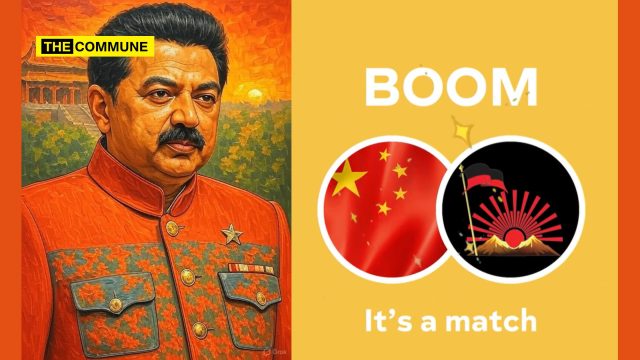
In 2017, a paper on “How the Chinese government fabricates social media posts for strategic distraction not engaged argument” was published. A closer look at this study reminds of something closer to home, the Dravidian model. First, let us take a finer look at the published study on Chinese propaganda.
The study, which analysed millions of posts linked to China’s infamous “50 Cent Party” (wumao), highlighted several key features of Beijing’s social media disinformation tactics.
Modus Operandi of Chinese Government Propaganda on Social Media
Nature of Propaganda – Contrary to the myth of paid trolls arguing with critics, most Chinese government-directed posts avoided confrontation. Instead, they sought to cheerlead, distract, and flood platforms with pro-government messaging.
Scale of Operations – Researchers estimated 448 million fabricated posts annually, strategically timed around protests, anniversaries, and politically sensitive events to drown out dissent.
Goal of Propaganda – The central aim was not persuasion but “strategic distraction”—filling feeds with positivity and irrelevant chatter to sideline genuine criticism.
Coordination & Secrecy – Operations were centrally directed yet covert. Local governments and Party offices quietly mobilised state employees and agencies to generate content, without admitting it was propaganda. Instructions and credit for posts were managed through propaganda offices at multiple government levels (district, township, bureau, etc.).
Style of Posting – Posts avoided negativity or direct rebuttals, instead relying on banal slogans such as “China is great,” “Support the Party,” and appeals to unity. Many were deliberately cheerful to mask their orchestrated nature.
Was 50-Cent A Myth? – Contrary to belief, most propaganda workers were regular government employees, not freelancers earning 0.5 yuan per post. Participation in online propaganda was often part of their official duties.
Propaganda Warfare Logic – The deeper strategy was agenda control, using mass posting to drown out critics rather than to convince them.
Volume spikes in posting were the result of top-down directions, often after internal meetings or government initiatives.
Selective Targeting – The regime increased posting during periods of potential social unrest, emergencies, or politically sensitive anniversaries.
Posts appeared on both government platforms and popular commercial sites like Sina Weibo, Tencent, etc., mixing with genuine citizen content.
Surveys and Validation – The researchers used leaked emails, direct surveys, and statistical validation to confirm the identity and behavior of government propagandists.
Chinese social media propaganda relied on coordinated, non-confrontational, government-authored posts to flood digital spaces with cheerleading distraction, carefully timed to influence collective perception and quell dissent without engaging in open debate.
Dravidian Model Propaganda – Mirrors Chinese MO
Observers now note that these tactics used by the Chinese echoed the DMK’s “Udan Pirappus”, where party-aligned web warriors are allegedly paid around ₹200 per day to amplify pro-government narratives and stifle criticism. Like the Chinese wumao, these cadres reportedly avoid logical debate, instead relying on volume, positivity, and coordinated flooding of social media feeds. Well, akin to the Chinese machinery, the taxpayer funded “fact checking unit” has also been disseminating fake news over and over again.
Critics argue that this exposes the so-called Dravidian Model as a derivative copy of the Chinese Communist Party’s online propaganda playbook, not a unique or indigenous innovation.
By borrowing wholesale from Beijing’s disinformation strategy, the DMK’s digital apparatus, they say, has less to do with grassroots democracy and more to do with agenda manipulation and narrative control.
Nothing about the #DravidianModel is original or shapechanging. Even the modeling of Rs200/- webwarrior cadre 'Udan Pirappu'🙄is stolen from China: 50CentParty/Wumao – folks who spread govt disinfo & smother critiques, taking 5 jiao per post. (payments from DMK via PR agencies) pic.twitter.com/lgoZfZ1BHg
— nʌᴉɐsᴉɥʇo (@othisaivu) August 16, 2025
Subscribe to our channels on Telegram, WhatsApp, and Instagram and get the best stories of the day delivered to you personally.