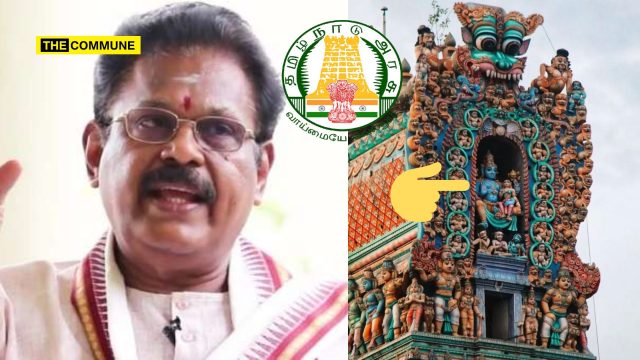
Statements made by Dravidianist-aligned orator Suki Sivam regarding the Tamil Nadu State Emblem and the Srivilliputhur temple gopuram have come under scrutiny after visual evidence showed the presence of Hindu deities on the gopuram, contrary to his claims.
Speaking at a public forum, DMK-supporting Suki Sivam stated that the Srivilliputhur temple gopuram was adopted as the Tamil Nadu government emblem during the tenure of Omandur Ramasamy Reddiar, who served as Chief Minister around 1947. He said the gopuram was chosen on the suggestion of Rasikamani TKC. and claimed that the selection had initially sparked controversy on the grounds that it represented a Hindu religious symbol.
According to Suki Sivam, the controversy was addressed by emphasising that the Srivilliputhur gopuram did not contain any deity figures. He said Omandur Ramasamy Reddiar, after consulting Rasikamani TKC, explained in the Assembly that the gopuram was unique because “there is not a single deity figure on it.”
“Sir, only if there is a statue will the question arise – whether it is a Vaishnava image, a Shiva image, a Vinayaka image or a Murugan image. But here, there is not even one deity figure,” Suki Sivam said, adding that the gopuram consisted purely of stonework and masonry.
He further claimed that the structure should not be viewed as a Hindu religious symbol but as a representation of Dravidian architectural tradition.
“This is not a symbol of the Hindu religion; it is a symbol of Dravidian architecture,” he said, arguing that such gopurams were found only in South India and not in the northern parts of the country.
திருவில்லிபுத்தூர் கோயில் கோபுரத்தை தமிழ்நாடு அரசின் இலச்சினையாக்கியவர் ஓமந்தூர் ராமசாமி அவர்கள், கோபுரம் இந்து மதத்தின் அடையாளம் என்ற விமர்சனம் எழுந்தபோது, அது ஒரு மதத்தின் அடையாளம் அல்ல அது திராவிடக் கட்டடக் கலையின் அடையாளம், ஏனெனில் அக்கோபுரத்தில் ஒரு சாமி பொம்மை கூட இல்லை. pic.twitter.com/xcDstuqJx0
— ஆதினி (@aathini_twitz) December 17, 2025
However, images of the Srivilliputhur temple gopuram show that Hindu deities are, in fact, part of the structure. Notably, the Lakshmi–Narayana form is prominently depicted in the upper tier of the gopuram, contradicting the assertion that there is not even a single deity figure.
Observers pointed out that the presence of deity figures on one of Tamil Nadu’s most prominent temple towers calls into question the accuracy of the claim that the gopuram is devoid of Hindu iconography. The depiction of Lakshmi-Narayana on the gopuram undermines the argument that the emblem was selected solely as a non-religious or purely architectural symbol.
It is now clear that the person has no understanding of what is present on a prominent gopuram in Tamil Nadu. The claim that there is “oru saami bommai kooda illai” (not a single deity figure) and that there are “no Hindi deities” on the gopuram is factually incorrect. In… https://t.co/lGwHkkbX1X pic.twitter.com/wc8LLQAN9n
— 𑀓𑀺𑀭𑀼𑀱𑁆𑀡𑀷𑁆 🇮🇳 (@tskrishnan) December 18, 2025
Suki Sivam – Self-Proclaimed Orator Who Inserts Dravidianist Ideology In Spiritual Talks
Suki Sivam, the self-proclaimed scholar who occasionally uses his eye-opening research on Hindu gods to subtly interweave Dravidianist ideology into his spiritual talks, displays a level of arrogance that seems boundless. In Indian philosophy, Hindu teachings assert that choosing a spiritual path should transcend the inherent arrogance of human nature – a quality considered essential for the human experience, except in Charvaka philosophy. However, Suki Sivam stands as an exception to this notion. Despite presenting himself as a devoted Hindu follower and spiritualist, his arrogance persists, embodied in his unyielding sense of self.
In one YouTube interview, Suki Sivam claimed that religion in India had been “hijacked” by politicians and that matters of faith should not be dictated by elected leaders. He defended Dravidian and DMK-linked criticism of Hindu practices, saying such politicians should be defeated electorally if people disagreed with them. Sivam argued that Hindu scriptures evolved to correct internal flaws and claimed historical Hindu temple practices excluded the downtrodden. He defended EV Ramasamy Naicker (Periyar), saying his attack on God stemmed from social reform. Sivam further asserted that Palani should not be considered one of Murugan’s six abodes, suggesting the deity was originally linked to Siddhars, possibly Bogar, and that Agamas do not apply to the temple.
Once he also claimed that Palani Murugan temple did not have a flagstaff, when it clearly had one.
Subscribe to our channels on WhatsApp, Telegram, Instagram and YouTube to get the best stories of the day delivered to you personally.