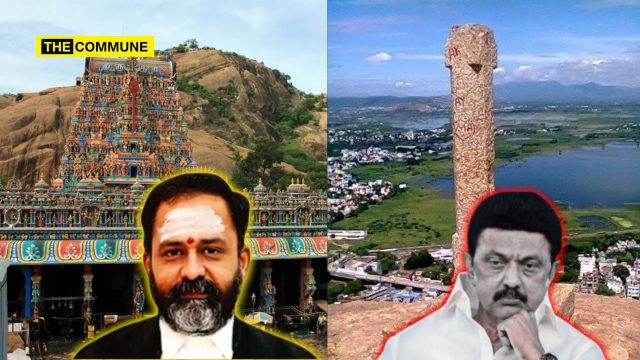
The Madras High Court (Madurai Bench) on Tuesday (6 January 2026) upheld a single judge’s order directing the lighting of a lamp at the ancient stone pillar (Deepathoon) atop the Thiruparankundram Hills, located near the Hazarath Sultan Sikkandar Badhusha Avuliya Dargah.
A division bench comprising Justice G Jayachandran and Justice KK Ramakrishnan, while pronouncing its judgment, held that the earlier order of the single judge was not hit by the principle of res judicata, as the issue of lighting the lamp had not been conclusively decided in previous rounds of litigation.
No Evidence Against Lighting of Lamp, Court Says
The bench observed that the appellants, including the State government, police authorities, and the Dargah, had failed to place any “formidable evidence” to establish that agama shastras prohibited the lighting of the lamp at the site.
Addressing the repeated claim of a potential law-and-order problem, the court made strong observations, stating, “Ridiculous and hard to believe the fear of mighty state that by allowing representatives of devasthanam to light a lamp at the stone pillar on a particular day in a year will cause disturbance to public peace. Of course, it may happen only if such a disturbance is sponsored by the state itself. We pray no state should stoop to that level to achieve their political agenda.”
The bench further remarked that the submission claiming the pillar belonged to the Dargah had only deepened mistrust, noting, “The submission that pillar belongs to dargah added another reason for the other side to be sceptical about the offer made by the workforce monitoring mediation.”
‘Imaginary Ghost’ of Law and Order
Rejecting the State’s justification, the court said the apprehension of disturbance was unfounded, “Apprehension of law and order was an imaginary ghost created by state authorities for their convenience to put one community against the other under suspicion.”
The bench added that the district administration ought to have treated the dispute as an opportunity to bridge the gap between communities through mediation, rather than escalating tensions.
ASI Clearance Required
Noting that Thirupparankundram Hill is a protected monument, the bench directed that any activity must comply with the Archaeological Survey of India Act. It clarified that the lamp could be lit and the number of persons permitted could be fixed after consultation with the ASI.
Background of the Case
The judgment was delivered in a batch of appeals challenging a December 1 order of a single judge, who had directed the management of the Arulmigu Subramania Swamy Temple to light the Karthigai Deepam at the Deepathoon on top of the hill.
Finding that the order was not complied with on the day of Karthigai Deepam, the single judge, on the same day, permitted the petitioner devotees themselves to go to the hill and light the lamp. However, the Deepam was not lit even then, and contempt proceedings are currently pending.
Appeals by State, Police, Dargah, and Waqf Board
Aggrieved by the single judge’s directions, the State government, police authorities, the Dargah, and the Tamil Nadu Waqf Board approached the division bench.
The State contended that the devotees had no enforceable legal right to seek lighting of the lamp and argued that Article 226 of the Constitution could not be invoked to alter a long-standing custom.
The Advocate General submitted that the writ petition was not a public interest litigation but a private interest litigation, stating that the court’s concern should be limited to the petitioner’s rights and the statutory obligations of the authorities.
The Executive Officer of the Arulmigu Subramania Swamy Temple argued that while a devotee could approach the court to protect an existing right, no such right had been established in this case.
The Hindu Religious and Charitable Endowments (HR&CE) Department informed the court that the decision to light the lamp rested with the devasthanam, adding that the department was willing to consider any application made by the petitioners.
The Dargah submitted that the minority community had been facing difficulty in enjoying the land allotted to it in 1920. It was also argued that the single judge did not grant adequate opportunity to the Dargah to present its case and had allegedly framed a case not pleaded by any party.
The Joint Commissioner of the HR&CE Department contended that the pillar was not originally intended for lighting the Karthigai Deepam, but was used by saints who once resided in the area.
Meanwhile, the Madurai District Collector and the Police Commissioner argued that the Deepathoon itself was a “figment of imagination” of either the devotees or the court and highlighted the practical difficulty of accessing the pillar by climbing steps through the Dargah premises. They maintained that implementation of the single judge’s order would disturb peace in the area.
Rejecting these submissions, the division bench dismissed the appeals and upheld the single judge’s order, subject to compliance with ASI norms.
Source: LiveLaw
Subscribe to our channels on WhatsApp, Telegram, Instagram and YouTube to get the best stories of the day delivered to you personally.