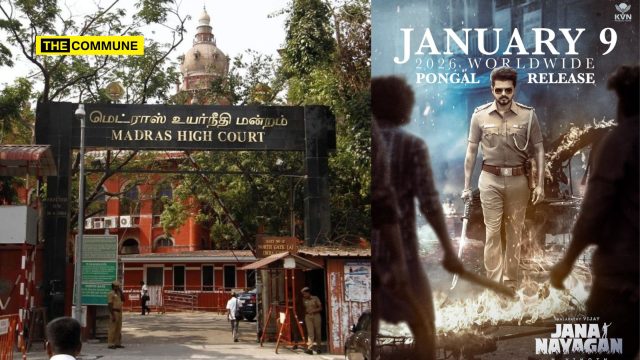
The Madras High Court on Tuesday, 27 January 2026, set aside an order passed by a single judge directing the Central Board of Film Certification (CBFC) to grant a U/A certificate to actor Vijay’s film Jana Nayagan.
A Division Bench comprising Chief Justice Manindra Mohan Shrivastava and Justice G Arul Murugan remanded the matter back to the single judge for fresh consideration, holding that the principles of natural justice had not been followed. The Bench directed the single judge to decide the matter afresh after granting an opportunity to the CBFC to file its response. The court also granted liberty to the film’s producer, KVN Productions, to amend the writ petition.
The court observed that the allegations raised in the complaint against the film were of a serious nature, which had prompted the CBFC Chairperson to send the film for review. In view of the seriousness of the allegations, the Division Bench held that the single judge ought to have provided the CBFC with an opportunity to defend its decision. The court further noted that the single judge should not have examined the merits of the case in the absence of any specific prayer challenging the Chairperson’s order.
Accordingly, the Division Bench directed the producers to amend their prayer before the writ court and specifically challenge the Chairperson’s decision to refer the film to the Revising Committee. The Bench reiterated that the single judge “ought not to have gone into the merits of the decision without granting sufficient opportunity to the CBFC.”
The court had reserved orders on 20 January 2026 after hearing submissions from both the CBFC and the film’s producer at length.
Jana Nayagan, which is slated to be Vijay’s final film before his formal entry into politics, became embroiled in litigation following a delay by the CBFC in issuing its certification. KVN Productions had approached the High Court challenging the delay.
Before the single judge, the production house argued that although it had been informed by the CBFC that the film would be granted a “UA” certificate subject to certain incisions or modifications, the certificate had not been issued even after such changes were carried out. The producers also questioned the CBFC Chairperson’s decision to send the film to the Revising Committee after initially indicating that the film would be certified.
The CBFC, however, informed the single judge that the decision to refer the film to the Revising Committee was taken after receiving a complaint from one of the members of the Examining Committee, alleging that his objections had not been considered. It was submitted that the complaint disclosed that certain scenes in the film could hurt religious sentiments and also portrayed the armed forces incorrectly.
On 9 January 2026, the single judge ruled in favour of the production house and directed the CBFC to certify the film forthwith. The court held that the Chairperson’s decision to send the film for review after informing the producers that it would be certified was without jurisdiction. The single judge also criticised the entertainment of complaints from members of the Examining Committee after they had already given their recommendations.
Following the single judge’s order, an urgent mention was made before the Chief Justice’s Bench on the same day. The Division Bench stayed the single judge’s order and made strong remarks against the producers for “creating an urgency” and exerting pressure on the judicial system.
On January 20, the Division Bench continued hearing the appeal. The CBFC, represented by Additional Solicitor General ARL Sundaresan, advanced two principal arguments. First, that the Board had not been granted sufficient time to file a counter affidavit, and second, that the communication dated January 6 referring the film for review by the Revising Committee had not been challenged by the producers.
Appearing for the production house, Senior Advocate Satish Parasaran and Senior Advocate Pradeep Rai contended that the Examining Committee had unanimously decided to certify the film and could not have subsequently revisited that decision. It was also argued that the Chairperson’s order referring the film for review was never shared with the producers, and that only an intimation regarding the same had been received.
Senior Advocate Satish Parasaran further submitted that the complaint placed before the Chairperson sought deletion of scenes that had already been removed pursuant to the suggestions of the Examining Committee. He argued that the CBFC was now seeking to reintroduce deleted scenes only to remove them again, describing the exercise as an empty formality.
Senior Advocates Satish Parasaran and Pradeep Rai, along with Advocate Vijayan Subramaniam, appeared for the production house, while the CBFC was represented by ASG ARL Sundaresan.
Source: LiveLaw
Subscribe to our channels on Telegram, WhatsApp, and Instagram and get the best stories of the day delivered to you personally.