


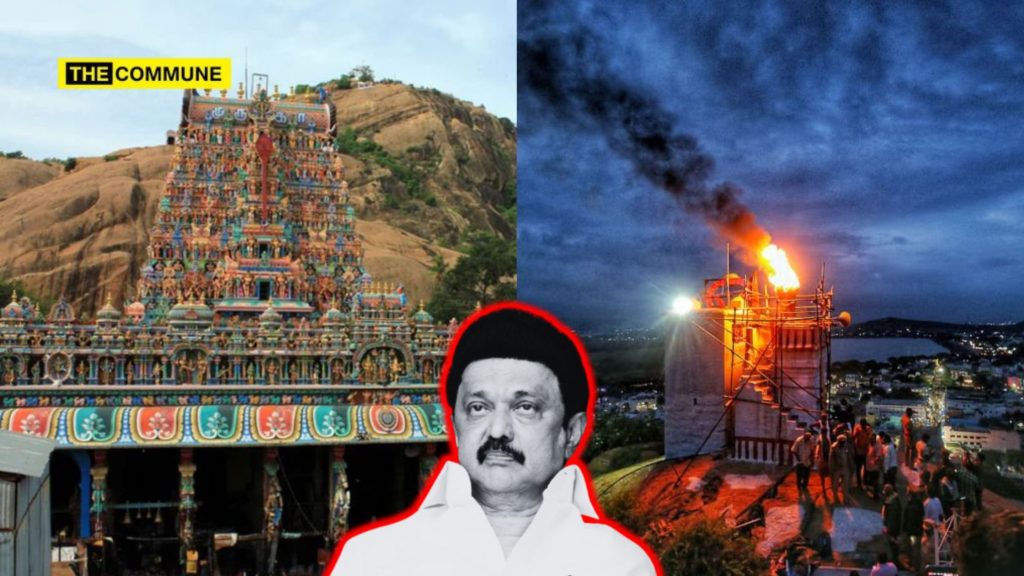
The Tamil Nadu government on Friday, 12 December 2025, informed the Madras High Court (Madurai Bench) that devotees who approached the court seeking permission to light the Karthigai Deepam lamp at the Thirupparankundram Hills “cannot claim such lighting as a legal right,” arguing that Article 226 powers cannot be invoked to change a longstanding religious custom.
A Division Bench of Justice G Jayachandran and Justice KK Ramakrishnan heard a batch of appeals challenging the single judge’s order directing temple authorities to light the lamp at the stone pillar (‘Deepathoon’) on the hill.
The State Authorities have also filed an appeal challenging the single judge’s December 4 order in a contempt petition, which had quashed a prohibitory order under Section 144 CrPC. Another group of appeals challenged the December 9 contempt order directing the appearance of the Chief Secretary, ADGP, DCP, and even impleading the Union Home Secretary.
AG: Devotees Do Not Have a Legal Right to Demand Lamp Lighting at Deepathoon
Appearing for the State, Advocate General (AG) P.S. Raman submitted that the appeals arise from a common order in five writ petitions filed by devotees of the ancient Thirupparankundram Murugan Temple.
He explained that the temple sits at the foothill of a 500-foot hill that also houses a dargah; that traditionally, the Karthigai Deepam lamp has been lit at the Uchi Pillaiyar temple, including this year and that a devotee, Rama Ravikumar, requested that either the temple authorities or he himself be permitted to light the lamp at a different site, now called Deepathoon, located near the dargah.
Calling it a private interest litigation, the AG said the writ court must confine itself to the petitioner’s individual rights and the statutory duties of temple authorities. “Any other issue need not be dragged into the four corners of this room. It’s for another battlefield,” he said.
After Ravikumar’s initial request was rejected, a fresh petition sought a direction either to allow him or to compel temple authorities to light the lamp at Deepathoon.
AG: No Evidence Deepathoon Was Ever a Traditional Site
AG Raman questioned the historical basis of Deepathoon. He pointed out that since the 1920 litigation, there has been no mention of Deepathoon, that devotees must establish that lamp-lighting at Deepathoon was a customary practice. He added that in the 1920 trial court ruling, part of the hill was held to belong to the Devasthanam and another part to the dargah. This was reversed on appeal. He also said that a 1994 PIL seeking a similar relief was rejected because the lamp was traditionally lit elsewhere and in 2014, the court again refused to shift the location; the order was upheld by a Division Bench.
The AG said the single judge nonetheless directed authorities to light the lamp at Deepathoon, which “he described as the correct place,” and added that the lamp could still be lit at the traditional site. This reasoning, the AG said, is now under challenge.
He argued that four courts had already applied their minds and upheld the traditional site.
“Any devotee does not have a legal right to demand that the lamp be lit in addition to the place where it is being lit,” he said.
AG: Article 226 Cannot Be Used to Change an Established Custom
The AG stressed that Article 226 is not meant to create or alter religious customs.
While acknowledging that the structure included a stone pillar, he questioned whether it was indeed a stone lamp pillar.
He argued, “If some historically acceptable evidence was placed before the court that before 1920 it used to be lit there… and if such practice was changed, the court could examine if a constitutional right was affected. But Article 226 is not intended to change a custom by creating a new custom.”
He noted that no one challenged the temple’s property rights and that the issue is not ownership but creation of a new religious custom. He added that there was “not a scrap of paper” before the single judge to identify the structure as Deepathoon.
He claimed that the only expert evidence before the court was the priests’ opinion that Agamas require lighting the lamp at Uchi Pillaiyar temple. “This finding (of the single judge) is without any factual basis,” the AG stated, calling for “greatest restraint.”
Senior Counsel Masilamani: A Vague Representation Used to Secure a Mandamus
Senior Advocate G. Masilamani, representing the Executive Officer of the temple, said the petitioner had no right to demand lighting of lamps at Deepathoon.
He warned that allowing such petitions would open a Pandora’s box, with devotees across the state seeking similar directions, making temple administration impossible.
Masilamani noted that the petitioner addressed his representation to the Executive Officer, not the Joint Commissioner of HR&CE, and the EO rightly replied. He stated that the representation never explicitly requested lighting the lamp near the stone pillar; it only sought permission to light the lamp “on the hills,” which includes Uchi Pillaiyar.
Calling it a “camouflage to secure an order of mandamus,” Masilamani said the petition sought reliefs beyond what the representation demanded.
‘Non-Practice for 175 Years Has Become Custom’
Masilamani stressed that customs are proved by longstanding practice, “From 1862 to 2025, there is no evidence to show that Deepathoon was where the Karthigai Deepam was lit. Long practice of non-practice becomes the custom.”
He also argued that the Deepathoon is not at the hilltop, the dargah is at one peak, Uchi Pillaiyar temple at another and that the Deepathoon lies 15 metres from the dargah.
He said the single judge incorrectly described the location and failed to follow established judicial precedents. If he disagreed with prior rulings, he should have referred the matter to a larger bench.
Court Seeks Permanent Resolution; State Declines to Commit
Justice Jayachandran observed, “This matter is perpetually going on from 1920. If we’re able to have a permanent resolution or solution… one day a year at a particular point in the hill, how far can a person’s claim go, without harming harmony? It is for the community to come together.”
However, the AG said the issue had been unnecessarily escalated.
Later, Senior Advocate R. Shunmugasundaram for the HR&CE department told the court that the Devasthanam alone must decide.
Justice Jayachandran asked whether the authorities would at least consider a fresh representation. Shunmugasundaram replied, “Let the authorities decide. I can’t give a word… It is the position of law.”
The court has listed the matter for 15 December 2025.
Source: LiveLaw
Subscribe to our channels on WhatsApp, Telegram, Instagram and YouTube to get the best stories of the day delivered to you personally.