


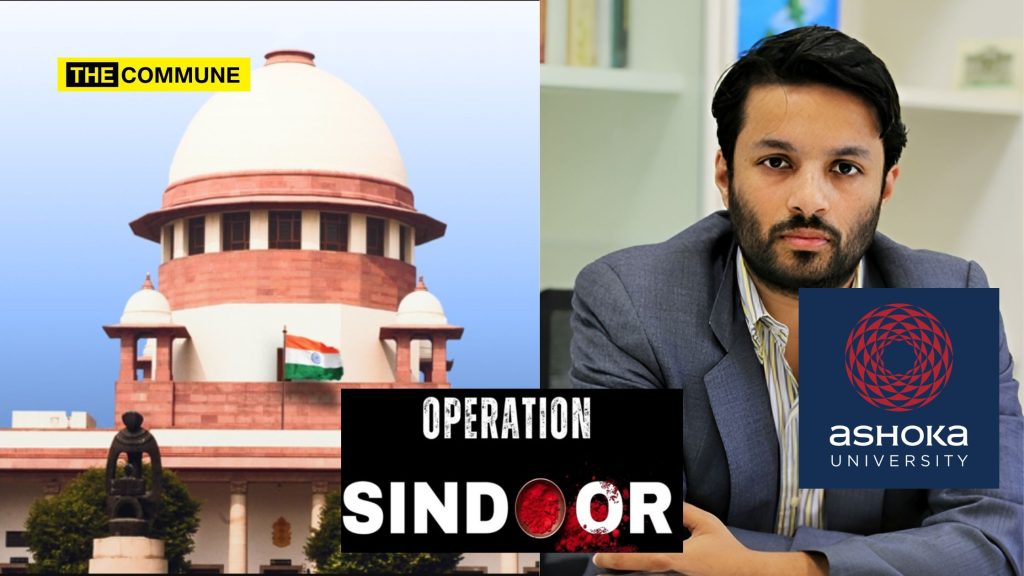
On 25 August 2025, the Supreme Court halted the trial against Ashoka University professor Ali Khan Mahmudabad in connection with a Facebook post he had written on Operation Sindoor.
A Bench led by Justices Surya Kant and Joymala Bagchi directed that no charges be framed against Mahmudabad and that the trial court should not take cognisance of the chargesheet already filed. The order stated, “No charges shall be framed in pursuance of the chargesheet filed with relation to FIR No. 147… No cognisance shall be taken of the chargesheet filed in FIR No. 147.”
The decision followed submissions from Additional Solicitor General SV Raju, who informed the court that two separate FIRs had been registered against Mahmudabad. He explained, “While a closure report was filed in one matter, a chargesheet was filed in the other because the offences were considered to be made out.”
Representing Mahmudabad, Senior Advocate Kapil Sibal criticised the proceedings, describing them as harassment. He argued that respondents are simply persecuting people in this country, while stressing that a Special Investigation Team (SIT) constituted earlier was expected to place its findings before the Court.
Mahmudabad had approached the apex court seeking to quash the two FIRs filed over his Facebook posts relating to Operation Sindoor, India’s military action against Pakistan following the Pahalgam terror attack of 22 April. In his post, he had condemned Pakistan-backed terrorism and war in general, while adding that the recognition given to Colonel Sofiya Qureshi, who fronted India’s press briefing on the operation, should translate into ground-level change. He further commented that right-wing groups in India ought to raise their voices against incidents of mob lynching.
Two complaints were filed against him for these remarks. The first FIR, lodged by Yogesh Jatheri, invoked provisions of the Bharatiya Nyaya Sanhita (BNS), including Sections 196 (promoting hatred), 197 (acts prejudicial to national integration), 152 (threatening sovereignty, unity, and integrity of India), and 299 (culpable homicide). The second FIR was based on a complaint from Haryana Women’s Commission Chairperson Renu Bhatia, which alleged offences under Sections 353 (public mischief), 79 (insult to modesty), and 152 of the BNS.
Following these cases, Mahmudabad was arrested by the Haryana Police and placed in judicial custody. When the matter first reached the Supreme Court on 19 May, the Bench refused to quash the FIRs but granted Mahmudabad interim bail. At that stage, the Court also replaced the Haryana Police with a Special Investigation Team to carry forward the inquiry.
The judges had noted at the time that some of Mahmudabad’s language in the posts could bear “dual meanings,” but later criticised the SIT for trying to expand its probe beyond the two FIRs. In the July hearing, the Court reprimanded the SIT, instructing it to restrict its investigation strictly to the two posts under question.
The Court also made it clear that Mahmudabad should not be summoned again since he had already cooperated with investigators and handed over relevant electronic devices. The SIT was directed to conclude its inquiry within four weeks, focusing solely on the two social media posts. Importantly, the Bench clarified that Mahmudabad remained free to publish articles or express views on social media except on issues that are currently sub judice before the Court.
(With inputs from Bar and Bench)
Subscribe to our channels on Telegram, WhatsApp, and Instagram and get the best stories of the day delivered to you personally.