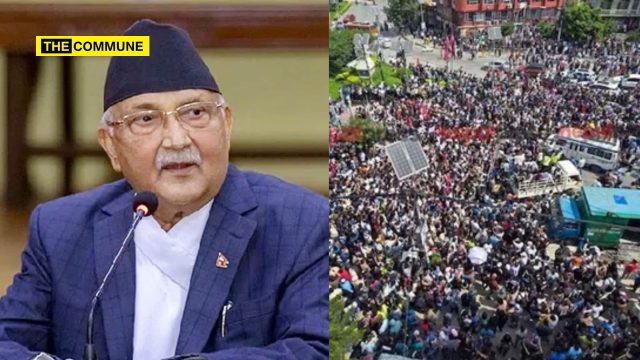
Between September 8 and 9, 2025, Nepal was rocked by unprecedented unrest as youth-driven protests spiraled into violent attacks on leaders, political parties, and government buildings. Sparked by anger over corruption, nepotism, and a controversial social media ban, demonstrators directly targeted symbols of state power. Homes of prime ministers past and present, party offices, and ministries were torched, vandalised, or besieged. The chaos culminated in multiple resignations, the collapse of the Oli government, and tragic casualties. Below is a detailed account of 18 major incidents that defined this turbulent two-day uprising.
#1 PM Oli’s Residence Set Ablaze
On 9 September 2025, protesters stormed and set fire to Prime Minister K.P. Sharma Oli’s private residence in Kathmandu. The attack marked a dramatic escalation of anti-government demonstrations that had gripped Nepal for days. Reports said several ministers had to be airlifted to safety as crowds turned violent around the premises.
Nepalese PM Oli's private residence was set on fire, with ministers airlifted to safety as anti-government demonstrations spread across the country #nepal #pm #house #cnnews #centristnation pic.twitter.com/rNiGwqQMMh
— Centrist Nation TV (@centristnattv) September 9, 2025
The assault on Oli’s home was seen as symbolic of growing rage against the Communist Party of Nepal (UML) leadership. Images of flames engulfing the property quickly spread across social media, fueling further anger and calls for his resignation.
#2 Parliament Building Gutted
On the same day, thousands of enraged youth stormed and gutted Nepal’s Parliament in Kathmandu. Demonstrators, frustrated over corruption and censorship, breached security barriers and set the iconic building ablaze. The destruction of the legislature was a shocking moment, symbolising the collapse of trust in democratic institutions.
Nepal Parliament gutted in Kathmandu by thousands of youth protestors. pic.twitter.com/MbzMxl4F5i
— Aditya Raj Kaul (@AdityaRajKaul) September 9, 2025
Eyewitness accounts described scenes of smoke and chaos as protesters danced and cheered outside. For many, the burning of Parliament highlighted the scale of generational anger against a political elite accused of betraying public trust. The event underscored the protest movement’s determination to dismantle symbols of entrenched authority in Nepalese politics.
#3 Law Minister Ajay Kumar Chaurasia’s Residence Burned
In Birgunj, the residence of Nepal’s Law Minister Ajay Kumar Chaurasia was set on fire on 9 September 2025. Reports suggested the minister narrowly escaped harm as demonstrators unleashed their fury against government officials. Chaurasia, a UML leader, had been a visible face of the controversial policies that triggered mass unrest. Local media reported that mobs ransacked the property before torching it, while neighbouring houses were also threatened. The attack reflected public resentment against those perceived as enforcers of an oppressive state. By targeting Chaurasia, protesters signaled their rejection of the legal and political machinery backing the Oli government.
#4 Former PM Sher Bahadur Deuba’s House Attacked
Protesters in Kathmandu vandalised and set fire to the home of former Prime Minister Sher Bahadur Deuba on 9 September 2025. Reports stated that Deuba was left bleeding as mobs ransacked his residence, looting and destroying property.
Protesters vandalise, set fire to the home of former Nepal prime minister Sher Bahadur Deuba
.
.
.
Track LIVE updates: https://t.co/P1FFZWWzyP pic.twitter.com/nWyXJJRAX8— WION (@WIONews) September 9, 2025
SHOCKING. In #Nepal, ex-PM Sher Bahadur Deuba left BLEEDING as his house was ransacked, ex-Peace Minister dragged like garbage, Street rule > Law 🤯
~ Don’t miss the subtext: this COLLAPSE is fuel for the same Regime-change cartels eyeing India nextpic.twitter.com/PSnLF2EQXf
— The Analyzer (News Updates🗞️) (@Indian_Analyzer) September 9, 2025
The attack stunned many, as Deuba had been a long-standing figure of the Nepali Congress and an opposition leader, not a ruling UML politician. Demonstrators, however, appeared intent on punishing all members of the political class, regardless of party affiliation. This assault illustrated how the protests had morphed from targeted dissent against the Oli government into a wholesale rejection of Nepal’s political establishment.
#5 Finance Minister Bishnu Paudel Chased and Beaten
On 9 September 2025, Nepal’s Finance Minister Bishnu Prasad Paudel was chased through Kathmandu streets and thrashed by angry demonstrators. Video footage showed mobs pursuing Paudel, cornering him, and attacking before security forces intervened. The shocking scenes highlighted the personal danger faced by political leaders amid the collapse of law and order.
Nepal's finance minister chased on street, thrashed by protesters as Oli govt collapses
A video, which surfaced today (Sept 9), shows Finance Minister Bishnu Prasad Paudel being chased on a road and thrashed by demonstrators.
In the video, over two dozen people were seen… pic.twitter.com/aoKBjKlUkZ
— The Indian Express (@IndianExpress) September 9, 2025
Paudel, long criticised for his handling of Nepal’s fragile economy, became a visible scapegoat for public rage. The incident sent shockwaves across the country, signalling that no minister was safe from the fury of Gen Z-led protests. It further deepened the Oli government’s political and moral crisis.
#6 PM Oli Resigns Amid Chaos
Facing relentless protests, Prime Minister K.P. Sharma Oli resigned on September 9. His departure came after days of escalating violence, including the burning of his residence and Parliament. Oli’s resignation marked the collapse of his UML government and left Nepal in political uncertainty.
#BREAKING | Nepal Prime Minister K.P. Sharma Oli resigned on Tuesday, his aide Prakash Silwal said.
Anti-corruption demonstrators in Nepal defied an indefinite curfew today (Sept 9), clashing with police and shouting slogans against Prime Minister K.P. Sharma Oli, a day after 19… pic.twitter.com/UdXWIZXSH0
— The Indian Express (@IndianExpress) September 9, 2025
His critics argued that the social media ban and entrenched corruption had alienated youth beyond repair. Supporters of the protests celebrated his fall as a generational victory, while others warned of instability in the absence of a clear successor. The resignation was the most dramatic outcome of the uprising, reshaping Nepal’s political landscape overnight.
#7 Home Minister Ramesh Lekhak Steps Down
On 8 September 2025, Nepal’s Home Minister Ramesh Lekhak announced his resignation amid violent demonstrations. His decision came after mounting criticism over the police crackdown that left several protesters dead. Lekhak’s exit was one of the earliest high-profile casualties of the unrest, signalling fractures within the government even before Oli stepped down.
#RaceToPower | Protests turn violent in Nepal
Nepal's home minister announces resignation amid deadly protests against social media ban@MollyGambhir brings you this report by @murarka_saloni pic.twitter.com/3HWseLnigt
— WION (@WIONews) September 8, 2025
Observers said his resignation was an attempt to defuse public anger, but it failed to calm demonstrators. Protesters accused him of authorising brutal repression and demanded accountability for lives lost. Lekhak’s fall showed how quickly the protests destabilised key figures in the Oli administration.
#8 Protesters Celebrate as Oli’s Bhaktapur Residence Burns
In Bhaktapur on 9 September 2025, jubilant protesters danced and celebrated as flames engulfed another residence of former Prime Minister Oli. The sight of young demonstrators rejoicing in front of a burning house captured the raw anger and symbolism of the uprising. Oli, once a dominant figure in Nepali politics, had become a hated symbol of corruption and authoritarianism for many youths.
Protesters dance and celebrate as the private residence of former Nepalese PM KP Sharma Oli, in Bhaktapur, burns
.
.
.
.
Video: TV Today Nepal/ANI pic.twitter.com/S5tfy69Ovw— WION (@WIONews) September 9, 2025
Videos from the scene circulated widely, further galvanising protesters elsewhere. The celebrations, though shocking, reflected the protesters’ belief that the destruction of elite property was a necessary act of resistance against decades of failed governance.
#9 Nepali Congress Party Office Torched
On 9 September 2025, protesters set fire to the Nepali Congress Party’s office in Kathmandu. The attack showed that the fury was not confined to the ruling UML but extended to the broader political class. Demonstrators accused all major parties of perpetuating corruption, nepotism, and betrayal of democratic ideals.
#NewsAlert | Nepali Congress Party's office set on fire in Kathmandu as protests intensify in Nepal pic.twitter.com/jWF3wfNLGk
— WION (@WIONews) September 9, 2025
The destruction of the Congress office symbolised generational disillusionment with both ruling and opposition parties. Videos shared online showed crowds surrounding the burning office, chanting slogans for justice. The attack underscored the depth of mistrust between Nepal’s youth and the political elite, threatening the survival of established party structures.
#10 Foreign Minister Arzu Rana Deuba’s Residence Attacked
On 9 September 2025, protesters attacked the residence of Foreign Minister Arzu Rana Deuba, wife of former PM Sher Bahadur Deuba. Demonstrators damaged the property amid escalating anger against political leaders of all stripes. The assault was part of a broader pattern where both ruling and opposition figures faced direct retaliation from the streets.
Protesters attack the residence of Nepal’s Foreign Minister, Arzu Rana Deuba. pic.twitter.com/ft1iNRJ0rf
— INDEPENDENT PRESS (@IpIndependent) September 9, 2025
Arzu Rana, a prominent Congress politician, had been a vocal critic of Oli but was nevertheless targeted. The attack demonstrated that protesters viewed the entire political class as complicit in corruption and misrule. It highlighted how the uprising blurred partisan lines in its fury.
#11 President Ram Chandra Paudel’s House Attacked
On 9 September 2025, demonstrators attacked the residence of Nepal’s President Ram Chandra Paudel. The assault followed earlier attacks on ministers’ homes, including those of the communications and finance ministers. Protesters pelted stones, set fires, and damaged property, escalating the sense of crisis.
Gen Z protesters have attacked house of Nepal's President Ram Chandra Poudel.
Earlier, protesters also set fire to the house of Communication Minister Prithvi Subba Gurung and pelted stones at Finance Minister Bishnu Paudel’s residence.
Nepal's PM KP Oli is planning to run away… pic.twitter.com/QRKKyh8JCC
— Incognito (@Incognito_qfs) September 9, 2025
As head of state, Paudel was seen as part of the same establishment that had imposed the social media ban and failed to address corruption. The attack on the president’s house shocked observers but illustrated how no office was beyond the protesters’ reach.
#12 Communications Minister Prithvi Subba Gurung’s House Torched
The home of Communications Minister Prithvi Subba Gurung was torched on 9 September 2025 by furious Gen Z protesters. As the minister linked to the social media ban that ignited the unrest, Gurung was a prime target of demonstrators. His house was set ablaze alongside those of other political elites.
🇳🇵 GEN Z PROTESTERS ATTACK HOMES OF NEPAL’S TOP LEADERS
Homes of ministers and political elites across Nepal were stoned and torched as angry Gen Z demonstrators took their rage straight to the front doors of power.
The house of Communications Minister Prithvi Subba Gurung was… https://t.co/1VuDYKGMfO pic.twitter.com/xhd5lS4T61
— Mario Nawfal (@MarioNawfal) September 9, 2025
Eyewitnesses described angry mobs hurling stones and chanting slogans against censorship and corruption. The attack highlighted the central role Gurung’s policies played in sparking the crisis. Protesters framed the burning of his residence as a symbolic rejection of repression and state-imposed curbs on digital freedoms.
#13 Former PM Pushpa Kamal Dahal’s Residence Vandalised
On 9 September 2025, protesters vandalised the residence of former Prime Minister Pushpa Kamal Dahal, also known as Prachanda. Demonstrators pelted stones, clashed with police, and faced tear gas near his home in Kathmandu. Dahal, a key UML figure, was accused by protesters of enabling decades of corruption and misrule. His house became another casualty of the movement’s anti-elite rage.
The incident reflected how protesters saw no distinction between current and former leaders, holding the entire establishment accountable. Police use of tear gas underscored the volatility of the situation, with violence spilling into neighbourhoods around Dahal’s residence.
#14 Army Evacuates Ministers
On 9 September 2025, as protests escalated, the Nepalese Army intervened to evacuate several government ministers from their residences. Demonstrators had already set fire to the homes of Prime Minister Oli, the president, and multiple cabinet members. The military’s deployment reflected the state’s loss of control over security forces and the urgency to protect officials from mob attacks.
🇳🇵 Nepal’s army is evacuating government ministers from their residences amid mass protests across the country.
Reports say the evacuation is being carried out by helicopter. Kathmandu’s international airport has been shut down due to the unrest, with all flights canceled.… pic.twitter.com/nnVFAOHHAg
— Visegrád 24 (@visegrad24) September 9, 2025
Helicopters were reportedly used to airlift ministers to safety. The dramatic scenes of ministers fleeing highlighted the collapse of civilian authority and the severity of the crisis. It was a turning point, marking the army’s central role in containing the unrest.
#15 Government Buildings Set on Fire
On 9 September 2025, protesters turned their fury toward government buildings across Nepal, setting several ablaze. Offices linked to the state apparatus were ransacked and torched as demonstrators sought to dismantle symbols of state power. Videos circulating online showed flames consuming administrative blocks while crowds chanted slogans.
Nepal’de hükümete ait binalar yakılıyor.pic.twitter.com/4ylo5ZqrNQ
— BPT (@bpthaber) September 9, 2025
The attacks disrupted government functioning and paralysed services. For protesters, burning government property was a symbolic act of resistance against decades of corruption and mismanagement. For officials, it represented an unprecedented collapse of law and order.
#16 Energy Minister’s Office Burned, Cash Scattered
In one of the most dramatic incidents on September 9, protesters set fire to the office of Nepal’s Energy Minister Deepak Khadka. Reports said demonstrators looted money from the building and threw it into the air as crowds cheered. The act, caught on video, became a striking symbol of public resentment against corrupt officials.
Nepal Enerji Bakanı’nın binası yakılıyor.
Binanın içindeki paralar protestocular tarafından toplanarak havaya saçılıyor.pic.twitter.com/0p5ZSC5SAR
— BPT (@bpthaber) September 9, 2025
Khadka, a UML minister, was accused of profiting while ordinary citizens suffered. The burning of his office and the symbolic scattering of cash resonated widely, reflecting anger at elite enrichment. It further deepened the narrative of corruption and betrayal fueling the uprising.
#17 Wife Of Former PM Burnt Alive
Tragedy struck on 9 September 2025 when Rajyalaxmi Chitrakar, wife of former Prime Minister Jhalanath Khanal, died after being burnt alive at her residence. Reports said protesters set her home on fire, and she was unable to escape.
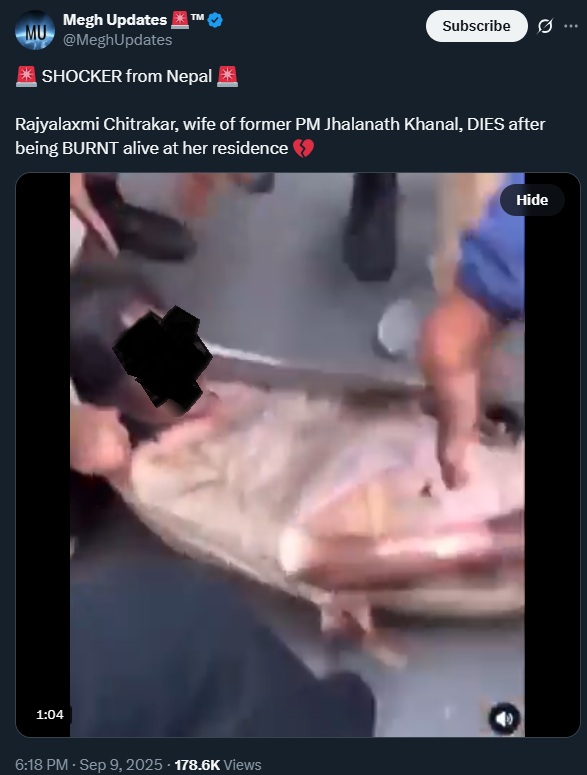
The incident shocked the nation and raised questions about the movement’s violence spiraling beyond control. While protesters claimed to be targeting corrupt leaders, the death of a family member of a political figure added a grim dimension to the unrest.
#18 Protesters Storm Communist Party Headquarters
On 9 September 2025, protesters stormed the headquarters of Nepal’s Communist Party (UML), tearing down its iconic hammer-and-sickle flag. The assault marked the symbolic dismantling of the ruling party’s authority. Demonstrators accused the UML of betraying democratic ideals and fostering corruption.
⚠️THE FALL OF COMMUNISM IN NEPAL!?
Nepalese protesters storm the Communist Party headquarters and tear down the Hammer and Sickle flag pic.twitter.com/zKf1g0wc14
— Megh Updates 🚨™ (@MeghUpdates) September 9, 2025
By toppling the flag, protesters sent a message that they were rejecting not only individual leaders but the party’s entire ideological and organisational apparatus. The incident underscored the depth of disillusionment with communist politics in Nepal, once hailed as revolutionary but now derided as corrupt and oppressive by the new generation leading the protests.
Subscribe to our channels on Telegram, WhatsApp, and Instagram and get the best stories of the day delivered to you personally.