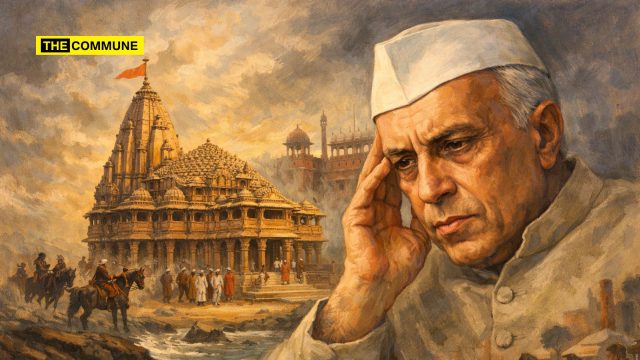
As India marks 1,000 years since the 1026 attack on the Somnath Temple by Mahmud of Ghazni, recent remarks by the Prime Minister recalling the shrine’s survival have renewed attention on one of the most contested episodes of post-Independence cultural history: the reconstruction of the Somnath Temple and the resistance it faced from India’s first Prime Minister, Jawaharlal Nehru.
Somnath: The “Eternal Shrine”
The Somnath Temple, located at Prabhas Patan near Veraval on Gujarat’s Arabian Sea coast, is one of the 12 sacred Jyotirlingas of Lord Shiva. Ancient texts such as the Shiva Purana and multiple inscriptions attest to its antiquity. Over centuries, the temple was repeatedly destroyed and rebuilt—historical records indicate at least six cycles of destruction and reconstruction—making it a symbol of civilisational continuity.
After Independence, the modern reconstruction of Somnath was initiated between 1947 and 1951, spearheaded by Sardar Vallabhbhai Patel and later supported by K.M. Munshi. The temple was rebuilt in the Chaulukya (Solanki) architectural style by temple architect Prabhashankar Sompura and inaugurated on 11 May 1951 by President Rajendra Prasad. Today, the Somnath Trust is chaired by the Prime Minister of India.
Nehru’s 17 Letters on Somnath: A Complete Record (1950–1951)
Archival correspondence shows that Jawaharlal Nehru wrote at least 17 separate letters between July 1950 and August 1951 opposing, distancing, or attempting to dilute the reconstruction and inauguration of the Somnath Temple. Each letter reflects sustained and deliberate intervention at different levels of government and diplomacy.
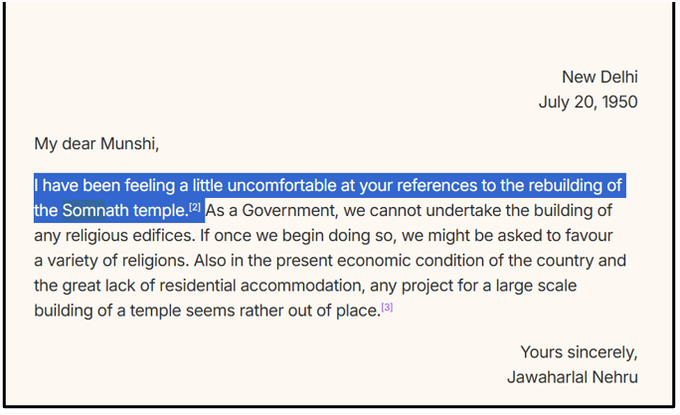
#1 20 July 1950 – To K.M. Munshi (Union Minister)
Nehru questioned the very necessity of rebuilding the Somnath Temple, arguing that India faced housing shortages and economic hardship. He framed the reconstruction as an avoidable expenditure rather than a civilisational restoration.
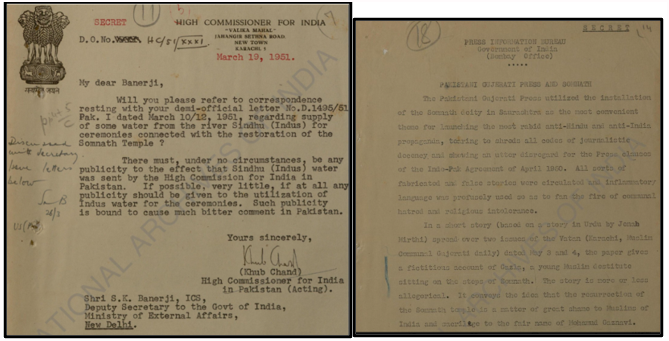
#2 19 March 1951 – To Khub Chand (High Commissioner to Pakistan)
Nehru formally disapproved the use of Indus water for the Somnath consecration and ordered that there be no publicity under any circumstances, citing fear of adverse reaction in Pakistan.
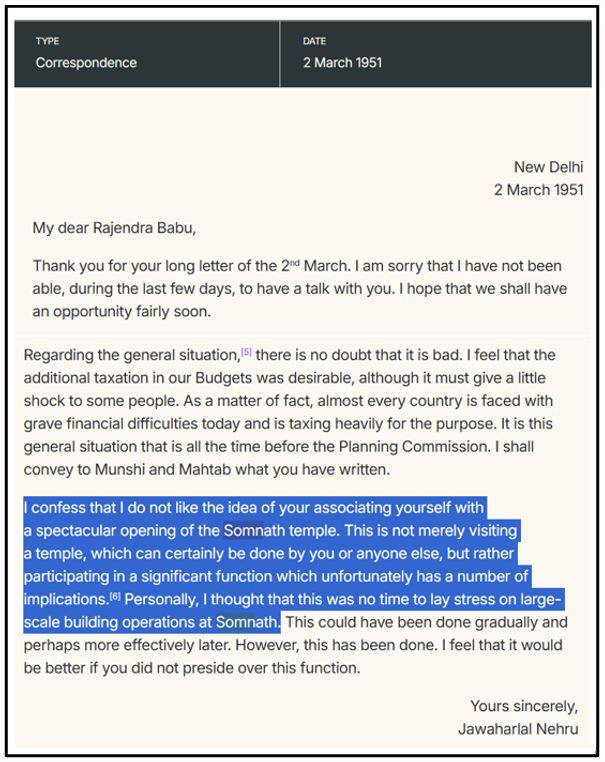
#3 2 March 1951 – To President Rajendra Prasad
Nehru bluntly stated that he did not like the President associating with the Somnath inauguration and suggested the event be postponed or scaled down.
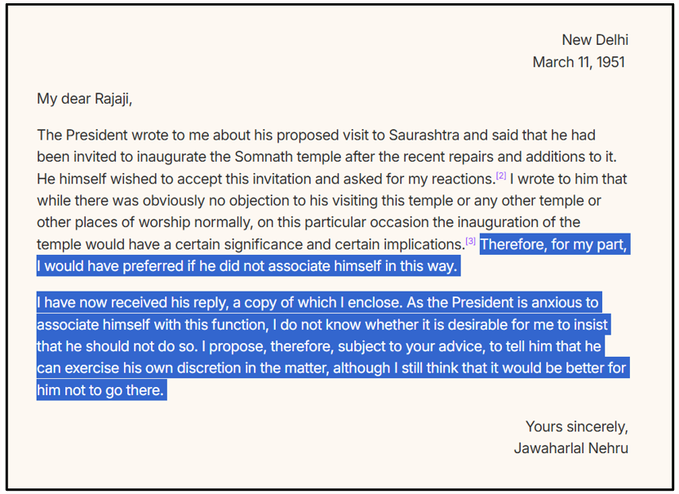
#4 11 March 1951 – To C Rajagopalachari (Union Home Minister)
Nehru reiterated that he would have preferred the President not to attend the inauguration, showing active opposition to constitutional endorsement.
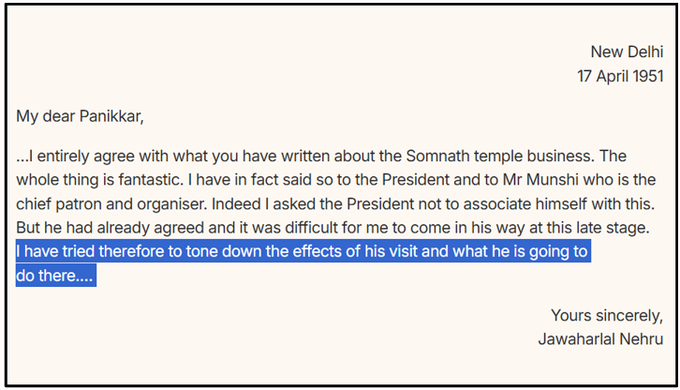
#5 17 April 1951 – To K.M. Panikkar (Indian Ambassador to China)
Nehru admitted that he had tried to “tone down the effects” of the President’s visit to Somnath, acknowledging active damage control after failing to stop it.
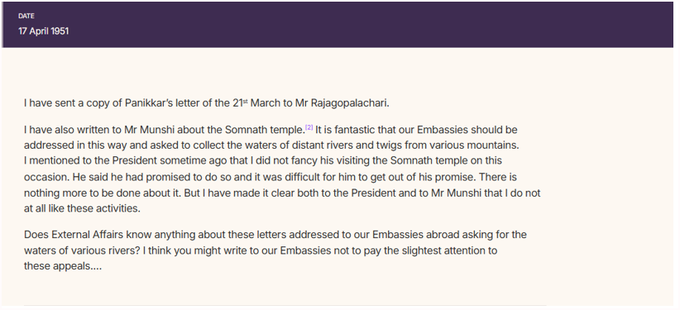
#6 17 April 1951 – To Secretary-General & Foreign Secretary, MEA
Nehru directed Indian embassies not to assist the Somnath Trust with requests for sacred river water or soil, signalling discomfort with even symbolic religious acts.
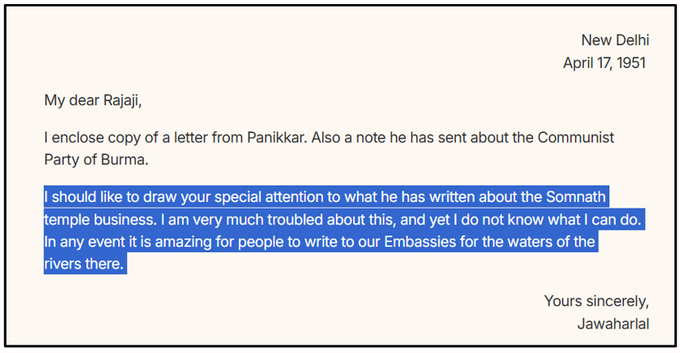
#7 17 April 1951 – To C. Rajagopalachari (Second Letter)
He stated that the Somnath issue was troubling him deeply, reinforcing that his opposition was ongoing and unresolved.
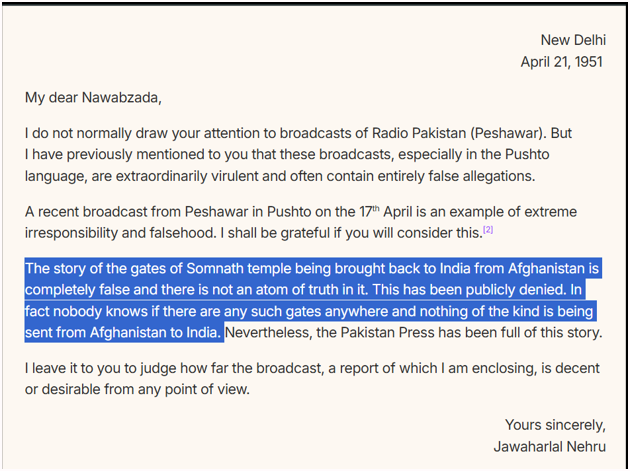
#8 21 April 1951 – To Liaquat Ali Khan (Prime Minister of Pakistan)
Nehru reassured Pakistan that claims surrounding Somnath symbolism were “completely false,” choosing to placate Pakistan rather than counter its propaganda.
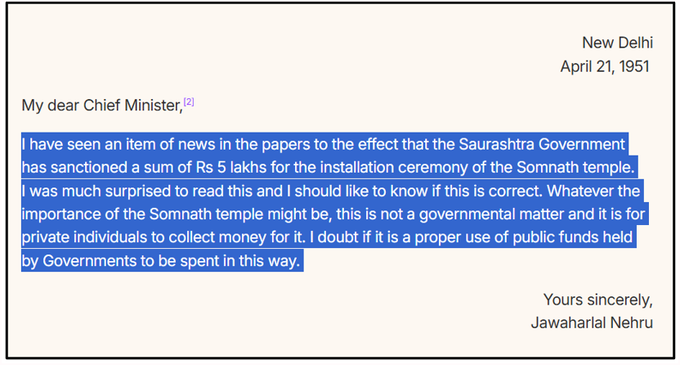
#9 21 April 1951 – To U.N. Dhebar (Chief Minister, Saurashtra)
He objected to the use of public funds for the Somnath ceremony, invoking secular propriety and insisting temples were not a government concern.
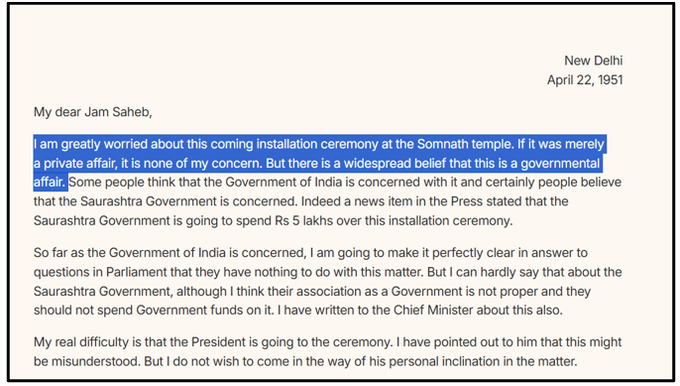
#10 22 April 1951 – To Digvijaysinghji (Jam Saheb of Nawanagar)
Nehru expressed anxiety over Somnath trustees contacting foreign missions for sacred river water and soil, fearing diplomatic misinterpretation.
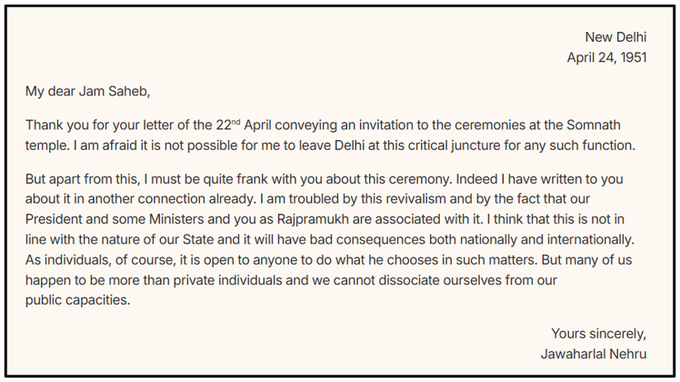
#11 24 April 1951 – To Digvijaysinghji (Second Letter)
He described the inauguration as “revivalism” and warned of “bad consequences nationally and internationally” if constitutional authorities participated.
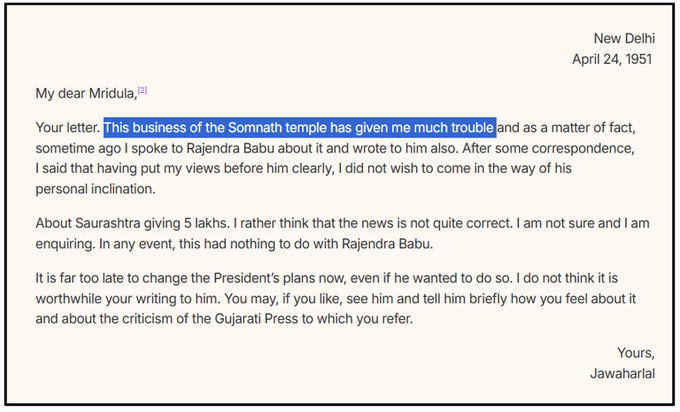
#12 24 April 1051 – To Mridula Sarabhai (Congress Leader)
In this letter, he says “this business of the Somnath temple” had given him “much trouble”. He says it is not worthwhile to change the President’s plans but pushes her to talk about another criticism.
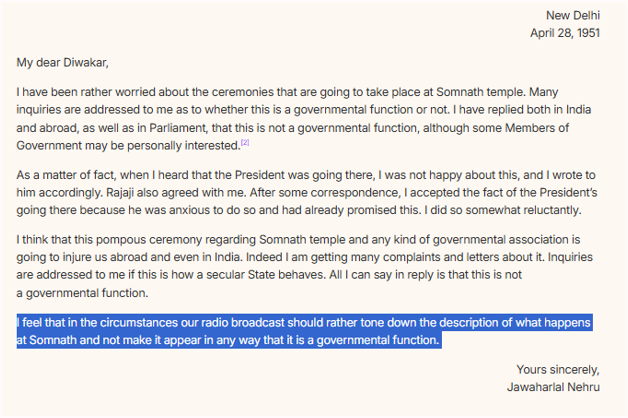
#13 28 April 1951 – To R.R. Diwaker (Minister of Information & Broadcasting)
Nehru instructed that media coverage and AIR broadcasts of the inauguration be toned down, calling the ceremony pompous and image-damaging.
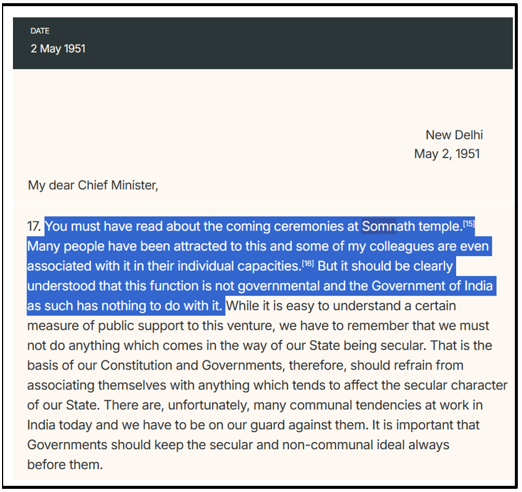
#14 2 May 1951 – To Chief Ministers (First Letter)
He emphasised that the Government of India must distance itself from Somnath and warned against any official participation despite popular support.
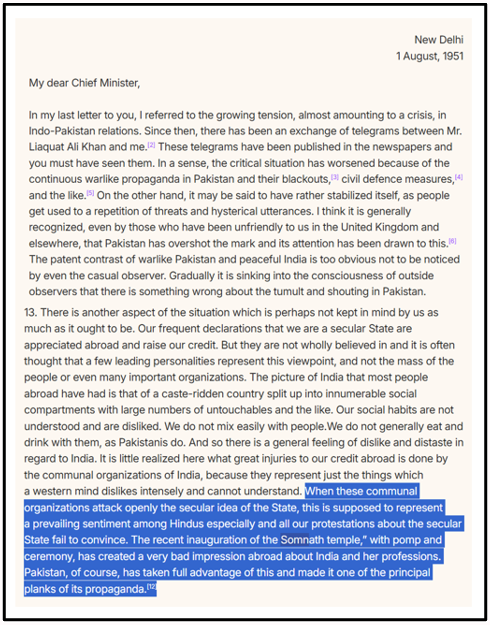
#15 1 August 1951 – To Chief Ministers (Second Letter)
In a follow-up, Nehru reiterated the same position, stressing secularism and non-association even as ministers and public figures supported the event.
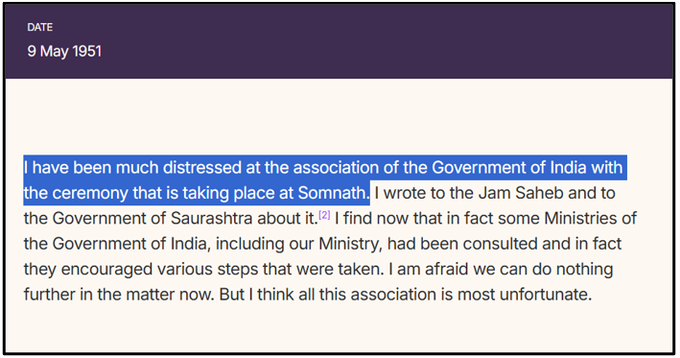
#16 9 May 1951 – To S. Dutt (Secretary, MEA)
Just days before the inauguration, Nehru objected again to any government linkage with Somnath, calling such association “most unfortunate.”
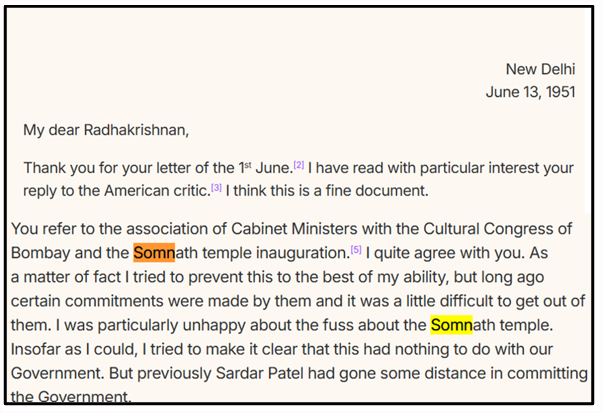
#17 13 June 1951 – To Vice President Dr S. Radhakrishnan
He dismissed the inauguration as unnecessary “fuss” and admitted he had tried to stop cabinet ministers from attending.
#18 1 August 1951 – To Chief Ministers
Even months after the inauguration, Nehru blamed the Somnath ceremony for creating a “very bad impression abroad” and weakening India’s secular image.
A Persistent Theme
Across all 17 letters, a consistent theme emerges: Nehru viewed the reconstruction and consecration of Somnath not merely as a religious act but as a political and diplomatic liability. He repeatedly prioritised secular optics, international perception, and Pakistan’s reactions over the civilisational symbolism attached to the temple.
Despite his sustained efforts, the Somnath Temple was inaugurated as planned, with President Rajendra Prasad asserting that the reconstruction represented India’s cultural continuity rather than state-sponsored religion.
Somnath’s Revival and Nehru’s Reluctance
As India marks a millennium since the 1026 destruction of Somnath, the temple’s resilience stands in contrast to the early Republic’s discomfort with Hindu civilisational revival.
Nehru’s letters remain a written record of how India’s first Prime Minister sought to suppress, sanitise, and politically distance the Republic from a revival he neither understood nor endorsed.
(This article is based on an X Thread By StarBoy Tarun)
Subscribe to our channels on Telegram, WhatsApp, and Instagram and get the best stories of the day delivered to you personally.