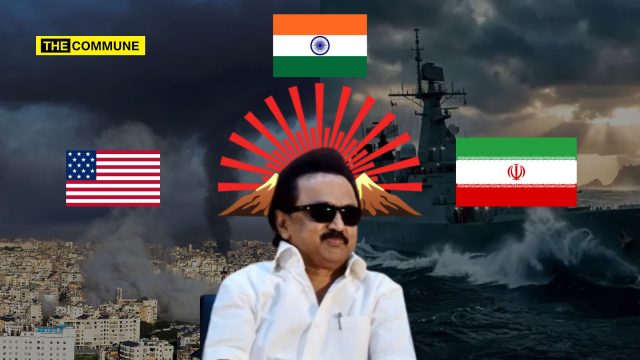
Tamil Nadu Chief Minister M. K. Stalin drew attention on social media after commenting on recent developments involving global oil supply and sanctions, but his remarks have triggered criticism from observers who say they were based on a misunderstanding of India’s energy policy.
The controversy began after the United States announced a temporary easing of sanctions to allow India to purchase Russian oil that is currently stranded at sea amid escalating tensions in the Middle East. According to a BBC report, the move came as millions of barrels of oil and gas remain stuck near the Strait of Hormuz, a narrow Gulf chokepoint through which nearly half of India’s crude oil and gas imports transit. The situation has grown tense after Iran warned that vessels attempting to pass through the area could face attacks following the conflict involving the United States and Israel.
In response to the development, Stalin posted a message on X criticising the Union government and questioning India’s strategic autonomy in foreign policy. In the post, he wrote: “When the United States decides to allow India to purchase Russian oil for just 30 days, it raises a fundamental question. Why should India need another country’s approval to secure its own energy needs? Equally troubling is the sinking of the unarmed Iranian warship IRIS Dena by the United States soon after it participated in the International Fleet Review 2026 naval exercise hosted by India in Visakhapatnam. When a ship that came to India as part of a multinational exercise meets such a fate, India cannot appear silent or passive. The Union BJP Government looks totally compromised on India’s long standing tradition of strategic autonomy and an independent foreign policy. India’s dignity in the international arena needs to be protected and the nation’s sovereignty and interests need to be defended.”
When the United States decides to allow India to purchase Russian oil for just 30 days, it raises a fundamental question. Why should India need another country’s approval to secure its own energy needs?
Equally troubling is the sinking of the unarmed Iranian warship IRIS Dena by…
— M.K.Stalin – தமிழ்நாட்டை தலைகுனிய விடமாட்டேன் (@mkstalin) March 6, 2026
However, the premise of Stalin’s criticism is flawed because India has never actually stopped importing Russian crude oil since the Ukraine conflict began.
Following Russia’s invasion of Ukraine in February 2022, Western nations imposed sweeping sanctions on Russian energy exports. Despite these restrictions, India continued importing Russian crude throughout the sanctions period and in fact significantly increased its purchases, taking advantage of steep price discounts offered by Russian suppliers.
Before the Russia-Ukraine war, Russia accounted for less than one percent of India’s crude imports. In the months following the sanctions, Indian refiners ramped up purchases sharply, with Russia’s share of India’s oil imports rising to nearly 40% at its peak. Even during periods of sustained diplomatic pressure from the United States and Europe, India maintained substantial Russian imports while also expanding purchases from other suppliers.
In fiscal year 2024–25, Russian crude accounted for an average of about 36% of India’s total imports, with volumes rising roughly seven percent year-on-year to around 1.88 million barrels per day. Monthly figures occasionally approached the 39-40% mark, reflecting Russia’s dominant position in India’s crude supply during that period.
Data from late 2025 shows that Russia’s share of India’s crude imports fell to a 38-month low of about 24.9% in December 2025, largely due to new sanctions targeting companies such as Rosneft and Lukoil and the European Union’s ban on Russian refined products. For January 2026, India imported approximately 1.2 million barrels per day of Russian oil, keeping Moscow as its single largest supplier.
Traditional suppliers such as Iraq and Saudi Arabia have continued to occupy the second and third positions in India’s crude supply chain, though their shares declined in recent years as Indian refiners shifted toward discounted Russian crude. In January 2026, Saudi Arabia supplied about 774,000 barrels per day to India, significantly lower than Russia’s volumes.
These figures illustrate that India never halted Russian oil imports and has instead maintained a diversified sourcing strategy aimed at protecting domestic energy security while taking advantage of favourable global pricing.
As a result, Stalin’s remarks suggesting that India needed US approval to purchase Russian oil were based on an incorrect assumption about India’s actual energy trade practices.
Subscribe to our channels on Telegram, WhatsApp, and Instagram and get the best stories of the day delivered to you personally.