The Supreme Court delivered its order for the case challenging the Waqf (Amendment) Act 2025 on 15 September 2025. Tamil Nadu Chief Minister MK Stalin claimed that the Supreme Court had stayed “key provisions” of the Union government’s Waqf (Amendment) Act, 2025, including the removal of the “Waqf by user” clause.
Taking to his official X handle, Stalin wrote, “Today, in the DMK’s petition and other writ petitions challenging the amendments to the #WaqfAct, the Hon’ble Supreme Court of India has stayed the following key provisions of the BJP Government’s amendments:
i) The mandatory 5-year practice requirement before dedicating a Waqf
ii) The power to divest Waqf properties on mere allegation of being government property pending report of a designated officer or decision of Government
iii) The Collector’s power to denotify ‘Waqf by user’ (property treated as Waqf after long period of religious use)
iv) Inclusion of more than 4 non-Muslim members in the Central Waqf Board and more than 3 in the State Waqf Boards, thereby ensuring Muslim majority in these Boards
This order is a major step towards undoing the unconstitutional and illegal amendments made by the BJP Government. The DMK has consistently opposed these amendments from the time the Bill was introduced in Parliament. After it became an Act, the DMK challenged it in the Supreme Court and succeeded, alongside others. The DMK Government also passed an assembly resolution urging the Union Government to withdraw the #WaqfAmendment Bill, countering the BJP’s attempt to misuse governmental power. Today’s order strengthens the hope and trust that people place in the Hon’ble Supreme Court to safeguard the religious rights of the Muslim minority community and to uphold the Constitution.”
தி.மு.க.வும் மற்ற மனுதாரர்களும் வக்பு திருத்தச் சட்டத்துக்கு எதிராகத் தொடர்ந்த வழக்கில், ஒன்றிய பா.ஜ.க. அரசு கொண்டு வந்துள்ள முக்கியத் திருத்தங்களுக்குத் தடை விதித்து மாண்பமை உச்சநீதிமன்றம் இன்று உத்தரவிட்டுள்ளது.
1) வக்புக்குச் சொத்தை அளிக்க, 5 ஆண்டு இஸ்லாத்தைக் கட்டாயமாக… pic.twitter.com/xosLNjGbVU
— M.K.Stalin – தமிழ்நாட்டை தலைகுனிய விடமாட்டேன் (@mkstalin) September 15, 2025
However, the Supreme Court’s ruling did not go as far as Stalin suggested. A bench led by Chief Justice B.R. Gavai and Justice A.G. Masih upheld the overall validity of the Waqf Amendment Act and allowed its implementation. The Court stayed only two provisions: the requirement that a person must have practiced Islam for five years to dedicate property as Waqf, and a clause empowering government officers to declare Waqf land as state land. It also clarified that while non-Muslims may be appointed to Waqf Boards, their number cannot exceed four in a 20-member central board or three in an 11-member state board.
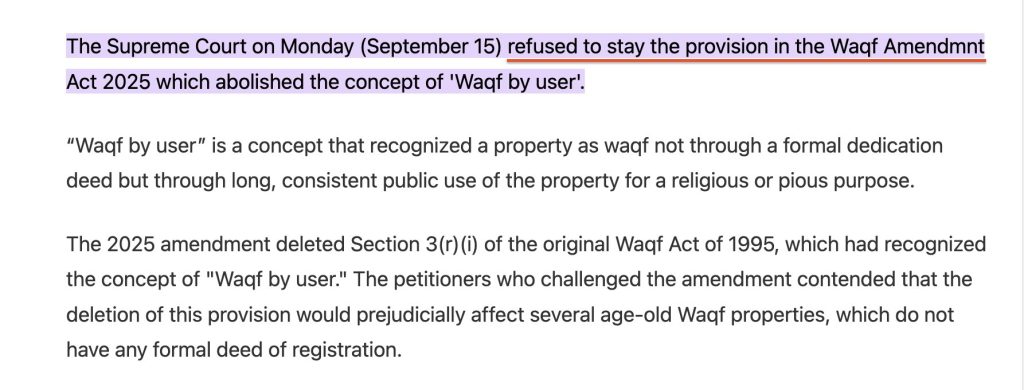
Crucially, the bench refused to suspend the deletion of the “Waqf by user” provision, which had allowed properties to be treated as Waqf after long-term religious use. That amendment remains in force despite petitions challenging it.
The Court allowed the Act’s implementation, including the requirement for Waqf properties to be registered by users, noting that a similar registration mandate had existed between 1995 and 2013. However, it issued interim directions against enforcement of certain contested clauses.
Provisions Stayed by the Court
Five-year practice requirement: Section 3(1)(r), which required an individual to have practiced Islam for at least five years to dedicate a property as Waqf, has been put on hold until state governments frame clear rules to avoid arbitrary implementation.
Encroachment reporting power: A provision allowing a government-appointed officer to declare whether Waqf property encroaches on state land, thereby authorizing the government to alter Waqf records, was stayed. The bench ruled that such determinations must follow proper judicial process.
Non-Muslim membership cap clarification: The Court did not strike down provisions allowing non-Muslims to sit on Waqf Boards but limited their number to a maximum of four in a 20-member Central Board and three in an 11-member State Board, ensuring Muslim majority representation.
What the Court Did Not Stay
Importantly, the bench refused to stay the deletion of the ‘Waqf by user’ clause, which earlier allowed property to be treated as Waqf after long-term religious use. This provision remains in effect despite petitions challenging it.
The case stems from multiple writ petitions, including one filed by the DMK, against the 2025 amendments. While the Court provided limited interim relief, the larger question of the Act’s validity will be taken up later.
Subscribe to our channels on Telegram, WhatsApp, and Instagram and get the best stories of the day delivered to you personally.