


The Office of the Chief Electoral Officer (CEO), Bihar, has strongly refuted a report published by Newslaundry alleging large-scale irregularities in the state’s electoral rolls. Calling the report “misleading” and “selectively presented,” the CEO issued a point-by-point clarification, stressing that the Special Intensive Revision (SIR) exercise in the state was conducted transparently and on an unprecedented scale.
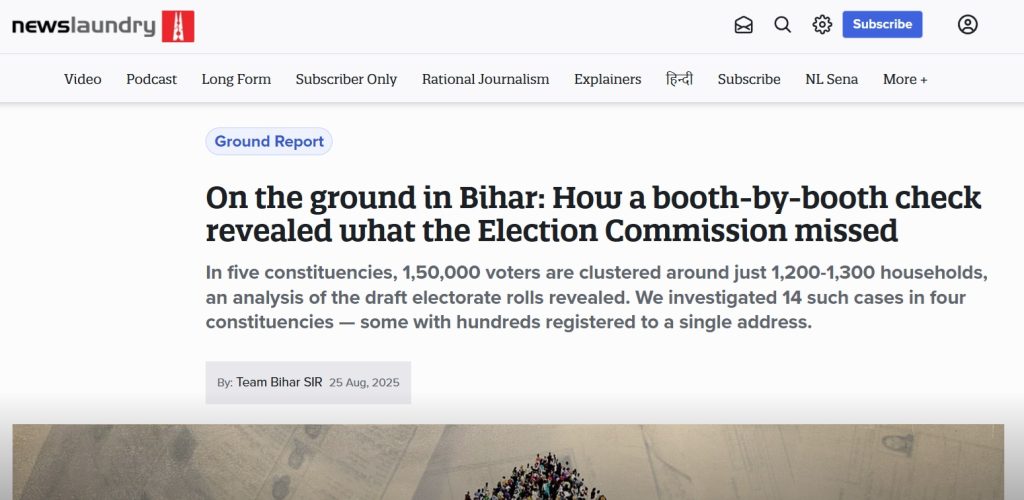
The Newslaundry report , published on 25 August 2025, claimed that in several constituencies, hundreds of voters were registered at single addresses and that the Election Commission had failed to verify them through door-to-door checks.

In a statement, the CEO’s office countered these claims:
#1 Verification Process Undertaken
The CEO clarified that during the SIR, door-to-door verification of 7.89 crore voters was carried out by Booth Level Officers (BLOs). Of the 7.24 crore electors listed in the Draft Roll published on August 1, documents of 99.11% of voters had already been collected. Verification work for the remaining electors is still ongoing. The claim that no verification was done was termed “baseless and fabricated.”
#2 Voter Clustering Explained
Responding to Newslaundry’s findings of large “clusters” of voters at single addresses, the CEO said this was a common socio-geographical feature in rural and semi-urban Bihar, where multiple families often live under one khata number, tola, or mohalla without formal house numbers. “Clustering at the same address is not an irregularity but a reflection of local realities,” the statement read.
#3 Incorrect Addresses and Unknown Names
The CEO pointed out that many students, migrant workers, and tenants may be registered under a particular household but are not currently residing there, which could explain why some residents claimed not to know the names on the rolls. Any discrepancies are being addressed through Form-7 (Deletion) and Form-8 (Address Correction) under the ongoing claims and objections process.
#4 Transparency of Electoral Process
The Commission emphasized that the system remains open and transparent. After the Draft Roll was published, all political parties and citizens were given the opportunity to file claims and objections, both online and offline, from 1 August 2025 to 1 September 2025.
#5 Sample Size of Investigation Questioned
The CEO criticized Newslaundry for drawing sweeping conclusions based on 14 cases across four constituencies, while the SIR exercise covers 7.89 crore voters across 243 assembly constituencies. “Questioning the credibility of the entire process on the basis of such a selectively chosen and statistically insignificant sample is neither rational nor objective,” the statement said.
The Election Commission has maintained that it welcomes genuine corrections and citizen participation in ensuring accurate rolls but warned against “mischaracterizing isolated issues as systemic failures.”
Newslaundry की रिपोर्ट की तथ्यों पर आधारित पड़ताल, Newslaundry की यह रिपोर्ट भ्रामक है।
1. विशेष गहन पुनरीक्षण (SIR) का दायरा और प्रक्रिया
बिहार में विशेष गहन पुनरीक्षण अवधि में 7.89 करोड़ मतदाताओं का घर-घर जाकर सत्यापन बूथ लेवल अधिकारियों द्वारा किया गया।
दिनांक 01… https://t.co/X4VZnlD7Dc— Chief Electoral Officer, Bihar (@CEOBihar) August 26, 2025
Subscribe to our channels on Telegram, WhatsApp, and Instagram and get the best stories of the day delivered to you personally.