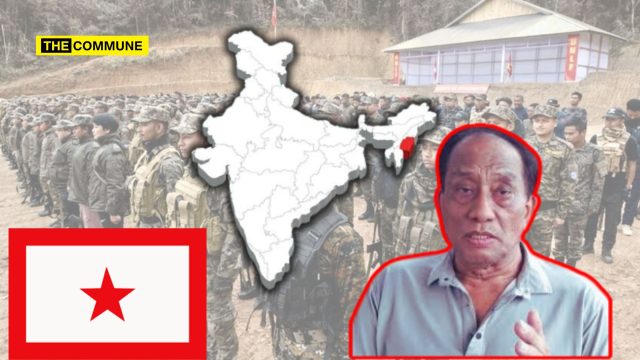
RK Meghen, the former chairman of the banned United National Liberation Front (UNLF), a Manipur-based terror group fighting for an “independent socialist Manipur,” recently gave a dangerous interview to The Lungleng Show.
In the conversation, he made several alarming statements undermining India’s sovereignty, predicting its breakup, and endorsing secessionist movements in Tamil Nadu, Punjab, and Bengal. UNLF is an organization banned by NIA in India, it is also listed as a terrorist organization as per the Ministry of Home Affairs in the First Schedule of the UAPA.
Why does Influencer gives platform to terrorists?
RK Meghen, aka Sana Yaima the leader of the UNLF is openly threatening that India won’t last.
Can you arrest both the podcaster & the terrorist for making such remarks? @manipur_police @NIA_India pic.twitter.com/rAQNBXk4tg
— Squint Neon (@TheSquind) July 27, 2025
Meghen, who spent years in jail under the Unlawful Activities (Prevention) Act (UAPA) before being released in 2019, remains unrepentant. His remarks are not just ideological rhetoric; they are a direct challenge to India’s constitutional integrity and internal security.
In the first 10-15 minutes of The Lungleng Show interview with RK Meghen (alias Sana Yaima), lays out his historical and ideological grievances against the Indian state. He begins by asserting that Manipur was a sovereign nation prior to its merger with India in 1949 and claims the annexation was neither voluntary nor democratic. Meghen says that the Indian Constitution was imposed on the people of Manipur without their consent and argues that the current federal structure is a façade masking centralized control from Delhi.
He repeatedly calls for the right of Manipur to reclaim its sovereignty and have its own constitution. Dismissing India’s nationhood as a colonial construct, he insists that people of the Northeast never identified as Indian in the first place. Meghen also draws parallels between Manipur’s situation and international conflicts like Ukraine-Russia, portraying both as struggles for freedom. Notably, he references political voices in Tamil Nadu that have questioned their continued participation in the Indian Union, claiming such sentiments show that Manipur is “not alone.” While Meghen avoids directly calling for violence, he defends armed resistance as a historically necessary path when democratic options are blocked by coercive state power.
Problematic Statements That Are A Threat To National Security
Through the 54-minute podcast, Meghen makes some very inflammatory statements that are secessionist, that attack India’s sovereignty and also rejects Indian constitution.
“The idea of India historically is a very very weak idea. A very young nation in that sense. Manipur is older nation than India. I remember a remark by Mountbatten who said, India will not last 100 years. I think he a historical remark. What’s happening in India today? India is boiling inside and the Dravidian south, the Aryan north and the in the east the Bengal and the rise of Maratha nationalism and Punjab Sikh nationalism, the Khalistan is there these factors I see may be weak today, it’s going to become stronger and sour.”
He cited “rising regional nationalism” in Tamil Nadu, Punjab, and Maharashtra as signs of India’s impending fragmentation. Such rhetoric fuels secessionist narratives and emboldens anti-India forces.
By legitimizing these movements, he indirectly supports forces that India has long fought to neutralize.
“Bengal they are a nation by themselves. The East Bengal is now Bangladesh West Bengal. Mamata Banerjee wants Bengal to be renamed as Bangla, but centre is not allowing because from Bangla, Bangladesh is not far, The joining of the two Bengals. Just like you know East German and East Germany and West Germany. Okay. It was artificially divided. I see. And Bengal same thing. East Bengal and West Bengal was divided during British rule. The sharpening of internal contradictions within India will lead to its breakup. Just like East and West Germany reunited, Bengal will too.”
Meghen claimed that Bengal is a single nation divided by colonial rule and compared it to the division of East and West Germany. He suggested that the renaming of West Bengal to “Bangla” was being blocked by the Centre to prevent symbolic closeness with Bangladesh and predicted that India’s internal contradictions would eventually lead to its breakup and Bengal’s reunification.
“… it is an existential threat and survival not just about sovereignty independence sovereignty independence is a very vague term to the people common people okay but now the reality is that we are being swamped by outsiders whether from Bangladesh Nepal or mainland India”
Makes secessionist statements by framing India as “mainland India” and calling Indians as “outsiders”, clubbing them with actual foreign nations like Bangladesh and Nepal, implicitly treating India as an external entity rather than a national home. By describing the presence of these groups as an “existential threat,” Meghen portrays Manipur’s identity as under siege from within the Indian state. Additionally, dismissing the idea of “sovereignty and independence” as vague while immediately decrying Indian influence suggests a coded attempt to legitimize ethno-nationalist grievances without an outright call for secession.
“Nobody has regained sovereignty dependence through a negotiation process. definitely the talks process uh weakens the struggle. I strongly feel that the government of India has always used the talks process as a tool to divide the revolutionary struggles and finish one by one. It has happened. It’s happening right there. It is happening and it will happen.”
Meghen dismisses peace talks as a government tactic to divide and weaken “revolutionary struggles,” suggesting that sovereignty cannot be regained through negotiation. This framing delegitimizes democratic processes and implicitly endorses armed resistance. By portraying the Indian state as deceitful and revolutionary groups as justified, his statement reinforces a secessionist worldview and encourages continued insurgency rather than political resolution.
“They picked me up from Bangladesh… I was kept under detention in Dhaka for 60 days… with the help of the Bangladesh government. Hasina’s government was directly involved in that. Not just me, also Tripura and Bodo leaders… We knew it would happen. But this new dispensation, I think, looks at our struggles as a freedom struggle.”
Meghen openly admits to using Bangladesh as a base for revolutionary activity, framing Indian operations to capture insurgents as hostile acts enabled by a foreign ally. He expresses hope that the new government in Bangladesh will support “freedom struggles” in India, thereby legitimizing secessionist militancy and seeking international political backing for it – a direct challenge to Indian sovereignty.
“The Manipur Merger Agreement was forced, not voluntary. It was an annexation, not integration.”
Meghen denied Manipur’s accession to India in 1949. This false historical revisionism is a staple of insurgent propaganda, used to justify armed struggle against the Indian state.
“Talks with India are a trap to weaken revolutionaries. Nagaland’s peace talks have failed, and Manipur’s struggle will continue.”
Meghen asserted that “sovereignty cannot be negotiated” and that armed struggle is the only way. His dismissal of democratic dialogue and advocacy for violence is a direct threat to India’s internal stability.
When questioned, if he “looked forward to the day where India will be disintegrated that all these regional powers can gain back their independence? “, Meghen replied, “I’m not looking forward like that, but the inevitable historical process will happen.”
While he tried to wriggle himself out of the tight spot the host put him in, Meghen’s words only reflect his true feelings – secessionism and a disintegrated India.
Meghen has consistently called for a plebiscite under UN supervision in Manipur to decide, “whether the people of Manipur would like to be part of the Indian Union or not.” He regards the Manipur-India political conflict as unresolved and accuses the Indian government of denying Manipuris the right to self-determination. He has publicly accused Indian security forces of racism, claiming anti-terror operations in the North East are conducted with a “racist attitude.” He asserts that alleged excesses by Indian security forces are based on ethnic profiling, which not only deepens divisions but also fuels anti-India narratives. In statements to the media after his release, Meghen declared he “would give [his] life for the people of Manipur,” portraying separatism as a noble struggle and himself as a martyr ready to inspire future generations. Meghen’s continued rhetoric risks reigniting dormant separatist tendencies not just in Manipur, but across the Indian Union by referencing other regions like Tamil Nadu. By presenting India as an unnatural union, he actively undermines the constitutional and territorial integrity of the country.
Subscribe to our channels on Telegram, WhatsApp, and Instagram and get the best stories of the day delivered to you personally.