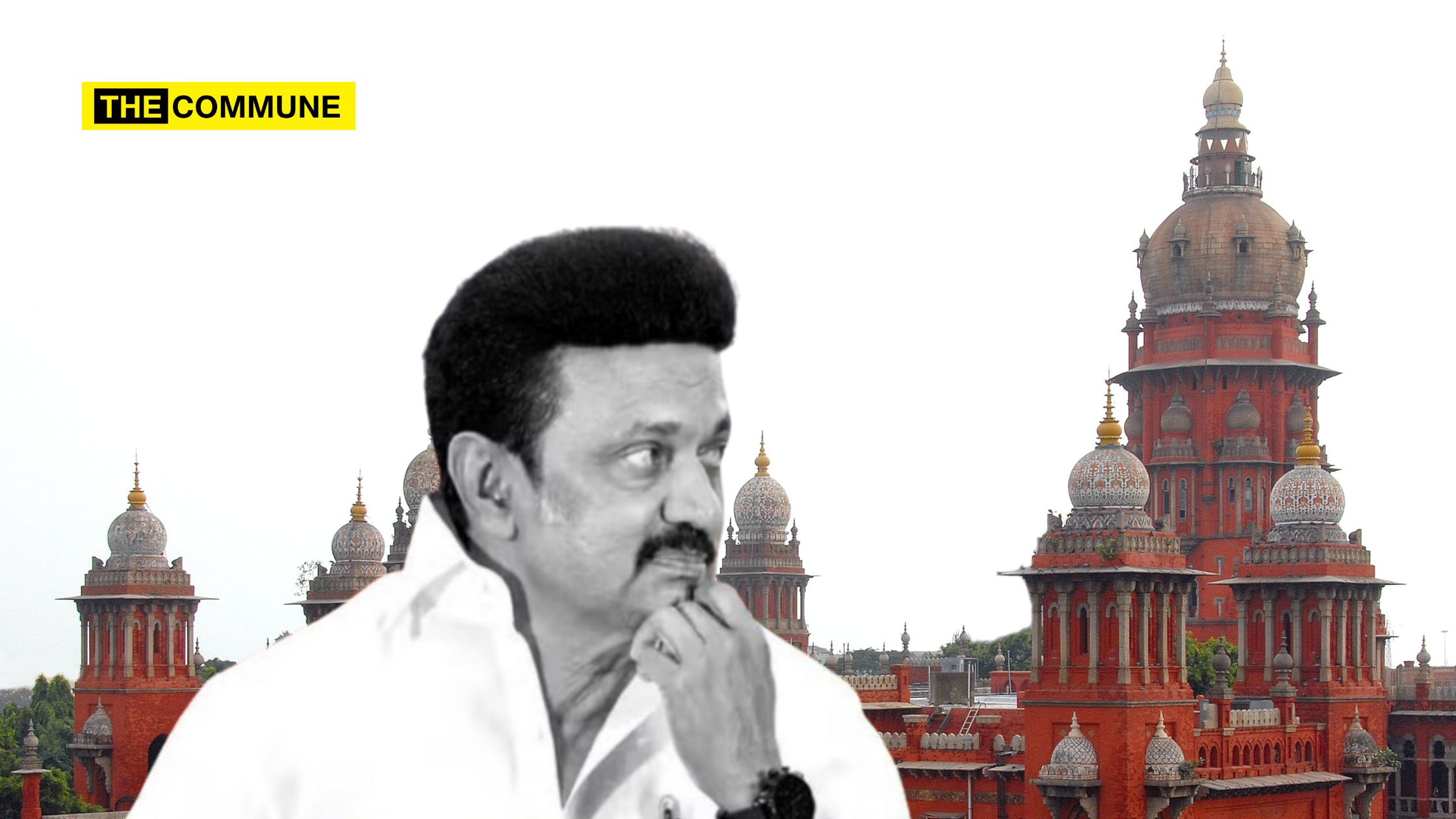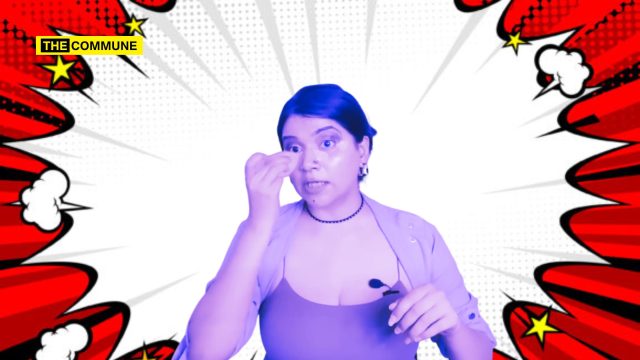
A few days ago, self-styled “historian” and makeup artist Ruchika Sharma triggered backlash at The Debate 2026, organised by the Calcutta Debating Circle, after claiming that Mariyamman was derived from the Christian Mary while arguing the motion “Hinduism Needs Protection From Hindutva.” Sharma, who spoke alongside Mahua Moitra, also asserted that Hinduism was largely shaped by external religious influences. She claimed that the Hindu deity Mariyamman was Mary which scholars and historians rejected, pointing out that Mariyamman is an ancient Tamil rain and fertility goddess rooted in folk-Shaiva traditions, predating Christianity by centuries. Critics accused Sharma of recycling colonial misreadings, ignoring Tamil linguistic evidence, temple history, and epigraphy, and reducing complex indigenous traditions to ideological caricatures.
With this controversy simmering, old videos of her claims started circulating on social media. In one such video, she is seen sitting on a panel discussion of News18 from 6 months ago. In the video, on the topic of brutality by Mughal invaders on Hindus and temples, she said, “I’d like to bring two examples of cruelty and brutality over here which the NCERT has missed and therefore I think NCERT is indulging in incomplete histories. First of all, there is a inscription on a temple in Tamil Nadu by Rajathiraja Chola and his people which says that Rajathiraja Chola in the 11th century went to Ceylon which is today called Sri Lanka and there was a Pandya ruler ruling over there called Veera Salamagan. After he defeated Vira Salamagan what he does is he cuts the nose off of Veera Salamagan’s mother and then loots his entire haram including Veera Salamagan’s sister and Vir Salamagan’s own daughter. They’re both abducted and uh kidnapped and they’re taken back to Tamil Nadu in the Chola Kingdom. This particular example of brutality is just nowhere there. In fact, if you look at any monarch, which monarch has gone and conquered a particular place without instances of brutality? Which particular monarch has not killed people in order to conquer a particular place? If you look at Akbar’s reign for example, since we’re talking about Chittorgarh, this is a person who ruled from 1560 all the way to 1605. Now this is 45 years. In in his 45 years of reign, there is only one instance that the NCERT could pick up and then use that to label him as cruel.”
The news anchor called out her hypocrisy and lack of understanding of what brutality is while comparing Islamic invaders and Hindu kings.
Distorian “Ruchika Sharma” got caught by the anchor on live TV debate 😡 pic.twitter.com/RBB2wWdt4P
— Praveen Shetty🇮🇳 (@ExpertShetty) January 17, 2026
Following this, she got schooled by historian TS Krishnan about the Chola king and what Meikeerthi of Rajadhiraja Chola actually meant. Sharma was relying on what seems to be a verbatim translation of the Tamil script rather than read it for what it is.
The Meikeerthi of Rajadhiraja Chola itself. It states: “விளங்குமுடி கவித்த வீரசாலமேகன் போர்க்களத்தஞ்சித்தன் கார்க்களி றிழிந்து கவ்வையுற்றோடக் காதலியொடுந்தன் றவ்வையைப் பிடித்துத் தாயைமூக் கரிய ஆங்கவ மானம் நீக்குதற்காக மீட்டும் வந்து வாட்டொழில் புரிந்து”
The question of brutality is a very interesting question of brutality. Rajadhiraja Chola did not personally campaign in Lanka; it was the Chola army that fought three Sri Lankan rulers. The Meikeerthi records that Veera Salamegan fled the battlefield, leaving his family behind, and later returned to fight in an attempt to redeem his honour, where he was defeated. Crucially, the inscription makes no reference to any attack on a harem. As a poetic eulogy, the Meikeerthi uses figurative language, terms such as mūkkariya signify humiliation and loss of honour, not physical mutilation. Interpreting such metaphors literally reflects a poor understanding of Tamil literary conventions, and equating these battlefield episodes with large-scale atrocities against civilians is historically and ethically unsound.
As further clarifications are being sought regarding the claims made by a “history degree holder”—but not a historian—it is necessary to turn to the Meikeerthi of Rajadhiraja Chola itself. It states:
“விளங்குமுடி கவித்த வீரசாலமேகன்
போர்க்களத்தஞ்சித்தன் கார்க்களி றிழிந்து… https://t.co/22GHGrGSbR— 𑀓𑀺𑀭𑀼𑀱𑁆𑀡𑀷𑁆 🇮🇳 (@tskrishnan) January 18, 2026
But Ruchika Sharma was relentlessly defending herself while abusing the senior historian.
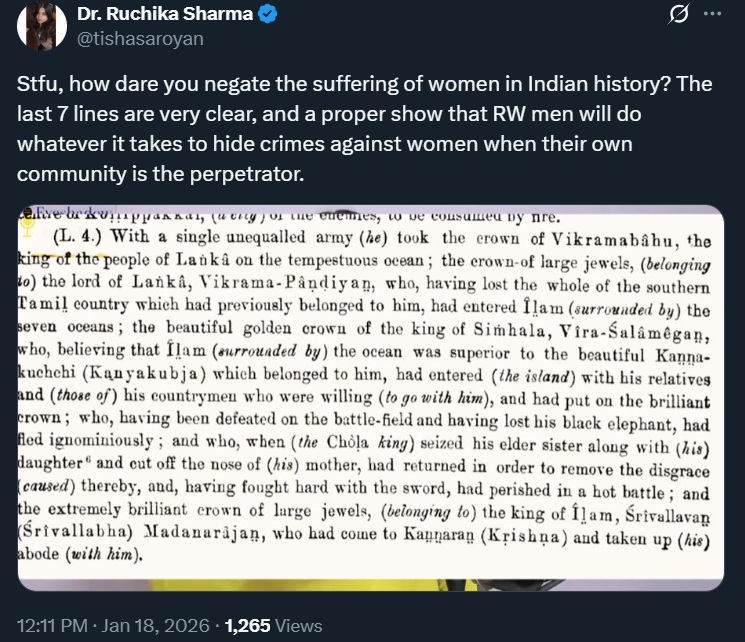
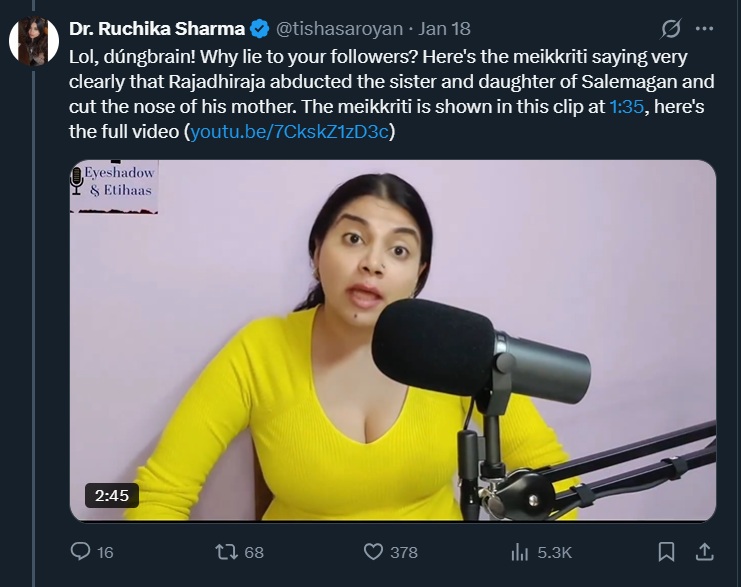 Despite trying to make sense of a person from the Tamil land, Sharma went on and on about her lies. She then questioned, “Stfu, how dare you negate the suffering of women in Indian history? The last 7 lines are very clear, and a proper show that RW men will do whatever it takes to hide crimes against women when their own community is the perpetrator.”
She blamed “right wing” of trying to hide the crimes against women, just because the king was a Hindu.
So, when she brought up the topic of people trying to hide crimes of the perpetrator, netizens reminded her of her own story – when she tried to hide the abuse she suffered at the hands of a Muslim boyfriend which she revealed in May 2025 when the allegations of sexual abuse and domestic violence made by a woman against Omar Rashid, a contributor associated with The Wire came out. Sharma shared the survivor’s account and wrote that it was “deeply triggering” due to her own experience of a long abusive relationship. She wrote, “Reading the allegations levelled against Omar Rashid was deeply triggering and very relatable as someone who has now (for the past 3.5 years) been successfully clean of a 10 year-long mentally and physically abusive relationship. The part where she says he would beat her up and then record her as being the hysterical one, is word by word true for my abusive ex too. Wonder if abusive chomus exchange notes on how to torture women!! Equally sad but predictable to see this woman’s harrowing experience be used to fan Islamophobia. This is also the reason why I decided a few moons ago to not call out my aggressor because I know the dingbat Sanghis will just use it to further their own horrible communal agenda. But maybe as she says silence is not the answer.”
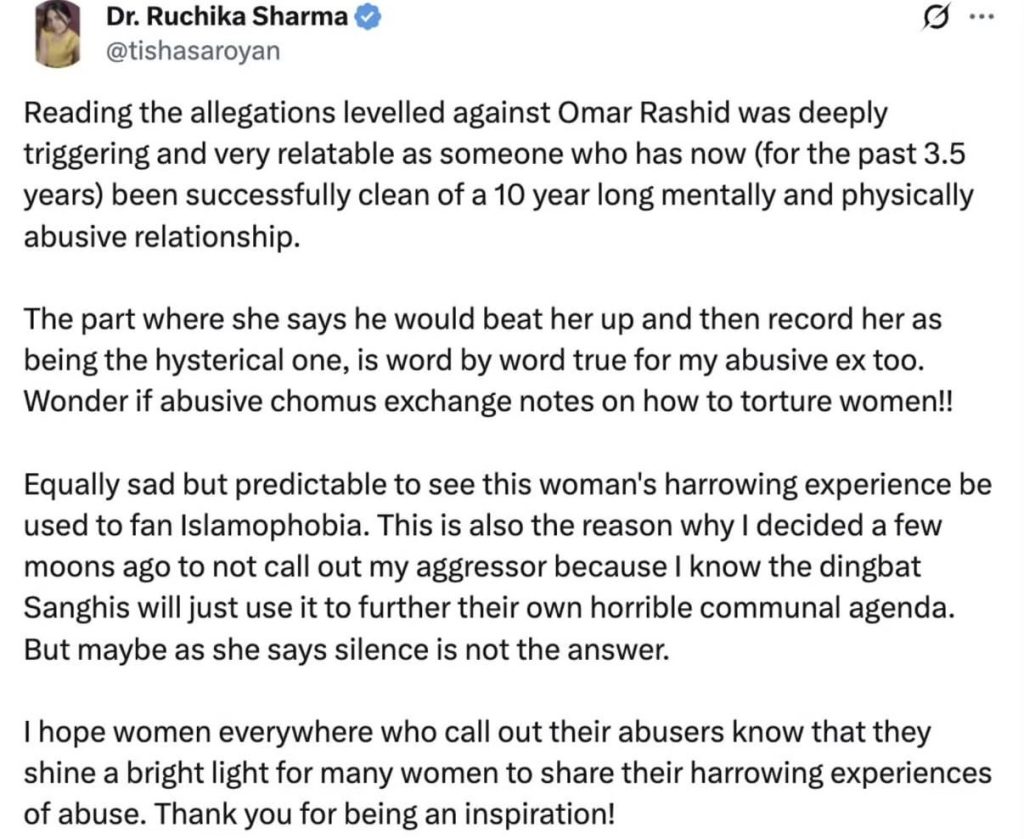
Sharma has effectively acknowledged that she remained silent about alleged abuse in her own life to protect a political narrative, while now aggressively accusing others of “negating the suffering of women” for disputing her historically unsupported reading of a medieval inscription. This is a contradiction.
By her own words, silence was acceptable when disclosure threatened an ideological cause. Yet she now adopts absolutist moral outrage, branding disagreement as misogyny and violence against women. That posture collapses under scrutiny. One cannot argue that silence is sometimes necessary for political optics and simultaneously weaponise women’s suffering to shut down scholarly rebuttal.
What this episode ultimately exposes is not a disagreement over history, but a collapse of intellectual and moral consistency. Ruchika Sharma demanded absolute deference to her claims in the name of women’s suffering, while openly admitting that she herself chose silence when speaking out threatened a preferred political narrative. She treated disagreement as violence, scholarship as misogyny, and correction as communal conspiracy.
Instead of admitting that she may have been wrong in interpreting the Tamil scripture, she resorted to abuse. History cannot be written through abuse, selective outrage, or ideological immunity. Feminism cannot function as a switch turned on only when it targets Hindus, and off when it inconveniences other identities. When trauma is invoked not to seek truth but to silence it, scholarship ends and propaganda begins.
Subscribe to our channels on Telegram, WhatsApp, and Instagram and get the best stories of the day delivered to you personally.