


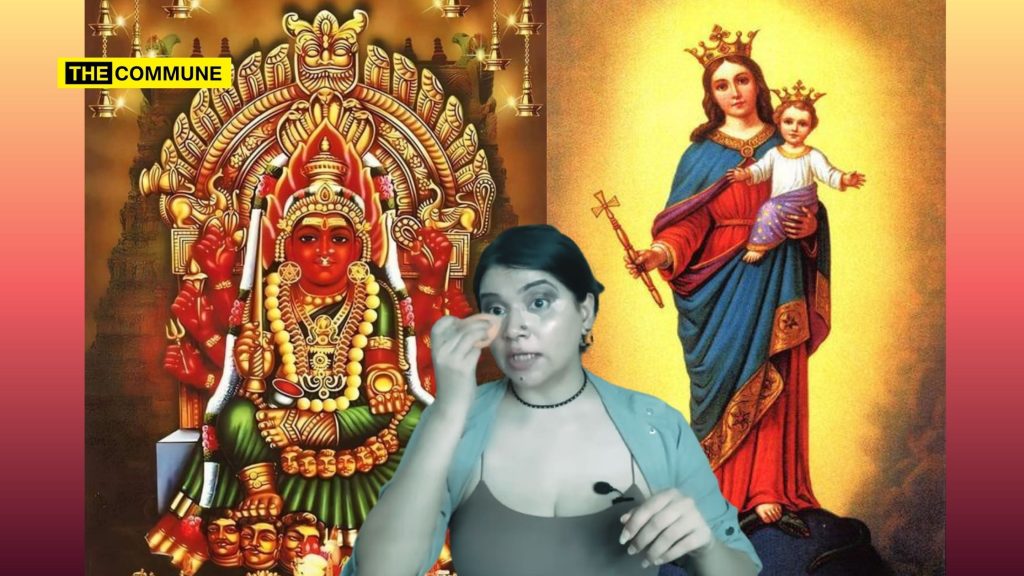
Self-described “historian” Ruchika Sharma, who is often seen applying makeup on her YouTube videos while ‘explaining history’, has triggered sharp criticism during her appearance at The Debate 2026, organised by the Calcutta Debating Circle, after making sweeping and historically untenable claims about Hindu traditions while arguing for the motion “Hinduism Needs Protection From Hindutva.”
The event featured speakers opposing the motion, including Swapan Dasgupta, Sudhanshu Trivedi, Agnimitra Paul, and J Sai Deepak, while Sharma spoke in support of the motion alongside Mahua Moitra, Mani Shankar Aiyar, and Ashutosh. The discussion was moderated by Prasenjit K Basu and Mridula Mukherjee.
During her intervention, Sharma argued that Hinduism is inherently pluralistic and accused proponents of Hindutva of misunderstanding its historical formation. While citing texts such as Dabistan-i Mazahib and Kitab al-Hind, she claimed Hindu traditions evolved primarily through the assimilation of local cults and external influences, including Buddhism, Jainism, Sufism, and Christianity. She said, “Two travellers who come over here say, yes, the word is “Indu”. But everyone defines their territory by their own words. Starting from the 7th century, the term itself is pluralistic. A 16th‑century work – and before that Al‑Biruni. The 16th‑century work being Dabistan‑i Mazahib, and before that Al‑Biruni’s, of course, Kitab al‑Hind. Both of which say that Hinduism in itself, or the religion of the non‑Muslims of Hind, is in a sense pluralistic. It is not defined by a single framework. And this is my problem with the opposition. They do not know how Hinduism has been formed. It has been formed by the worship of the likes of the goddess Pampa. Pampa was a local cult deity, assimilated into the Shaiva fold as a form of Shakti. By the worship of Jagannath, again a local cult deity, assimilated into Vaishnavism. By the likes of the worship of Krishna, whose assimilation with a local cowherd deity called Gopal made him extremely popular. But it also included the worship of a very fantastic personality called Pir Baba Haji Ratan Nath – a Nathpanthi and a Sufi saint. His shrine is still there in Peshawar, dedicated to Shiv, outside his Pir Baba’s, mazar. He is the Haji Ratan Nath of the same Nathpanthis of which Adityanath, the Chief Minister of UP, boasts himself to be from. It is extremely sad that from there we have come to this. And it is absolutely interesting that Hinduism took from Mahayana Buddhism the art of temple‑making, the art of idol‑making. From Jainism, the concepts of Ashtadikpala, the eight guardian deities of the temple. William Sleeman in 1849, when he is going through Bahraich, says, “Hindus and Muslims revered the shrine of Syed Salar.” Neither of them required their religion to be changed. They could just worship whoever they wanted to worship.”
In the course of her remarks, Sharma made the assertion that “Mariamma was, of course, the Christian Mary,” presenting it as evidence of Hinduism’s absorptive character. She further stated that colonial definitions of Hinduism as “non-Muslim” and “non-Christian” were later adopted wholesale by Hindutva ideologues. She said, “Mariamma was, of course, the Christian Mary. Interestingly, all of this was rubbished when the British came into being. I am glad Mr Deepak said that Hindutva was born here because colonialism was born here. Yes, Hindutva takes a lot from colonialism – most of all, its definition of Hindus. When the English came here, they defined Hinduism negatively, not positively – not as how I am defining it, as a pluralist entity. They defined it as non‑Muslim, non‑Christian. And that is exactly how Hindutva also defines Hinduism.”
Dr Ruchika Sharma buried Saffron Hindutva straight in under 4 minutes. pic.twitter.com/NStFuaxvCf
— Muralidharan Gopal (@muralitwit) January 14, 2026
This specific claim has drawn strong backlash from scholars and historians familiar with Tamil religious history, who say it reflects a fundamental ignorance of linguistic, cultural, and historical evidence. The Tamil word “Mari” denotes rain, and Mariyamman is a rain and fertility goddess deeply rooted in Tamil folk-Shaiva traditions. Far from being derived from Christianity, Mariyamman worship predates colonial contact by centuries and is integrally linked in Tamil oral and temple traditions to Renuka Devi, the mother of Parashurama.
Major Mariyamman temples such as Samayapuram and Punnainallur are attested well before European missionary activity, with continuity traceable to the Chola period and earlier. Equating Mariyamman with Mary is a colonial-era projection that sought to reinterpret indigenous deities through a Christian lens, rather than an authentic reflection of Tamil religious development.
Historians have also criticised Sharma for making such claims without engaging with Tamil literary sources, epigraphy, temple histories, or ethnographic scholarship. They argue that presenting colonial misreadings as historical fact, while accusing others of ignorance, undermines serious academic discussion and reduces complex indigenous traditions to convenient ideological tropes.
“Mariyamma was Mary” — this claim is not just incorrect, it reflects a complete ignorance of Tamil history, linguistics, and religious continuity.
The word “Mari” in Tamil means rain. The deity worshipped for rain, fertility, and protection from epidemics is Mariyamman — Amman… https://t.co/dJhPUpNsEq
— 𑀓𑀺𑀭𑀼𑀱𑁆𑀡𑀷𑁆 🇮🇳 (@tskrishnan) January 16, 2026
Subscribe to our channels on Telegram, WhatsApp, and Instagram and get the best stories of the day delivered to you personally.