


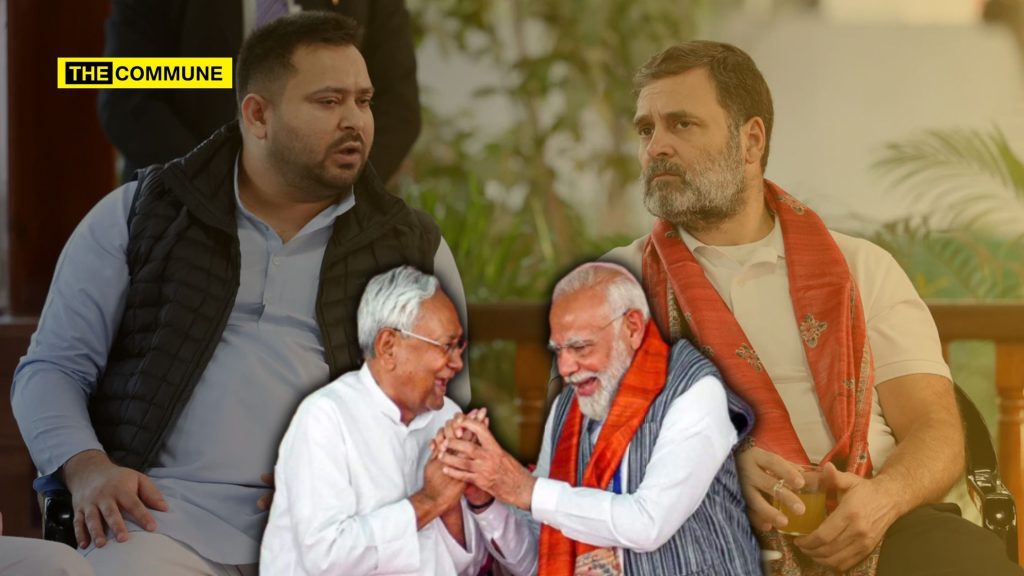
The Bihar Assembly elections are on the verge of commencing, with campaigns actively underway from all involved parties since the announcement of the election dates. The Mahagathbandhan, led by the RJD, appears to have squandered a significant opportunity to displace the ruling NDA. The RJD’s chosen candidate for Chief Minister, Tejaswi Yadav, has unfortunately been largely eclipsed by his coalition partner, Rahul Gandhi.
Since the onset of campaigning in Bihar, Congress has seemingly prioritized the promotion of Rahul over Tejaswi, effectively diminishing the presence of latter. Promoting Rahul Gandhi in the Bihar elections, where Congress has struggled to gain traction since the rise of Mandal politics, is a serious miscalculation. Whether this strategy is intentional or amounts to political self-sabotage remains subject to interpretation.
If the Mahagathbandhan truly had a chance against the formidable NDA, it was solely when Tejaswi Yadav was their primary representative. There is no lack of a list of failures during the incumbent Nitish Kumar regime; however, Rahul Gandhi is preoccupied with trivial matters such as SIR and Vote Chori, which has hindered Tejaswi’s campaign from gaining momentum while Rahul remained at the center of attention.
The Congress party also enlisted the support of its alliance partners from Tamil Nadu and Telangana. M K Stalin and Revanth Reddy were actively campaigning in Bihar alongside leaders from Congress and RJD. This approach lacks any sense or logic, especially considering that Stalin has publicly criticized migrant laborers in Tamil Nadu. Furthermore, this strategy does not resonate with the average Bihari at all, and it is likely to backfire.
RJD has failed to take advantage of the shortcomings of the Nitish Kumar-led NDA. Their campaign appeared to be disorganized, resembling random shots fired in various directions. The topics of SIR and ‘vote chori’ do not constitute significant electoral issues in Bihar. It does not require extensive time or effort to confirm this fact. Even a brief discussion in various locations would clearly demonstrate this.
RJD participated in the Congress campaign regarding SIR, which attempted to elevate a trivial matter into a serious concern. Instead, they ought to have concentrated on genuine issues such as migration, the scarcity of employment opportunities in Bihar, and the recently deteriorating law and order situation in the state. Elevating a fabricated ‘vote chori’ to a primary issue effectively provides an easy victory to the NDA.
RJD has frequently depended on its core voter base – the crucial MY (Muslim Yadav) equation, with Muslims making up around 16% and Yadavs 14% of the state’s population. RJD’s excessive dependence on MY polarization serves as a clandestine advantage for the ruling NDA & it cleverly highlights the rogue elements within this combination, instilling a fear of a return to Lalu 2.0, which effectively counteracts the polarization among other communities that are opposed to the idea of RJD regaining power.
Tejaswi Yadav has made significant efforts to unify these votes en bloc. However, this is not the 1990s, and Tejaswi is not Lalu Yadav, who could easily gather support from the backward classes cutting across the castes. Furthermore, the Modi-led BJP is executing OBC politics more effectively than any other political party; even a brief examination of their key office bearers confirms this. Therefore, Tejaswi’s efforts to consolidate his voter base are likely to lead to a counter-polarization, where the non-Yadav OBCs, a substantial portion of SCs, and the General category would align with the NDA.
The achievements of Nitish’s leadership in the NDA are noteworthy, if not remarkable. The initiatives in infrastructure development, such as roadways, metro systems, and connectivity projects like the Patna Mokama Aunta-Simaria bridge, illustrate the persistent efforts of the state government. According to UNDP data, Bihar, which has the highest Multidimensional Poverty Index (MPI) value in the National Family Health Survey-4 (NFHS-4) conducted in 2015-16, experienced the most rapid decline in MPI value in absolute terms. The MPI value decreased from 0.265 in NFHS-4 (2015-16) to 0.160 in NFHS-5 (2019-21). During this same timeframe, the percentage of multidimensionally poor individuals fell from 51.89% to 33.76%. Additionally, its Infant Mortality Rate (IMR) is lower than the national average. Although there is still much work to be accomplished, the state is gradually overcoming longstanding stereotypes.
The NDA government’s announcement of a domicile policy that allocates 35% of government jobs to women has been positively received by the women voters of Bihar. Previously, these voters have shown considerable trust in the NDA Government. Furthermore, the introduction of various women-centric welfare initiatives, such as the ‘Mukhyamantri Mahila Rozgar Yojana’ and the ‘Mukhyamantri Kanya Suraksha Yojana’, along with programs aimed at disadvantaged groups like the Chief Minister Divyangjan Empowerment Scheme (Sambal) and the Parwarish Yojana for orphans, resonates strongly with the electorate.
Another party, Jan Suraj, founded by Prashant Kishore, is generating considerable media attention in the Bihar elections. Upon closer objective examination, its electoral impact appears to be insignificant. Since Jaganath Mishra, there has not been an upper caste Chief Minister in Bihar. The upper castes have primarily allied with the RJD in the past and subsequently with the BJP in the state. The late Raghuvansh Prasad Singh of the RJD was a prominent Rajput leader, and its current state president, Jagdanand Singh, continues to be a significant figure. Jan Suraj seems to have garnered a faction of disgruntled upper castes who are seeking their electoral relevance; they perceive an opportunity within Prashant Kishore’s organization. However, their overall numbers are not substantial (approximately 15%), and a considerable portion remains loyal to the BJP. Jan Suraj may secure 5-10 seats, largely contingent on candidate selection. Nevertheless, Prashant Kishore’s choice to refrain from contesting elections after promoting the narrative of alternative politics does not instil much confidence.
The victory of the NDA is clearly evident. The Mahagathbandhan attempted to raise issues that do not resonate with the average Bihari. The genuine concerns have been overshadowed, and the electoral prospects of the RJD have been adversely affected by its coalition partners in Bihar.
Kanishk Shekhar, is a columnist and also teaches students preparing for Civil Services Exam.
Subscribe to our channels on WhatsApp, Telegram, Instagram and YouTube to get the best stories of the day delivered to you personally.