


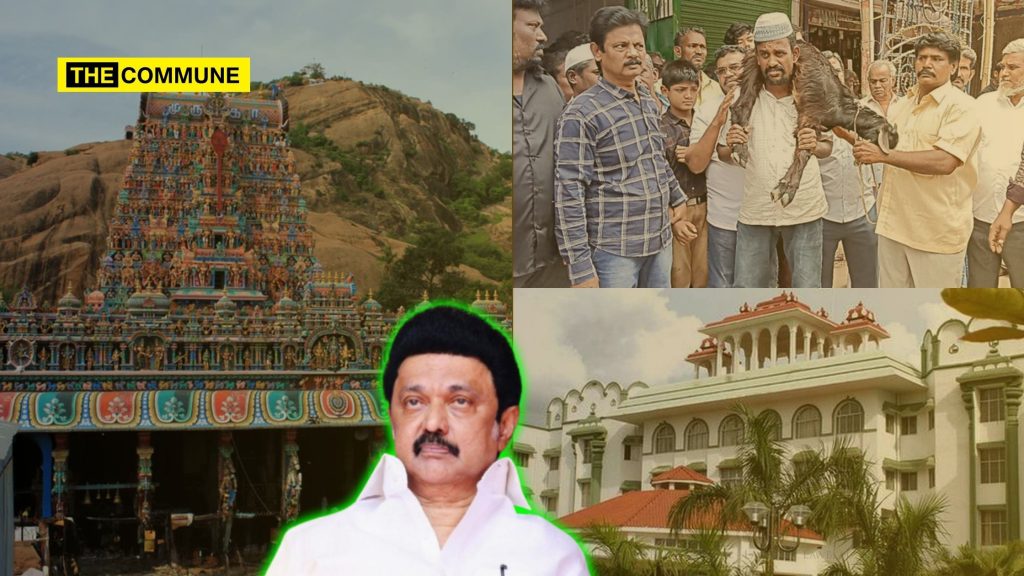
The Madurai Bench of the Madras High Court has issued a significant order prohibiting the sacrifice of goats and chickens, as well as the cooking and serving of non-vegetarian food, on the Thiruparankundram Hill in Madurai district. The court also ruled that the hill should not be referred to as “Sikandar Hill.”
The order was passed by Justice R. Vijayakumar after a series of petitions were filed by representatives from both Hindu and Muslim communities seeking various directions concerning religious practices and property rights on the hill.
The Petitions
Madurai district president of the Hindu Makkal Katchi, Solai Kannan, filed a petition requesting a ban on the sacrifice of goats and chickens and the serving of non-vegetarian food at Thiruparankundram Hill. Similarly, Ramalingam, executive of the Akhil Bharat Hanuman Sena, filed a petition seeking to ban prayers in the Nellithope area of the hill, while Paramasivam, organization secretary of the Hindu Makkal Katchi, also sought a prohibition on animal sacrifice.
On the other side, Osir Khan, Senior Managing Trustee of the Sikandar Dargah, filed a petition seeking permission to carry out maintenance and renovation works in the Dargah area. Abdul Jabbar petitioned for the provision of basic amenities — including roads, lighting, drinking water, and toilets — for devotees visiting the Dargah. Additionally, Suvasthi Sri Letshumisena Bhattacharya Maha Swami sought a declaration that the hill be recognized as “Samanar Hill” (Jain Hill).
Differing Bench Orders
These petitions were initially heard by a division bench comprising Justices J. Nisha Banu and S. Srimathi. Justice Nisha Banu dismissed all six petitions, while Justice Srimathi issued a differing order, stating that:
- The hill should be referred to only as “Thiruparankundram Hill”, not as “Sikandar Hill” or “Jamanar Hill.”
- The right to conduct Kanduri ceremonies or sacrifice goats and chickens at the Dargah must be established before a civil court.
- Until such rights are determined, no prayers, ceremonies, or animal sacrifices should be conducted.
Due to the conflicting opinions, the case was referred to a third judge, Justice R. Vijayakumar, for a final decision.
Archaeological and Legal Findings
Justice Vijayakumar, in his detailed judgment, upheld Justice Srimathi’s findings and provided several legal and historical clarifications.
He noted that under the Protection of Ancient Monuments Act, the Archaeological Survey of India (ASI) had issued notifications on 29 July 1908 and 7 February 1923, declaring the Pancha Pandava caves on the western slope and the caves behind the Sikandar Mosque on the hilltop as protected monuments.
Both notifications referred to the area as “Thiruparankundram Hill,” with no historical evidence of it ever being called “Sikandar Hill.” Justice Vijayakumar further cited a Privy Council order stating that 33 cents out of 170 acres of the hill excluding the Dargah and grove belong to the temple.
In a notable analogy, the judge observed, “A person who owns a house in Madurai may name that house as he wishes, but cannot expect the entire city to adopt that name. Similarly, when the entire hill is temple property and only a small portion has been granted to Muslims, it is unacceptable to rename the entire hill after the Dargah.”
Ban on Animal Sacrifice
Justice Vijayakumar agreed with Justice Srimathi’s view that animal sacrifices cannot be permitted on Thiruparankundram Hill. He noted that while the Dargah administration claimed that goat and chicken sacrifices were an ancient custom, the temple administration had denied any such historical practice.
The judgment cited peace talks held on 31 December 2024 under the supervision of the Kottatchiyar, where the temple authorities objected to the Dargah’s request for animal sacrifice and agreed to approach the appropriate court. The temple management also confirmed that no sacrifices took place during the last Kanduri festival, and no meeting was held to approve such rituals.
Justice Vijayakumar held that the matter remains sub judice, and no decision can be taken until a civil court determines the legitimacy of the claimed custom.
Archaeological Restrictions
The ASI has classified 172.2 acres of Thiruparankundram Hill as a protected monument area. Under the Ancient Monuments and Archaeological Sites and Remains Rules, 1959, animals cannot be brought into such protected areas for any purpose, including ritual sacrifice. The court ruled that cooking and consumption of non-vegetarian food are prohibited except in designated zones outside the protected boundaries.
The judgment also noted that the ASI had written twice to the district administration requesting demarcation of the protected area, but the administration failed to cooperate.
On Prayer Rights and Access
The court further clarified that, as per a civil court order, the stairs leading to the Nellithope area belong to the Murugan Temple and connect the Murugan Temple with the Kashi Vishwanathar Temple. During festival processions, the Murugan temple’s vel (spear) is carried through these stairs.
Therefore, the judge held that Muslims may offer prayers in the Nellithope area during Ramzan and Bakrid, provided it does not interfere with the traditional temple routes.
Summarising the findings, the court concluded that animal sacrifices of goats and chickens are banned on Thiruparankundram Hill, cooking and serving non-vegetarian food are prohibited in the protected area, the hill must be referred to as “Thiruparankundram Hill” only not as “Sikandar Hill” or “Samanar Hill” and any claim to perform religious rites or sacrifices must first be established before a civil court.
With two of the three judges (Justices Srimathi and Vijayakumar) concurring on these points, the High Court’s ruling effectively prohibits all forms of animal sacrifice and non-vegetarian offerings on Thiruparankundram Hill, affirming its status as a protected archaeological and temple property.
Setback For DMK
In August 2025, the DMK government of Tamil Nadu asserted in the Madurai Bench of the Madras High Court that the practice of sacrificing animals has long been followed at Thiruparankundram hill in Madurai.
Additional Chief Government Advocates Veera Kathiravan and Ravindran emphasized that religious practices should not be discriminated against based on caste, religion, or dietary customs. They presented records indicating that the location has been known as Sikandar Hill and that the practice of sacrificing goats and chickens has been ongoing.
(With inputs from Hindu Tamil)
Subscribe to our channels on Telegram, WhatsApp, and Instagram and get the best stories of the day delivered to you personally.