


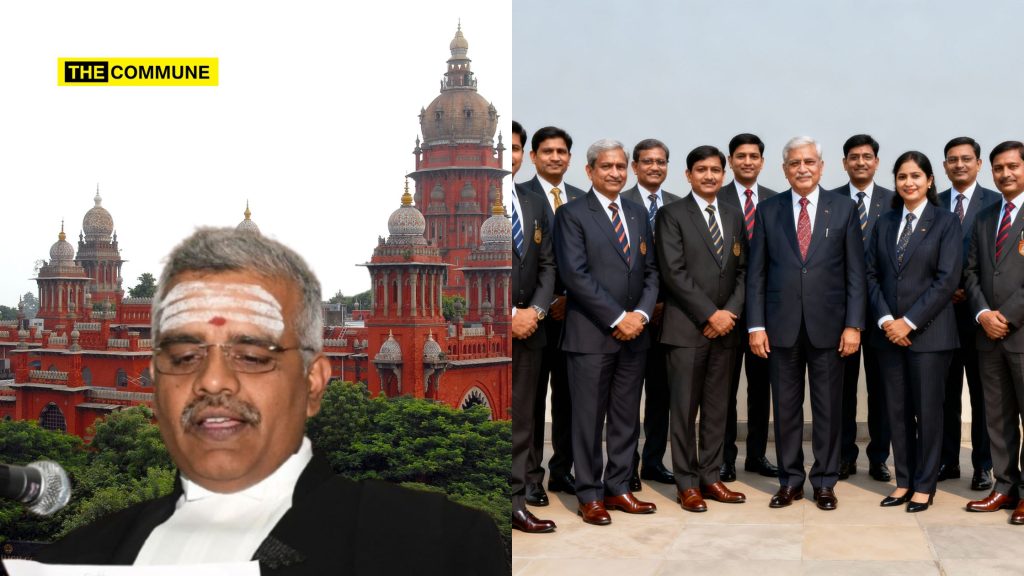
Expressing concern over the prolonged delay in obtaining sanction to prosecute senior bureaucrats, the Madras High Court on Monday questioned why the “wheels of prosecution grind very slowly when it comes to Indian Administrative Service (IAS) officers accused of corruption.”
Justice N Anand Venkatesh, who made the observation while hearing a case related to alleged ₹98.25-crore corporation contract irregularities during the tenure of former AIADMK Minister S.P. Velumani, sought an explanation from the Directorate of Vigilance and Anti-Corruption (DVAC) for not securing sanction against IAS officers K.S. Kandasamy and K. Vijaya Karthikeyan, despite completing its investigation in January 2024.
Delay in Sanction and Translation Costs
The judge agreed with advocate V. Suresh, appearing for Arappor Iyakkam, the anti-corruption organisation that had lodged the complaint in 2021, that the Tamil Nadu government would not have had to spend nearly ₹30 lakh translating 12,000 pages of documents if the DVAC had obtained the required sanctions before October 2024.
He noted that the requirement to submit translated copies was made mandatory by the Centre only from that month.
Hence, the DVAC, he said, was “duty bound to list out the reasons for not having obtained the sanction against the two IAS officers between January and October 2024,” especially since “the sanction to prosecute Mr. Velumani was obtained from the Legislative Assembly Speaker on February 12, 2024.”
‘Courts Have to Prod Investigating Agencies’
Lamenting systemic inertia, Justice Venkatesh remarked that “more often than not, the investigating agencies had to be prodded by the courts to take every other action in corruption cases right from the stage of registration of First Information Report.”
In this case, he observed, the DVAC had submitted its request to the Centre seeking sanction to prosecute the two IAS officers only after Arappor Iyakkam’s Jayaram Venkatesan filed the present contempt of court plea.
The request, made on 30 August 2025, was subsequently returned for want of translated copies of the vernacular documents submitted in support of the request. Following a series of interim orders issued in the contempt proceedings, the DVAC translated the voluminous records, at considerable public expense and re-submitted the request to the Centre on 7 November 2025.
‘The Same Speed Should Apply to Corruption Cases’
During the hearing, Justice Venkatesh also asked what the outer limit was for the Centre to decide on a sanction request. Additional Public Prosecutor E. Raj Thilak informed the court that the prescribed period was three months and assured that he would obtain instructions from all investigating officers who had handled the case since January 2024 to determine the reasons for the delay.
“The State shows speed in doing every thing else. The same speed should be shown when it comes to taking action against corruption too. Otherwise, people will lose faith. In fact, action against corruption should get the first priority. Everything else can wait. Contrarily, what we see is that the action against corruption gets the last priority,” Justice Venkatesh said before adjourning the contempt plea.
The case pertains to allegations of irregularities in awarding Chennai Corporation contracts during S.P. Velumani’s tenure as Minister for Municipal Administration, Rural Development and Implementation of Special Programme. The High Court’s observations come amid repeated judicial concerns over delays in prosecuting senior bureaucrats in corruption cases despite completion of investigations.
(Source: The Hindu)
Subscribe to our channels on WhatsApp, Telegram, Instagram and YouTube to get the best stories of the day delivered to you personally.